
JBDI Holdings Ltd: Navigating Nasdaq Compliance with Limited Operational Transparency
JBDI Holdings Ltd’s recent efforts to maintain Nasdaq compliance spotlight the company’s capital management and regulatory navigation, but limited disclosure on business fundamentals constrains assessment of sustainable value creation.
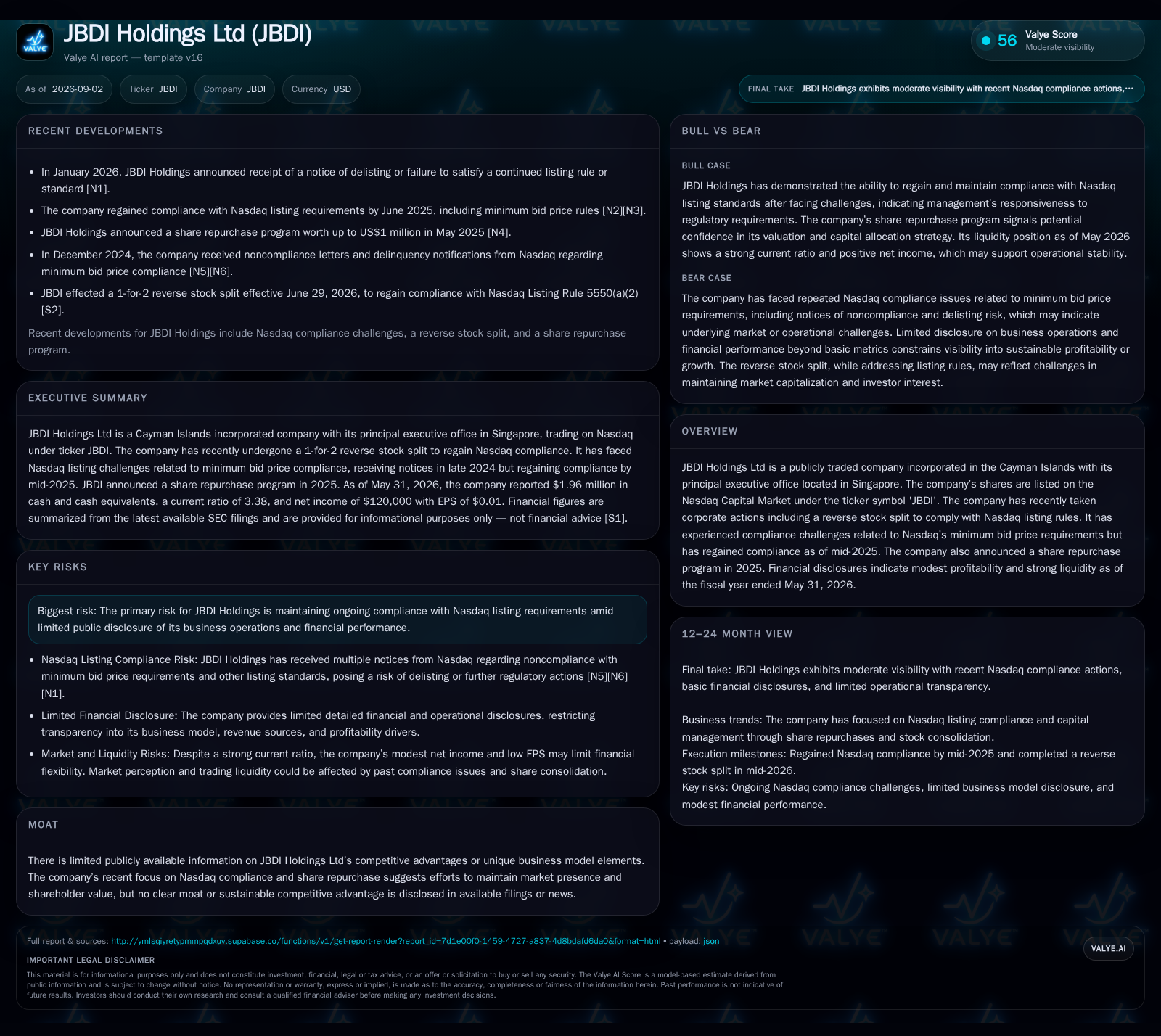
JBDI Holdings Ltd has addressed Nasdaq listing challenges through a reverse stock split and share repurchase program, achieving compliance by mid-2025 and sustaining modest profitability with reported liquidity position as of mid-2026. However, scant operational disclosure and recurring regulatory notices cloud clarity on its business model, growth prospects, and competitive positioning. The key uncertainty revolves around whether JBDI can translate regulatory compliance into scalable profitability amid limited visibility on its core operations and market dynamics.
JBDI Holdings Ltd, a Cayman Islands incorporated entity with its principal office in Singapore, has primarily focused on regulatory compliance and capital structure adjustments to maintain its Nasdaq listing. The company’s recent 1-for-2 reverse stock split and share repurchase program underscore these efforts amid recurring minimum bid price compliance challenges. While liquidity and modest profitability offer some operational stability, the absence of detailed disclosures on its underlying business model leaves investors reliant on regulatory milestones rather than fundamental growth narratives. The pivotal question remains whether JBDI can leverage its regulatory compliance into meaningful operational progress and durable value creation.
Latest Operating Snapshot
JBDI Holdings successfully regained compliance with Nasdaq listing requirements, including minimum bid price rules, by June 2025 after receiving noncompliance notices in December 2024 [N2][N3][N5][N6]. This achievement was followed by a 1-for-2 reverse stock split effective June 29, 2026, which reduced shares outstanding from roughly 19 million to 9.5 million, aiming to sustain compliance with Nasdaq Listing Rule 5550(a)(2) [S2].
The company also initiated a $1 million share repurchase program in May 2025, signaling management’s intent to support share price and potentially improve capital structure [N4]. Financially, as of May 31, 2026, JBDI reported cash and equivalents of approximately $1.96 million and a current ratio of 3.38, indicating solid short-term liquidity relative to current liabilities of $1.43 million [S1]. However, net income remained modest at $120,000 with EPS of $0.01, suggesting limited operational scale or profitability [S1].
Business Model and Unit Economics
Public disclosures provide scant detail on JBDI’s core business activities, revenue streams, or cost structure, limiting direct analysis of its unit economics. The company’s financials indicate a small-scale operation with low net income and minimal earnings per share, implying constrained pricing power or volume-based growth. The absence of segment reporting or product-level detail makes it difficult to assess revenue mix or margin drivers.
Given the company’s reported liquidity position ratios but modest profitability, it is plausible that fixed costs may be relatively low or that operating expenses are tightly managed. Capital intensity appears limited as no significant investments or capital expenditures are disclosed. Operating leverage could be constrained by the company’s current scale and lack of evident economies of scale or scope. Without recurring revenue streams or visible subscription or platform models, predictability of cash flows remains uncertain.
Moat, Competition and Counterforces
There is no publicly available evidence of differentiated technology, proprietary assets, or network effects that could constitute a sustainable competitive moat for JBDI Holdings. The company’s primary recent focus on regulatory compliance and capital management suggests an absence of clear strategic advantages or competitive position.
Competitive pressures are difficult to evaluate due to limited operational transparency. If JBDI operates in a commoditized or highly competitive sector, the lack of disclosed differentiation could expose it to pricing pressures and margin erosion. Conversely, regulatory scrutiny and low market capitalization may weaken investor confidence and liquidity, further challenging competitive positioning. The key counterforce to any moat development is the company’s recurring Nasdaq compliance risk and limited public information, which undermine investor trust.
Bull Case
In a positive scenario, JBDI leverages its regained Nasdaq compliance and share repurchase program to stabilize investor sentiment and maintain listing status, providing a platform for operational scaling. Improved transparency and disclosure of its business model could attract new investors and partnerships, enabling revenue growth and margin expansion. The company’s strong short-term liquidity supports continued operations and potential strategic investments.
Confirmation of this scenario would include sustained Nasdaq compliance without further notices, improved earnings and cash flow metrics, and disclosures clarifying revenue sources and competitive positioning. Conversely, failure to enhance operational scale or transparency would falsify this outlook, as would renewed regulatory challenges or deteriorating liquidity.
Base Case
The base case envisions JBDI maintaining Nasdaq compliance and current liquidity levels, continuing modest profitability without significant revenue or operational expansion. The company may persist in using capital management tools like share repurchases to support stock price while facing limited growth opportunities due to constrained market visibility and investor interest.
In this scenario, financial metrics remain relatively stable, with net income hovering near current modest levels and no material changes in business disclosure. The company manages to avoid delisting but does not make substantive progress in scaling its business or revealing strategic direction. This scenario is confirmed by steady compliance notices absence, stable but unimpressive financial results, and continued lack of detailed operational transparency.
Bear Case
The downside scenario involves JBDI failing to maintain Nasdaq listing compliance, triggering delisting or regulatory sanctions that could severely impair liquidity and investor confidence. The reverse stock split might be insufficient to sustain minimum bid price requirements amid weak trading volumes or market interest. Additionally, the company’s limited profitability and unclear business model may fail to attract investor support or strategic partners.
This scenario would be confirmed by new Nasdaq noncompliance notices, deteriorating liquidity ratios, negative net income trends, or announcements of impaired trading status. Conversely, an absence of regulatory actions or improved financial performance could falsify this bear case.
What Matters Next
Key indicators to monitor include: (1) Nasdaq compliance status updates, particularly regarding minimum bid price and listing standards; (2) changes in share count or additional stock splits that impact compliance or market capitalization; (3) quarterly and annual financial disclosures revealing revenue growth, profitability trends, and cash flow generation; (4) management commentary or disclosures clarifying the company’s business model, revenue sources, and competitive dynamics; (5) liquidity metrics such as cash balances and current ratios to assess potential financial flexibility; (6) trading volume and share price trends as signals of market confidence; (7) potential strategic initiatives like partnerships, acquisitions, or new business lines; and (8) regulatory filings detailing any material operational changes or risk factors.
Disclosure of segment-level performance or customer concentration data would be particularly valuable to gauge business sustainability. Additionally, tracking share repurchase activity could provide insight into management’s view on valuation and capital allocation priorities.
Disclaimer: This is research-only, informational analysis and not investment advice. It may include AI-generated interpretation and general industry context. Always verify important details using primary sources.

Comments