
Keysight Technologies, Inc. (KEYS) Comprehensive Business Analysis
Keysight leverages its dual-segment structure and recent strategic acquisitions to capitalize on secular growth trends in AI infrastructure, advanced semiconductor technologies, and next-generation communications. Its ability to integrate acquisitions and maintain margin expansion amid rising R&D investments will be pivotal for sustained value creation.
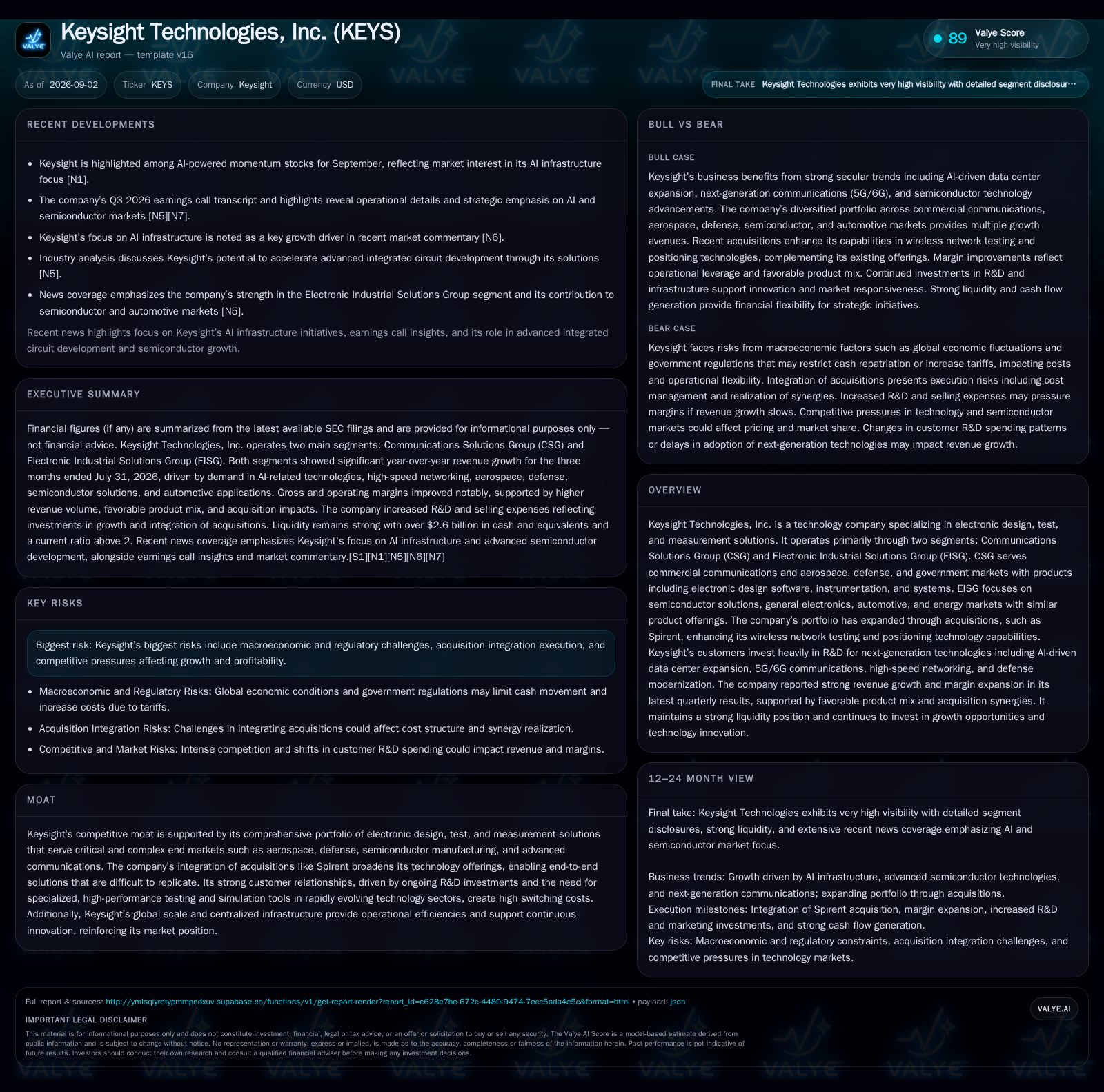
Keysight Technologies operates two core segments—Communications Solutions Group and Electronic Industrial Solutions Group—that both showed strong revenue and margin growth in Q3 2026, driven by AI, semiconductor, and defense market demand. The company’s broad and deep portfolio, expanded by acquisitions such as Spirent, supports a potentially durable competitive position underpinned by high switching costs and integration of complex test and measurement solutions. However, macroeconomic headwinds, acquisition execution risks, and competitive market pressures pose material challenges. Key value drivers include the pace of AI infrastructure adoption, semiconductor innovation cycles, and successful integration of acquisitions.
Keysight Technologies, Inc. reported robust third-quarter 2026 performance with double-digit revenue growth across its Communications Solutions Group (CSG) and Electronic Industrial Solutions Group (EISG), fueled by accelerating demand in AI infrastructure, next-generation communications, and semiconductor technologies. Margin expansion accompanied this growth despite elevated R&D and selling expenses, reflecting strategic investments and acquisition-related costs. The company’s portfolio expansion, including the Spirent acquisition, positions it to address complex and evolving customer needs in high-value markets such as aerospace, defense, automotive, and advanced semiconductor testing. However, the interplay of macroeconomic headwinds and integration execution will critically determine whether Keysight can sustain its growth trajectory and operational leverage in a competitive landscape.
Latest Operating Snapshot
In the third quarter ended July 31, 2026, Keysight’s Communications Solutions Group (CSG) generated $1.345 billion in revenue, representing a 43% year-over-year increase driven predominantly by high-speed networks supporting AI capabilities and aerospace and defense demand. Simultaneously, its Electronic Industrial Solutions Group (EISG) delivered $501 million in revenue, a 21% year-over-year growth fueled by AI-driven semiconductor technology needs, automotive innovations including autonomous driving, and digital health applications [S1].
Gross margins showed marked improvement, increasing 4 percentage points to 70.8% in CSG and 7 points to 64.1% in EISG, while operating margins rose 8 and 9 points respectively, reaching 34.0% and 31.0%. These margin expansions reflect favorable product mix shifts, operational efficiencies, and synergies from acquisitions such as Spirent, which broaden Keysight’s wireless network test and assurance capabilities. Despite this, research and development expenses rose significantly—26% in CSG and 16% in EISG—reflecting ongoing investments in innovation and acquisition integration costs. Selling, general, and administrative expenses similarly increased, largely due to acquisition-related activities and increased marketing spend [S1].
Business Model and Unit Economics
Keysight generates revenue primarily through sales of electronic design, test software, instrumentation, and system solutions across its two main segments. Pricing dynamics entail a mix of product sales and related services, with volume growth driven by customer investments in next-generation technologies such as AI infrastructure, 5G/6G communications, and semiconductor fabrication. The company’s business benefits from a product mix skewed toward specialized, high-performance test equipment that commands premium pricing due to technical complexity and critical application requirements.
The business exhibits a significant fixed-cost base, particularly in R&D and manufacturing facilities, which creates operating leverage as incremental sales absorb these fixed expenses. The recent margin expansion indicates that increased volumes and more favorable product mix have started to leverage these fixed costs effectively. However, rising R&D and SG&A outlays—necessary to sustain innovation and integrate acquisitions—could constrain operating leverage if revenue growth moderates. Capital intensity is moderate, with investments focused on R&D and acquisitions to capture emerging technology trends rather than heavy asset-heavy manufacturing. Switching costs for customers are elevated due to the complexity and integration of Keysight’s solutions within R&D and production workflows, supporting pricing power and customer retention.
Moat, Competition and Counterforces
Keysight’s moat is anchored in its comprehensive portfolio of electronic design and test solutions that serve mission-critical sectors including aerospace, defense, semiconductor manufacturing, and high-speed communications. The integration of acquisitions such as Spirent enhances its end-to-end capabilities, particularly in wireless network testing and positioning technology, which are challenging to replicate due to technical specialization and domain expertise. High switching costs arise from the essential role Keysight’s instruments and software play in customers’ product development and manufacturing processes, fostering long-term relationships and recurring demand for upgrades and complementary services.
Competitive pressures stem from established test and measurement vendors, new entrants leveraging software-driven testing approaches, and evolving customer preferences for integrated solutions. Peers such as Tektronix, Anritsu, and Rohde & Schwarz offer overlapping capabilities, while semiconductor design software companies like Cadence and Synopsys compete in adjacent domains. Moreover, market dynamics such as accelerated innovation cycles and customer shifts toward software-defined instrumentation could erode traditional hardware margins, requiring Keysight to continuously innovate. Macroeconomic factors and trade regulations also pose counterforces by potentially increasing costs or restricting market access.
Bull Case
In a bullish scenario, Keysight capitalizes on sustained secular tailwinds in AI-driven data center expansion, 5G/6G deployment, semiconductor technology advancement, and defense modernization. The company’s diversified segment exposure enables multiple growth avenues, allowing it to capture rising R&D budgets in commercial communications, aerospace, automotive, and semiconductor markets. The Spirent acquisition and other portfolio expansions create synergistic cross-selling opportunities, enhancing customer value propositions and justifying premium pricing.
Operational leverage materializes as revenue scales, driving further margin expansion despite elevated R&D spending. Keysight’s reported liquidity position and strong cash flows enable disciplined capital allocation toward innovation and bolt-on acquisitions, fueling long-term growth. Confirmation of this scenario would include sustained double-digit revenue growth in both segments, continued margin improvements, successful integration of acquisitions delivering synergy targets, and stable or expanding market share in key technology verticals. Conversely, signs of margin compression, acquisition underperformance, or slowed adoption of AI infrastructure technologies would challenge this view.
Base Case
The base case envisions Keysight maintaining solid growth driven by ongoing investments in AI infrastructure, semiconductor advancements, and next-generation communications, albeit at a moderated pace compared to the bull case. Revenue growth remains in the low to mid-teens percentage range with margins stabilizing around current levels, reflecting a balanced trade-off between increased R&D and SG&A expenses and operational efficiencies.
Acquisition integration proceeds without major disruption but synergies realize more gradually, while competitive pressures and macroeconomic headwinds temper pricing power. The company’s reported liquidity position supports continued investment but prioritizes prudent capital allocation. Evidence supporting this scenario includes steady but decelerating revenue growth, stable margins, manageable expense growth, and incremental progress on acquisition integration. Falsification would arise from either sustained rapid growth and margin expansion or material deterioration in financial performance.
Bear Case
In the downside scenario, Keysight confronts macroeconomic headwinds such as a global economic slowdown, unfavorable regulatory changes restricting cash repatriation, and escalating tariffs that increase input costs. These factors compress margins and limit operational flexibility. Acquisition integration challenges materialize, leading to cost overruns and failure to realize anticipated synergies, which pressure profitability further.
Competitive intensity intensifies as rivals innovate more rapidly or offer disruptive, lower-cost alternatives, eroding Keysight’s market share and pricing power. Additionally, a shift in customer R&D spending away from next-generation technologies or delays in AI infrastructure and semiconductor adoption could stall revenue growth. Confirmation would be visible through declining or flat revenues, contracting margins, negative operating leverage, and persistent integration costs. Conversely, evidence of sustained growth and margin resilience would falsify this scenario.
What Matters Next
Key performance indicators to monitor include: (1) Quarterly revenue growth rates within CSG and EISG segments, which reflect demand trends across end markets; (2) Gross and operating margin trajectories, indicating operating leverage and cost management effectiveness; (3) Research and development expense levels and productivity, important for innovation and competitive positioning; (4) Progress and financial impact of acquisition integration, especially realization of cost synergies and cross-selling opportunities; (5) Cash flow generation and liquidity metrics, including operating cash flow and remaining stock repurchase authorization, which inform capital allocation flexibility.
Additional milestones include customer adoption rates of AI infrastructure solutions, market share trends in wireless network testing post-Spirent acquisition, regulatory developments affecting operations, and macroeconomic indicators impacting customer R&D budgets. Disclosure of segment announced awards or multi-year contract metrics, if introduced, would provide valuable visibility into future revenue streams and customer commitment.
Disclaimer: This is research-only, informational analysis and not investment advice. It may include AI-generated interpretation and general industry context. Always verify important details using primary sources.

Comments