
Kazia Therapeutics: Pipeline Expansion, Regulatory Headwinds, and the Search for Clinical Validation
Kazia Therapeutics is advancing its brain-penetrant PI3K inhibitor paxalisib across multiple cancer indications, supported by regulatory designations and recent equity financing. The company’s near-term trajectory hinges on generating additional clinical evidence after FDA feedback in glioblastoma, expanding its pipeline into new oncology and rare disease markets, and managing dilution risks amid continued reliance on capital markets.
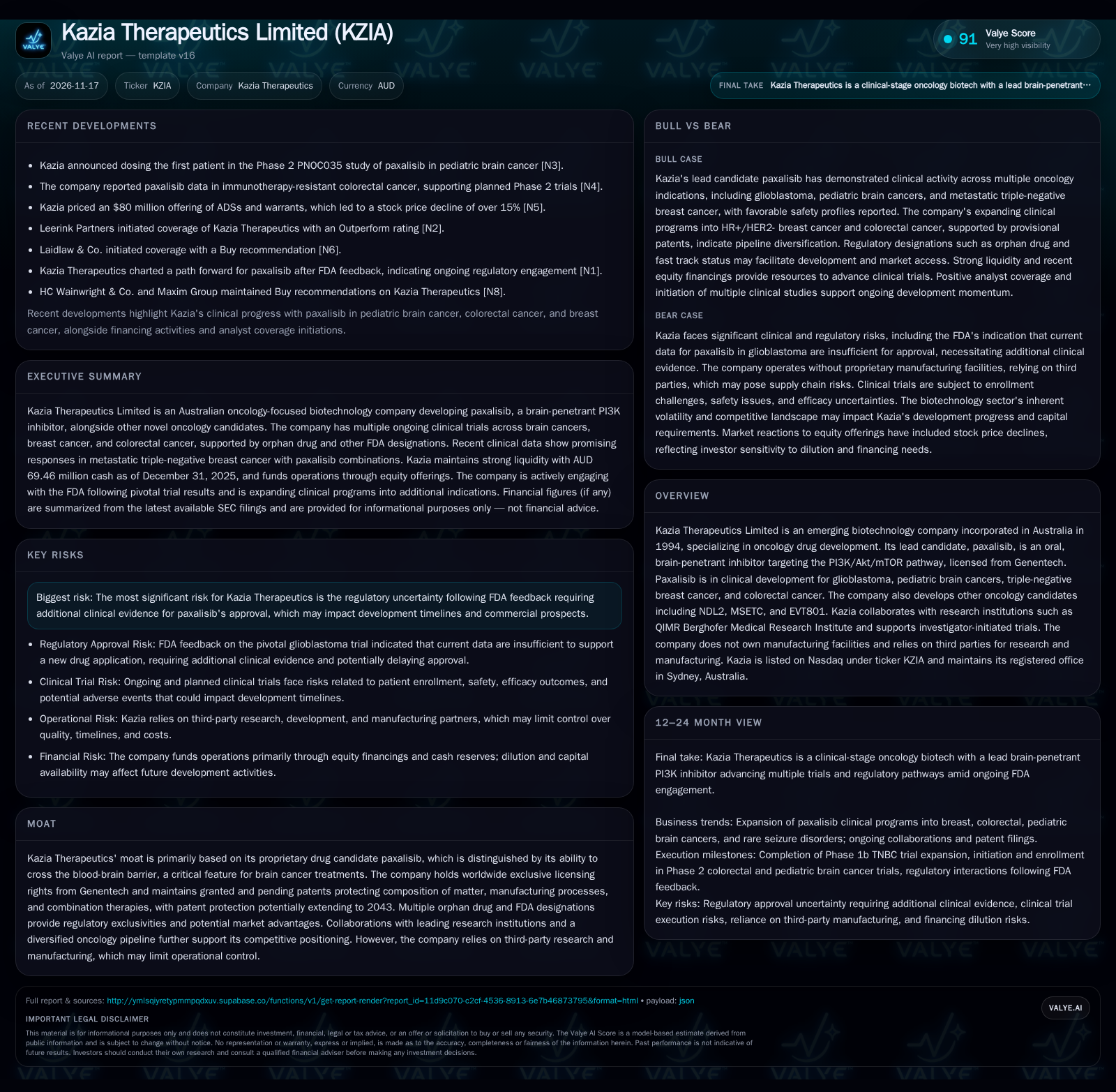
Kazia Therapeutics is a clinical-stage biotech focused on oncology, with its lead asset paxalisib targeting brain and other cancers. The company holds strong cash reserves and recently raised $80 million, but faces regulatory setbacks in glioblastoma requiring more clinical data. Expansion into breast, colorectal, and rare seizure disorders diversifies risk, but future value depends on clinical outcomes and regulatory progress. Dilution and operational reliance on third parties remain ongoing challenges. [S1] [N5]
Kazia Therapeutics stands at a pivotal juncture as it seeks to translate promising early clinical signals from its lead asset, paxalisib, into durable value across several oncology and rare disease indications. Recent regulatory feedback has set a higher bar for approval in glioblastoma, requiring additional evidence and potentially extending timelines. The company’s ability to secure meaningful clinical wins, particularly in new indications like triple-negative breast cancer and pediatric brain cancer, will determine whether its differentiated brain-penetrant PI3K inhibitor can achieve commercial relevance in a highly competitive field. [S1] [N1] [N5]
Recent Regulatory Setbacks and Pipeline Progress Define Kazia’s Current Position
Kazia Therapeutics’ lead program, paxalisib, remains the company’s primary value driver, with clinical development spanning glioblastoma, pediatric brain cancers, and advanced breast and colorectal cancers. However, the pivotal GBM AGILE Phase 2/3 trial in glioblastoma did not meet the criteria required for continued enrollment, with FDA feedback indicating that current data are insufficient for approval and additional evidence will be needed. This regulatory setback has delayed the most advanced commercial opportunity and shifted focus toward generating new clinical data. [S1] [N1]
Despite this, Kazia reported encouraging early-phase results in advanced triple-negative breast cancer (TNBC), where an objective response rate of 83% was observed among six evaluable patients in a combination study, and no serious adverse events attributed to paxalisib were reported. The company is also expanding its trial portfolio into HR+/HER2- breast cancer, microsatellite stable colorectal cancer, and rare seizure disorders, seeking to mitigate risk through diversification. [S1] [S2]
Financially, Kazia closed 2025 with AUD 69.46 million in cash and equivalents, subsequently raising an additional $80 million via an offering of ADSs and warrants in August 2026. While these moves bolster liquidity, the offering triggered a more than 15% decline in share price, underscoring persistent dilution risk and market sensitivity to equity financing in the biotech sector. [S1] [N5]
How Kazia’s Economic Model Hinges on Clinical Success and Funding Cycles
Kazia’s business model is emblematic of clinical-stage biotech: value creation is contingent on advancing lead assets through costly and lengthy clinical development to regulatory approval, followed by commercialization or out-licensing. The company’s revenue prospects depend on successful late-stage trial outcomes and subsequent market entry, with orphan drug and other FDA designations potentially enabling premium pricing and exclusivity in rare and high-need indications.
With no approved products or manufacturing operations, Kazia’s cost structure is dominated by R&D and external contracting for clinical trials and manufacturing. This structure is highly variable and scales with the number and stage of concurrent trials, but fixed overheads remain modest compared to fully integrated biopharma peers. Capital needs are substantial and recurring, necessitating reliance on equity markets for funding. The recent $80 million raise provides operating runway but also raises questions about future dilution if clinical milestones are not met or if additional studies are required by regulators. [S1] [N5]
If paxalisib or other pipeline assets achieve approval, commercial success will depend on pricing, payer acceptance, and competitive differentiation—especially in crowded oncology categories. Royalty or milestone income from licensing remains a potential but unproven economic lever.
Differentiation, Patent Position, and External Dependencies Shape Kazia’s Moat
Kazia’s competitive edge stems from paxalisib’s ability to cross the blood-brain barrier—a significant hurdle in brain cancer therapeutics—and its exclusive worldwide license from Genentech. The company holds granted and pending patents covering composition, manufacturing, and combination therapies, with protection potentially out to 2043, as well as multiple orphan drug and regulatory designations that could confer market exclusivity in key indications. [S1]
However, the oncology landscape is intensely competitive, with multiple PI3K pathway inhibitors, targeted agents, and immunotherapies in development or on the market. Large pharmaceutical companies and mid-cap biotechs with greater resources and more advanced data represent direct and indirect competition. The fact that Kazia relies entirely on third-party manufacturers and research partners introduces operational risk and limits supply-chain control, potentially impacting trial timelines, cost structure, and quality assurance.
Switching costs for prescribers and payers in oncology are typically low unless a therapy is clearly differentiated on efficacy, safety, or patient convenience. Kazia’s future competitive strength will hinge on demonstrating superior or complementary clinical benefit in well-defined patient subpopulations.
Accelerated Progress from Positive Data in New Indications Could Transform Kazia’s Narrative
A favorable scenario sees Kazia delivering robust, statistically significant results from ongoing or upcoming trials in TNBC, HR+/HER2- breast cancer, pediatric brain cancers, or rare seizure disorders. If larger cohorts confirm the high response rates and favorable safety profile observed in early TNBC data, and if similar efficacy is demonstrated in new indications, this would support both regulatory submissions and potential partnerships or licensing deals. Expansion into rare seizure disorders via the Sovargen Co. trial could further open niche but high-value markets. [S1] [S2]
Such clinical successes would likely catalyze additional analyst upgrades, attract strategic interest, and justify further capital raises on favorable terms. Confirmation would come from published Phase 2/3 data meeting primary endpoints, positive FDA feedback on new submissions, and evidence of partnership or out-licensing activity. Conversely, the upside case would be weakened by inconclusive trial results, safety issues, or continued regulatory delays.
Most Likely Outcome: Incremental Clinical Progress and Ongoing Capital Requirements
The most plausible trajectory for Kazia is a period of incremental progress: the company continues to generate data from ongoing trials, but faces the need for additional studies to support regulatory submissions—particularly in glioblastoma, where the FDA has already requested more evidence. Expansion into new cancer types and rare diseases diversifies risk but also increases capital intensity and operational complexity.
In this scenario, Kazia maintains reported liquidity position for near- to medium-term operations, but will likely need to return to the equity markets before commercialization, especially if trial timelines extend or new studies are required. Market volatility and dilution risk remain central challenges, and value creation depends on demonstrating clear clinical benefit in at least one major indication. Confirmation of this scenario would be ongoing trial enrollment, steady R&D spend, and sequential but not transformative clinical updates. It would be challenged by either a major clinical breakthrough or a significant negative safety or efficacy signal.
Failure to Deliver Pivotal Data or Delays in Regulatory Engagement Could Erode Value
The bear case for Kazia centers on continued regulatory hurdles, inconclusive or negative clinical results, and the resulting inability to progress paxalisib or other candidates toward approval. If additional studies fail to demonstrate efficacy or reveal new safety concerns—especially in larger, later-stage trials—regulatory timelines could be pushed back by years or programs discontinued entirely. [S1] [N1]
Persistent negative market reactions to equity offerings may make future capital raises more dilutive or even inaccessible, forcing pipeline cuts or organizational restructuring. Operational dependence on third parties could compound these risks if supply-chain issues delay trials or inflate costs. Evidence of this scenario would be missed clinical milestones, a flat or shrinking trial pipeline, negative FDA or investigator feedback, and declining cash balances without offsetting progress.
What Will Determine Kazia’s Trajectory in the Next 12–24 Months?
The outcome of ongoing and planned Phase 2 and 3 trials for paxalisib in TNBC, HR+/HER2- breast cancer, pediatric brain cancers, and glioblastoma. Published efficacy and safety data—especially in larger cohorts—would help test the thesis.
FDA feedback and regulatory engagement milestones, particularly regarding additional evidence required for glioblastoma and potential submissions in new indications.
The pace and success of enrollment in new and existing clinical studies, as delays or slow accrual could signal operational or competitive challenges.
Dilution impact and investor sentiment following the recent $80 million equity raise and any subsequent financing events.
Progress on investigator-initiated and combination therapy trials, including those with QIMR Berghofer Medical Research Institute. Evidence of synergy or new intellectual property filings would be useful markers.
Any partnership, licensing, or M&A activity that could enhance funding, market access, or validation.
Cash burn rate and updated runway disclosures, if provided, to assess the timing and magnitude of future capital needs.
Disclaimer: This is research-only, informational analysis and not investment advice. It may include AI-generated interpretation and general industry context. Always verify important details using primary sources.

Comments