
nLIGHT, Inc.'s Recovery Trajectory: From Losses to Operational Cash Flow Growth
nLIGHT’s financial improvement reflects strategic vertical integration, defense-driven demand, and disciplined capital management amid ongoing competitive and regulatory complexities.
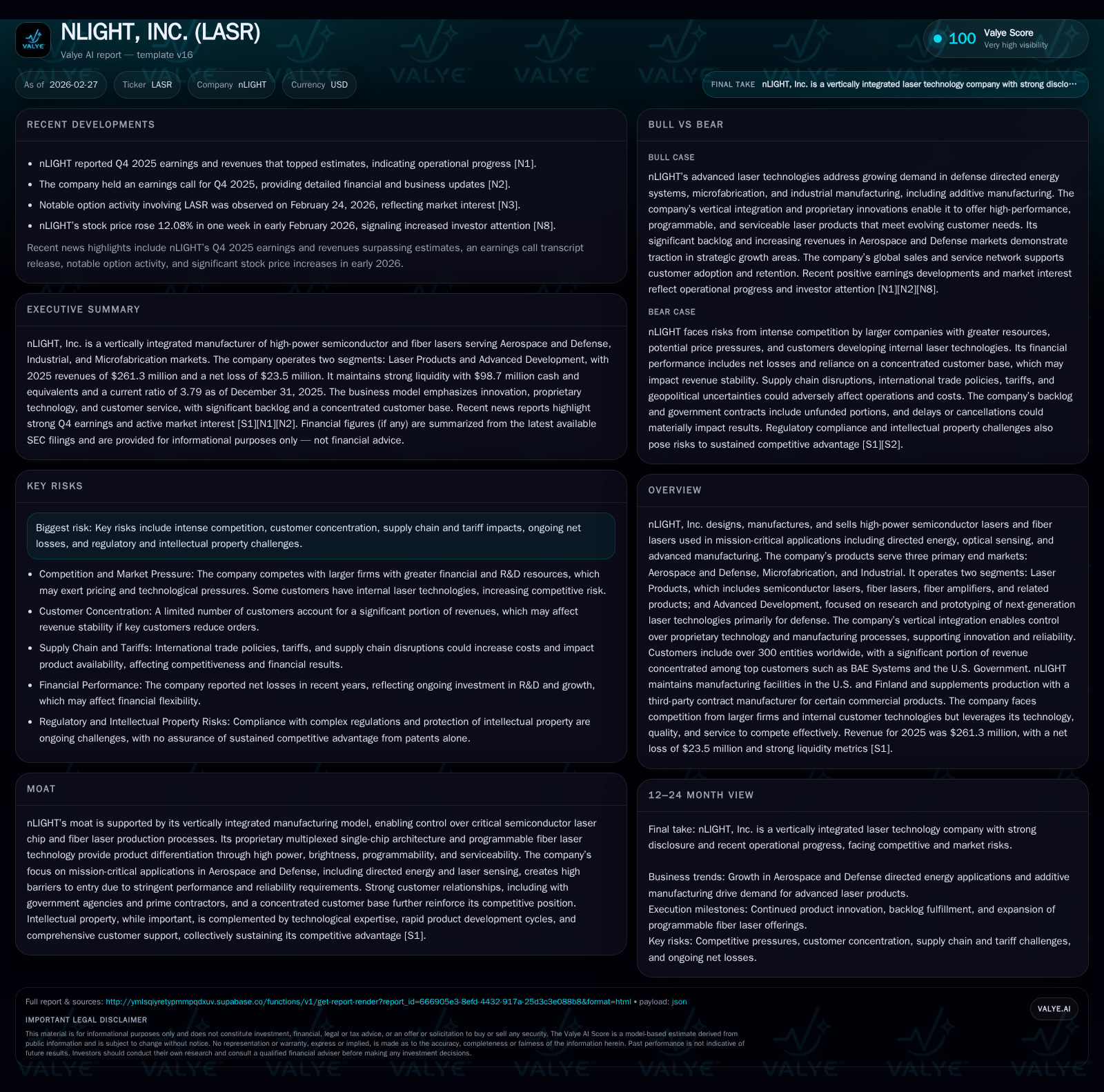
After years marked by significant net losses, nLIGHT, Inc. has exhibited a pronounced recovery in operating cash flow and reduced operating losses in 2025, signaling operational improvements tied to its vertically integrated semiconductor and fiber laser manufacturing. The surge in revenues driven largely by the Aerospace and Defense sector reflects both increased government-related contracts and robust design wins, supported by proprietary multiplexed single-chip architecture and programmable fiber lasers. Despite strong top-line growth and improved cash generation, risks remain from intense competition, customer concentration, export controls, and supply chain sensitivities.
Financial Turnaround: Reviewing Past Performance and Profitability Trends
nLIGHT’s financial trajectory over recent years demonstrates a gradual yet meaningful recovery from sustained operating losses accompanied by volatile cash flows [F1]. Operating income improved substantially, shrinking the loss margin by 59.5% to a -$26.5 million figure in FY2025 from a -$65.6 million loss in FY2024 — a noteworthy inflection point after persistent deficits since 2022 [F1]. Net losses mirrored this improvement with a reduction of over 61%, closing FY2025 at -$23.5 million versus -$60.8 million the prior year [F1].
Perhaps more striking is the transformation in operating cash flow (CFO), which reversed from a negative $2.36 million in FY2024 to an impressive positive $21.3 million in FY2025 — an increase over 1000% — underscoring stronger operational execution and working capital management [F1]. This improvement is indicative of enhanced collection cycles, better inventory control, or shifts toward higher-margin product sales [S1][N1]. Capital expenditures increased modestly by ~14%, totaling $9 million in FY2025, reflecting sustained investment in manufacturing capabilities alongside R&D efforts [F1][S11].
Historical performance (annual)
| FY | Net ($mm) | CFO ($mm) | OpInc ($mm) | Capex ($mm) | Net YoY |
|---|---|---|---|---|---|
| 2025 | -23 | 21 | -27 | 9 | +61.4% |
| 2024 | -61 | -2 | -66 | 8 | -45.9% |
| 2023 | -42 | 10 | -47 | 5 | +23.7% |
| 2022 | -55 | -15 | -55 | 21 |
Source: SEC companyfacts cache [F1].
Capital returns and efficiency (annual)
| FY | FCF ($mm) | ROE% |
|---|---|---|
| 2025 | 12 | -10.3 |
| 2024 | -10 | -28.1 |
| 2023 | 5 | -16.4 |
| 2022 | -36 | -20.2 |
Source: SEC companyfacts cache [F1].
Figures highlighted show a clear pivot toward improved profitability metrics alongside steady revenue growth starting FY2025.
Vertical Integration and Product Differentiation Driving Competitive Advantage
At the heart of nLIGHT's rebound is its vertically integrated manufacturing model that spans semiconductor chip fabrication through to fiber laser assembly — a structure enabling tight control over proprietary technologies such as its patented multiplexed single-chip semiconductor laser architecture [S1][F1]. This design merges multiple gallium arsenide-based semiconductor laser chips into single modules delivering superior optical brightness and power density compared to conventional multi-chip assemblies.
In fiber lasers, nLIGHT offers programmable continuous wave (CW) and pulsed fiber lasers utilizing rare-earth doped active fibers to amplify emissions effectively [S1][S7]. Their engineered programmability allows dynamic beam shaping, pulse modulation, hardware back-reflection suppression, and rapid field serviceability — features essential for mission-critical aerospace & defense applications including directed energy systems and optical sensing [S1][S7].
This integration fosters rapid product development cycles unencumbered by vendor delays or quality inconsistencies common among OEM competitors relying on outsourced components [S1]. The programmable nature extends applications beyond industrial cutting into advanced microfabrication where precision waveform tuning optimizes material interactions.
Revenue Composition: The Role of Aerospace & Defense and Customer Concentration
nLIGHT's growth engine clearly runs on the strong demand from Aerospace & Defense markets, which accounted for approximately two-thirds (67%) of revenues in FY2025 — up sharply from just over half (55%) in FY2024 [S24][S21]. This segment includes sales of directed energy lasers for defense platforms as well as classified research-related contracts primarily with U.S.-based government entities.
The Microfabrication market contributed another ~18%, reflecting incremental volumes of semiconductor diode lasers used for precision manufacturing processes globally [S24]. Conversely, the Industrial segment declined to just under 15%, contracting due to deteriorating demand for fiber lasers across traditional cutting/welding applications amid softer global conditions [S24][S14].
Customer concentration continues as a salient feature: about three-quarters of revenues derive from the top ten customers including BAE Systems, Raytheon Technologies, Northrop Grumman, KORD Technologies, Mazak, QinetiQ Limited, plus direct U.S Government contracts [S4][S6]. While these relationships secure sizable design wins often protected through technical complexity and long qualification cycles, they also create dependence vulnerabilities subject to funding fluctuations or contract renewals.
Geographic Revenue Shifts and Their Strategic Implications
Geographically, North America has surged ahead as the dominant market representing roughly 71% of revenues in FY2025 compared to approximately 67% in FY2024 — reflecting intensified procurement activity from U.S.-based defense agencies and prime contractors sourcing highly specialized laser components domestically [S5][S14]. With near-term governmental budget priorities emphasizing directed-energy weapon systems development cycles remain active.
Asia Pacific showed marginal growth reaching about 14.7%, driven mainly by select Aerospace & Defense contract expansions and some microfabrication sales offsetting weaker industrial fibre laser demand across China and South Korea due to trade frictions and supply chain disruptions [S5][S14][S2]. EMEA slipped slightly below previous periods at ~14%, impacted predominantly by lower Industrial sector volumes despite some increases attributable to aerospace exports within allied programs [S5][S14].
The geographic variation underscores an overarching shift toward specialization aligned with politically prioritized sectors rather than mass-market manufacturing where price competition predominates.
Expectations and Forward Outlook: Growth Catalysts and Market Challenges
Management indicated with optimism during recent earnings communications that backlog remained robust at approximately $161.6 million at end-2025 with an additional unfunded government contract portfolio valued near $184 million awaiting appropriations or modifications — collectively supporting revenue visibility over the next two years albeit with acknowledged timing risks related to federal budget cycles [N2][S6].
Innovation pipelines highlight continued investments in next-generation fiber beam combination systems tailored for directed energy applications critical for national security programs alongside newer microfabrication product introductions aiming at improving semiconductor chip brilliance further enhancing competitive moats [N2][S25].
However, uncertainties linger around international trade policies particularly U.S.-China export restrictions limiting some product shipments or technology transfers constraining expansion opportunities into Asian markets [S8]. Additionally, competitive pressures from well-funded rivals capable of aggressive pricing tactics necessitate sustained elevated R&D spend placing margin pressures over midterm horizons.
Capital Allocation: Cash Flow Generation, Capex Strategy, and Return on Equity
The company’s capital discipline manifests through measured capital expenditure increments tuned to augment manufacturing capacity without overextending operational leverage—capex rose modestly from $7.9 million in FY2024 to $9 million in FY2025 signaling measured reinvestment consistent with volume scaling aspirations [F1][S11]. Liquidity remains strong with total cash plus equivalents near $99 million backed by current assets exceeding liabilities by nearly fourfold yielding a favorable current ratio approximately at 3.79x—indicating ample working capital buffer amid ongoing investment needs [F1][S12].
Despite narrowing losses from operations providing better cash flow fundamentals resulting in free cash flow around $12.3 million (operating cash flow minus capex), return on equity still stands negative circa -10%, reflecting residual historical cumulative deficits though trending positive should recent momentum persist into profitability normalization phases [F1]. Notably absent are dividend payouts or share buyback programs indicating reinvestment preference into growth initiatives rather than shareholder returns currently [S12].
Risks on the Horizon: Competition, Supply Chain, and Regulatory Pressures
While nLIGHT’s technological edge rooted in proprietary vertical integration constitutes a considerable barrier-to-entry for new competitors, it nonetheless faces intense rivalry from larger legacy players such as IPG Photonics or Coherent who benefit from governmental subsidies or scale advantages allowing aggressive pricing strategies impacting ASPs especially within Industrial markets [S8][S17]. Consolidation trends among competitors may further heighten resource asymmetries.
Supply chain constraints remain salient risks exacerbated by tariffs imposed recently on Chinese imports affecting raw materials or components critical to laser manufacturing—mitigation efforts via supplier diversification incur costs without immediate offsets leaving cost structures vulnerable [S2][S8]. Export control regimes particularly U.S.-led restrictions on critical laser technologies constrain potential cross-border sales restricting addressable markets notably across China or sanctioned countries [S8].
High customer concentration intensifies exposure should principal clients alter procurement plans unexpectedly given no contractual long-term purchase obligations exist widely; moreover technology obsolescence risks are compounded by lingering intellectual property litigation threats where patent infringement claims could impose injunctions or expensive licensing requirements materially disrupting operations at key junctures [S20][S26].
Disclaimer: This report synthesizes publicly available information as of February 27, 2026; it does not constitute investment advice or recommendations but provides an analytical perspective on nLIGHT Inc.'s financial performance and industry dynamics.
Disclaimer: This is research-only, informational analysis and not investment advice. It may include AI-generated interpretation and general industry context. Always verify important details using primary sources.

Comments