
LanzaTech’s Carbon Recycling Platform: Commercial Progress, Capital Strain, and the Stakes of Scaling Sustainable Fuels
LanzaTech advances its gas fermentation technology with six commercial plants and ongoing SAF initiatives, but persistent losses and dilution risks underscore the capital intensity of scaling carbon recycling. The next phase hinges on project execution, policy support, and translating IP into recurring revenue streams.
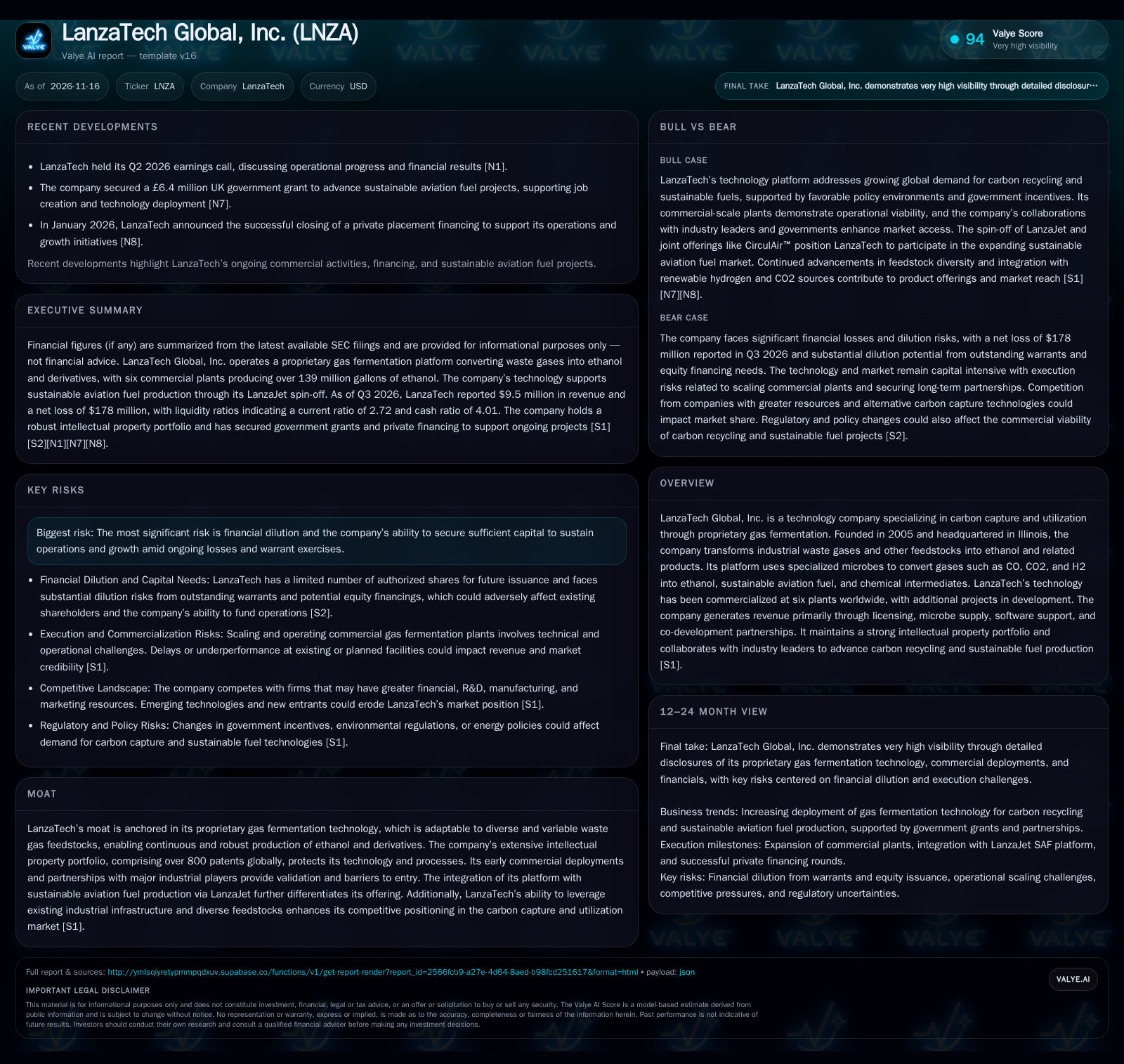
LanzaTech has deployed its proprietary gas fermentation at six commercial plants, producing over 139 million gallons of ethanol, and maintains a significant stake in sustainable aviation fuel spin-off LanzaJet. While its technology has secured government grants and private financing, Q3 2026 results show a $178 million net loss on $9.5 million in revenue, with dilution and capital needs posing structural risks as the company pursues broader commercialization. The core question: can LanzaTech convert technical and policy momentum into a sustainable, scalable business before financial constraints force strategic tradeoffs? [S1] [S2] [N7] [N8]
LanzaTech Global, Inc. stands at the intersection of industrial decarbonization, advanced fermentation, and the emerging sustainable fuels economy. Its proprietary gas fermentation process has moved beyond pilot stage, with six commercial plants generating over 139 million gallons of ethanol and a technology footprint spanning diverse waste streams. Yet, the company’s Q3 2026 results lay bare a familiar dilemma for climate tech pioneers: strong technical validation and policy momentum are offset by steep net losses, ongoing dilution risks, and the daunting economics of scaling capital-intensive infrastructure. The coming quarters will test whether LanzaTech can convert its IP, partnerships, and government backing into a self-sustaining business—or whether the gap between vision and commercial scale remains stubbornly wide.
Commercial Deployments and Financial Strain Define LanzaTech’s 2026 Status
As of Q3 2026, LanzaTech has deployed its gas fermentation technology at six commercial plants worldwide, collectively producing more than 139 million gallons of ethanol. These deployments validate the operational feasibility of the platform across a range of waste gas feedstocks, from industrial off-gases to agricultural residues [S1]. However, this technical progress is juxtaposed with substantial financial strain: the company reported $9.5 million in revenue and a steep net loss of $178 million for the quarter, with negative EPS of $13.6 per share [S2]. The company reported cash and liquidity metrics for the period; these figures do not by themselves establish operating runway, investment capacity, financial flexibility, or financing capacity. [S2] Recent external support includes a January 2026 private placement financing and a £6.4 million UK government grant to advance sustainable aviation fuel (SAF) initiatives [N7] [N8].
The Mechanics and Constraints of Monetizing Gas Fermentation at Scale
LanzaTech’s business model is built around licensing its proprietary gas fermentation technology, supplying specialized microbes and software to plant operators, and engaging in co-development projects where it may hold minority equity stakes [S1]. This model, if scaled, could create a mix of upfront licensing fees, ongoing royalty or usage-based payments, and ancillary revenue from microbe/material sales and software services. However, the economics remain challenging at early scale: capital expenditures for commercial plants are significant, and the company’s revenue run-rate (sub-$10 million per quarter) is dwarfed by operating costs and R&D outlays, resulting in persistent, deep losses [S2].
Operating leverage could, in theory, improve as more plants adopt the platform and recurring revenue streams build, but the lag between project launch, ramp-up, and meaningful royalty flow is long. The spin-off of LanzaJet for SAF production introduces an additional monetization avenue—potentially through equity appreciation or intercompany agreements—but also reduces direct control and future consolidated revenue share [S1]. The capital intensity of both LanzaTech’s core and its SAF ventures means external financing (equity, grants, or strategic partnerships) remains a structural requirement unless and until the installed base generates sufficient cash flow to cover corporate overhead and R&D.
Intellectual Property, Feedstock Flexibility, and the Challenge from Larger Players
LanzaTech’s competitive positioning is anchored in its robust intellectual property portfolio, with over 800 granted and pending patents protecting its gas fermentation processes and microbial engineering [S1]. This IP, along with demonstrated feedstock flexibility—being able to process industrial off-gases, municipal solid waste, and agricultural residues—offers a technological moat against single-feedstock competitors and some alternative carbon capture approaches.
However, the broader carbon management and sustainable fuels landscape is increasingly crowded. LanzaTech competes with large chemical and energy conglomerates, biofuel startups, and companies developing alternative carbon utilization or direct-air-capture technologies. Many of these entities have deeper balance sheets, greater manufacturing capacity, and established customer networks. Furthermore, the company’s reliance on external partners for plant deployment and commercialization introduces execution risk and potential margin compression, as larger partners may seek more favorable terms. LanzaTech’s early commercial validation and policy-linked grants provide some market credibility, but sustaining a durable advantage will require demonstrating reliable plant performance, cost competitiveness, and the ability to translate IP leadership into sticky, recurring economics over time.
If Policy Tailwinds Persist and Commercial Plants Scale: The Path to Cash-Generating Growth
In a favorable scenario, government incentives for carbon recycling and sustainable aviation fuel persist or expand, driving new customer demand for LanzaTech’s platform. Successful commissioning of additional commercial plants—especially those integrated with renewable hydrogen or CO2 sources—would validate scalability and unlock higher-margin licensing and royalty streams. The LanzaJet spin-off could gain commercial traction, delivering both equity value and potential technology licensing revenue back to LanzaTech.
Confirmation of this scenario would come from a step-change in reported revenue growth, a narrowing of net losses as new plants ramp, and public disclosure of multi-year licensing or royalty contracts with major industrial partners. Additional policy support—such as SAF blending mandates or carbon credit mechanisms—would further enhance project economics and customer willingness to adopt LanzaTech’s technology. Evidence of successful plant ramp-ups, repeat orders from existing customers, and third-party validation of commercial yields would further reduce perceived execution risk.
Commercialization Progress Is Steady, but Losses Persist and Dilution Remains Likely
The most plausible near-term trajectory is one of gradual commercial progress offset by ongoing financial strain. LanzaTech’s installed base may grow moderately as new projects reach commissioning, but with long lead times from engineering to revenue recognition and continued need for grant or equity funding to bridge operating losses. The company’s SAF initiatives—via LanzaJet—may yield technology validation and incremental revenue, but are unlikely to transform the consolidated P&L in the next few quarters.
Evidence confirming this scenario would include continued announcements of new plant projects, moderate sequential revenue growth, and recurring grant or equity financings to maintain liquidity. Net losses are likely to persist, and dilution risk remains elevated given outstanding warrants and the need for additional capital raises. If LanzaTech can demonstrate stable plant operations and incremental licensing deals, it may sustain its position in the market, but a step-change in profitability or cash generation could remain elusive until a much larger installed base is achieved.
Execution Failures or Policy Shifts Could Expose Vulnerabilities in the Business Model
In a negative scenario, LanzaTech faces project execution setbacks—such as delays, technical underperformance, or cost overruns—at new or existing plants. These issues could erode customer confidence, slow adoption, and trigger contractual disputes or financial penalties. If key policy supports (such as SAF subsidies, carbon credits, or waste-to-fuel mandates) are reduced or delayed, the economics of new projects may become unattractive, leading to cancellations or deferrals.
Confirmation of this scenario would include missed project milestones, downward revisions to revenue guidance, or disclosures of impaired plant assets. Inability to secure new government grants or private financing could force the company to curtail R&D investment, scale back growth plans, or seek strategic alternatives under distressed terms. Dilution could accelerate if equity is issued at progressively lower valuations. Competitive advances by better-funded rivals or the emergence of superior carbon utilization technologies could further compress LanzaTech’s addressable market and pricing power.
How to Gauge LanzaTech’s Progress from Commercialization to Self-Sustaining Growth
Quarterly revenue growth rates and the mix of licensing versus co-development/project-based income, if disclosed.
Number of new commercial plant deployments reaching operational status, with disclosed production yields and uptime.
Updates on the LanzaJet spin-off: stake changes, commercial milestones, and any SAF offtake or licensing agreements.
Disclosure of multi-year licensing or royalty contracts with major industrial or energy partners.
Cash burn trajectory and timing/terms of future equity or debt financings, as persistent losses and dilution remain material risks.
Impact of government policy or grant developments on project economics and customer demand.
Evidence of technological advances that improve plant economics, reduce capital intensity, or expand feedstock flexibility.
Disclaimer: This is research-only, informational analysis and not investment advice. It may include AI-generated interpretation and general industry context. Always verify important details using primary sources.

Comments