
LightWave Acquisition Corp.: The Stakes and Levers in a Technology-Focused SPAC’s Pre-Deal Phase
With over $220 million raised and a management team versed in SPAC transactions, LightWave Acquisition Corp. sits at a pivotal juncture: the search for a technology sector target amid shifting market appetites, regulatory scrutiny, and the inherent risks of the SPAC structure.
LightWave Acquisition Corp. (LWAC) is a Cayman-based SPAC with $220 million in trust, aiming for a technology-oriented business combination. The company’s experienced team and substantial capital base offer strategic advantages, but the absence of a deal, limited operational liquidity, and SPAC market headwinds present meaningful uncertainties. Execution on a suitable acquisition will define value realization or erosion.
LightWave Acquisition Corp. exemplifies the modern SPAC: a cash-rich, acquisition-focused entity with a mandate to bring a private company—ideally in technology—to public markets. With $220 million in trust and an experienced team at the helm, the company’s prospects now depend almost entirely on its ability to source, negotiate, and close an attractive business combination. Yet, as the window to complete a deal narrows and the market for SPACs grows more discerning, LightWave’s future will be determined less by its balance sheet and more by its strategic agility, target selection, and ability to navigate complex incentives and market dynamics.
Current Financial Position and Strategic Inflection
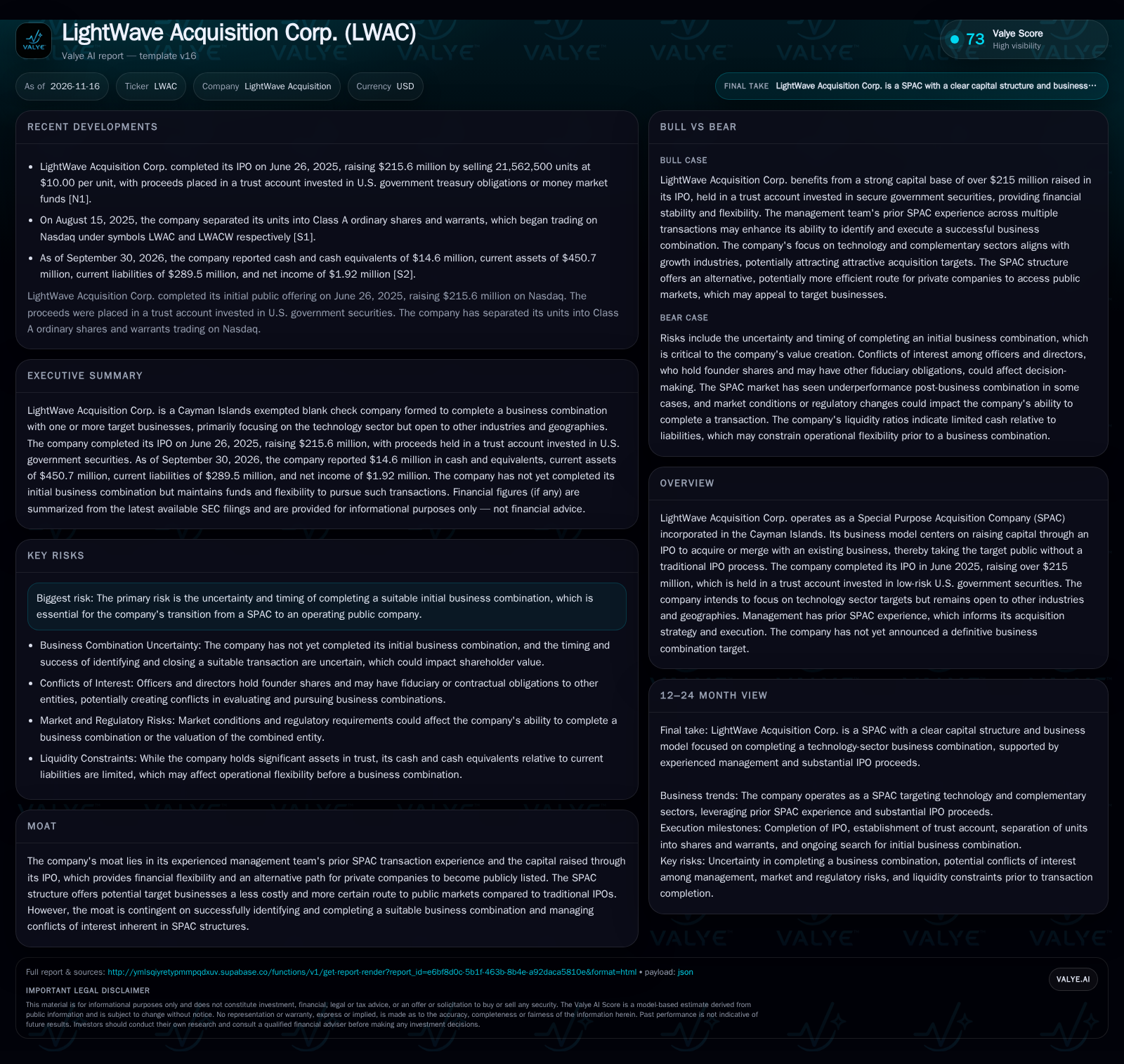
LightWave Acquisition Corp. completed its IPO on June 26, 2025, raising $215.6 million through the sale of 21,562,500 units, each containing one Class A ordinary share and one-half redeemable warrant. An additional 606,250 units were sold in a private placement to the Sponsor and underwriters, all at $10 per unit [S1] [N1]. As of December 31, 2025, the trust account held approximately $220.1 million, invested in U.S. government securities [S1]. By September 30, 2026, current assets totaled $450.7 million compared to $289.5 million in current liabilities, resulting in a current ratio of 1.56 and a cash ratio of 0.05 [S2]. Importantly, the company has not yet completed a business combination, and Nasdaq rules require that at least 80% of trust assets be used for any such transaction [S1].
The management team’s prior SPAC deal experience is a central asset, but risk disclosures emphasize that conflicts of interest and the uncertainty of finding and executing a suitable deal remain material [S1] [S2]. These facts set the stage for a business model defined by deal execution, not by ongoing operations or revenue generation at this stage.
SPAC Economics: Trust Capital, Deal Incentives, and Value Realization
The SPAC model is fundamentally transactional: value for public shareholders emerges only when the sponsor successfully sources, negotiates, and closes a business combination. Until then, the company generates non-operating income from low-risk investments (e.g., U.S. Treasury securities) held in trust, while incurring ongoing G&A and diligence expenses [S2]. The economics are heavily back-loaded; the substantial IPO capital is inaccessible for operational uses outside of a deal, and the sponsor’s incentives are primarily tied to deal completion—often via founder shares and warrants that convert only upon a successful transaction.
Capital needs are minimal pre-deal, but post-combination, the new entity’s economics will depend on the acquired business’s revenue, margin, and capital intensity. The SPAC structure can offer operating leverage if the target is growth-oriented and capital-efficient, but dilution is a persistent risk due to the sponsor promote, warrant overhang, and potential redemptions. The company’s current cash ratio (0.05) suggests that while trust assets are secure, operational reported liquidity position until a deal closes [S2].
The Race for Tech Targets: Advantages and Headwinds in a Crowded SPAC Field
LightWave’s potential differentiation rests on two pillars: its experienced SPAC management team and a substantial, uncommitted capital pool. In theory, this should make it an attractive partner for private technology firms seeking an expedited, less market-volatile route to public markets. However, competitive intensity is high—other SPACs, direct listings, and traditional IPOs all vie for similar targets, and the market’s appetite for SPACs has become more selective following high-profile underperformers.
Counterforces include a tightening regulatory environment, heightened diligence standards, and greater skepticism from PIPE investors and institutional shareholders. Technology sector targets, in particular, may command high valuations or prefer alternative exit routes if public market sentiment is tepid. The question is whether LightWave’s deal team can source a target that is both high-quality and willing to transact at terms acceptable to public shareholders, overcoming both market and structural frictions.
Unlocking Value: A High-Quality Tech Acquisition with Low Redemptions
The favorable scenario for LightWave is a successful negotiation and closure of a business combination with a technology company exhibiting strong growth, robust margins, and a compelling public-market narrative. If the management team leverages its prior SPAC experience to secure a differentiated target—perhaps in a segment like enterprise SaaS, fintech, or digital infrastructure—the resulting entity could command a premium valuation and attract long-term institutional holders.
Confirmation for this scenario would come from the announcement of a definitive agreement with a credible, growth-oriented technology target, followed by low redemption rates from public shareholders and robust PIPE participation. If the post-combination entity demonstrates early revenue growth and operating leverage, this would further validate the upside thesis. Falsification would occur if the company fails to secure a target, if redemptions are high (eroding available capital), or if the target struggles to meet public market expectations soon after listing.
Most Likely Outcome: Moderate Target Quality, Mixed Market Reception
The most plausible path is that LightWave ultimately announces a business combination with a mid-tier technology company—attractive enough to close the deal, but not in the market’s top decile of growth or profitability. The transaction may feature compromises on valuation or structure to accommodate both sponsor incentives and public shareholder protection.
Confirmation would be a deal announcement with a credible but not standout target, followed by moderate-to-high redemption rates and a PIPE raise sufficient to meet minimum cash conditions but not to significantly expand the capital base. Shareholder returns in this scenario would be mixed, with potential for post-combination volatility and limited immediate upside. Falsification would be either a failure to close (forcing a return of capital) or, conversely, securing a truly high-quality target as in the upside scenario.
Deal Failure or Poor Target Selection: Capital Erosion and Sponsor Dilution
The adverse outcome is twofold: either LightWave fails to identify or close on any business combination within the required timeframe, or it consummates a transaction with an underperforming or overvalued target. In the first case, trust assets are returned to shareholders, and sponsor capital (including founder shares and warrants) is wiped out—an outcome that, while protecting public capital, renders the SPAC exercise moot for all stakeholders except deal advisors.
Alternatively, if the company proceeds with a lower-quality or mispriced target, high redemptions and poor post-merger stock performance could erode remaining capital, dilute public shareholders, and damage sponsor reputation. Confirmation would be continued delays, vague deal announcements, or high-profile redemptions, while falsification would require a surprisingly high-quality and well-received transaction.
Milestones and Metrics That Will Determine LightWave’s SPAC Outcome
Announcement of a definitive business combination agreement, including target sector, valuation, and financial projections.
Redemption rate at the shareholder vote—high redemptions would constrain deal funding and signal weak investor confidence.
PIPE (private investment in public equity) participation and pricing, if disclosed, as a gauge of institutional support for the deal.
Quality and growth prospects of the chosen target (revenue growth, margin profile, customer concentration, and sector positioning).
Sponsor promote structure and any amendments to founder share or warrant terms in response to market feedback.
Regulatory or Nasdaq compliance milestones, including satisfaction of the 80% trust asset rule and SEC review outcomes.
Post-combination trading performance and achievement of initial business milestones by the combined entity.
Disclaimer: This is research-only, informational analysis and not investment advice. It may include AI-generated interpretation and general industry context. Always verify important details using primary sources.

Comments