
NB Bancorp’s Growth Evolution: Post-IPO Expansion and Integration Challenges
NB Bancorp has reshaped its regional banking footprint through a public listing and a transformational acquisition while navigating regulatory capital constraints.
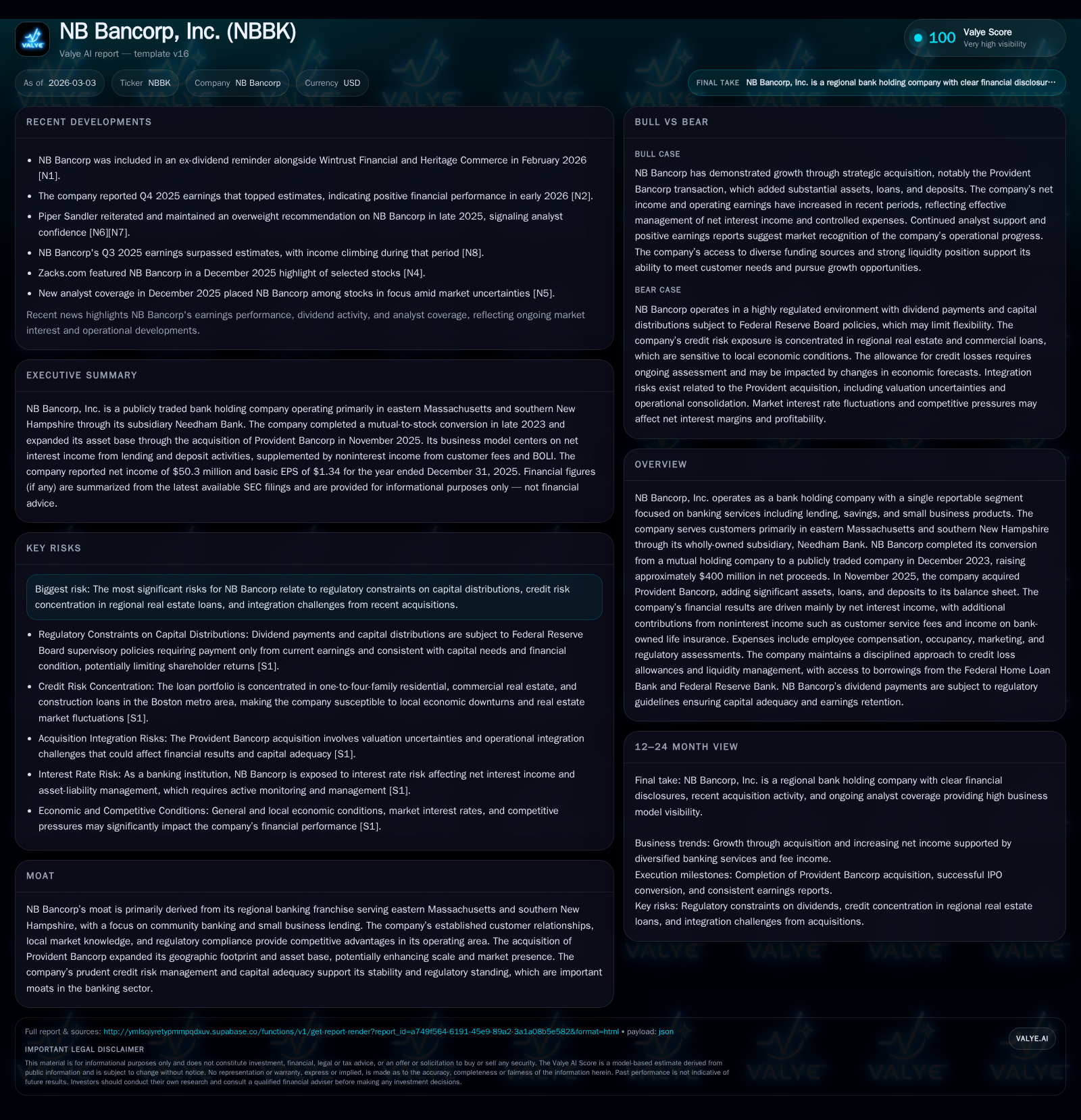
NB Bancorp transitioned from a mutual to a publicly traded bank holding company in late 2023, raising $400 million that financed its November 2025 acquisition of Provident Bancorp. This deal significantly increased assets, loans, and deposits, enhancing scale in eastern Massachusetts and southern New Hampshire. The company’s growth drivers include net interest income expansion fueled by loan portfolio diversification and operational leverage. Regulatory capital buffers and dividend constraints temper capital allocation flexibility, while integration risks from the Provident transaction and regional real estate loan concentration remain key challenges. Monitoring quarterly profitability, deposit retention on large maturing time deposits, and credit quality trends will be critical going forward.
Foundation Shift: Transition from Mutual Company to Public Bank Holding
NB Bancorp's strategic trajectory shifted fundamentally following its December 2023 mutual holding company conversion into a publicly traded entity. This transformation unlocked $400 million in net capital proceeds, dramatically enhancing its financial flexibility after decades as a community-oriented mutual institution [N1][S1]. The infusion of equity capital established a robust foundation for growth initiatives including acquisitions—a path typically restricted under the mutual model due to capital limitations.
However, this shift brought NB Bancorp under intensified regulatory scrutiny. The Federal Reserve’s supervisory policies impose strict guidelines on capital distributions, requiring dividends be paid only from current earnings and contingent on satisfactory capital retention consistent with asset quality and overall financial condition [S1]. While this limits near-term shareholder returns potential relative to legacy banks unrestricted by such buffers, it ensures resiliency amid economic cycles.
Historical Performance and Growth Drivers Through 2025
Post-IPO operational results highlight NB Bancorp’s strong execution amid expansion. Net income grew 19.3% year-over-year to $50.3 million in FY2025 from $42.1 million in FY2024 [F1], reflecting gains from an expanded loan book alongside rising net interest margins due to higher market rates after the IPO.
Operating cash flow surged even more sharply by 40.8% to approximately $60.8 million in FY2025 [F1], signaling healthy core earnings converted efficiently to liquidity. This robust cash generation supports both strategic investments and financial obligations without excessive reliance on external financing.
Capital expenditures increased considerably (+76.3%) to nearly $3.4 million in FY2025 as NB Bancorp upgraded its infrastructure footprint coincident with scaling operations post-acquisition including technology integrations and branch network enhancements [F1].
Historical performance (annual)
| FY | Net ($mm) | CFO ($mm) | Capex ($mm) | Net YoY |
|---|---|---|---|---|
| 2025 | 50 | 61 | 3 | +19.3% |
| 2024 | 42 | 43 | 2 | +329.0% |
| 2023 | 10 | 53 | 3 |
Source: SEC companyfacts cache [F1].
Capital returns and efficiency (annual)
| FY | FCF ($mm) | ROE% |
|---|---|---|
| 2025 | 57 | 5.9 |
| 2024 | 41 | 5.5 |
| 2023 | 50 | 1.3 |
Source: SEC companyfacts cache [F1].
The uneven trajectory from FY2023 to FY2024 owes largely to the timing of the IPO at the very end of December 2023—no material activities occurred before that date—as well as initial expenses related to structural conversion which normalized out in FY2025 results [S1][F1].
Provident Bancorp Acquisition: Scale Expansion and Geographic Penetration
The November 2025 acquisition of Provident Bancorp marked a pivotal scale event for NB Bancorp [N1][S2][S13]. This transaction enlarged NB’s loan portfolio by over $1 billion, increased deposit funding notably including $120 million brokered deposits assumed from Provident, and deepened penetration across Eastern Massachusetts and Southern New Hampshire markets.
This geographic expansion diversifies NB’s footprint within its regional community banking model but introduces integration execution challenges customary in bank consolidations—aligning IT systems, converging culture, standardizing credit policies—and increased costs reflected partially in merger-related expenses reported in FY2025 [S26]. The acquisition also added intangible assets such as goodwill ($18.5 million) and core deposit intangibles ($19 million), which necessitate annual impairment assessments driving future earnings volatility risk if synergies fall short [S24].
The enlarged balance sheet post-acquisition crossed the $7 billion asset mark by end-2025 supporting enhanced competitive positioning albeit with amplified complexity around credit risk monitoring and liquidity management given the larger mix of brokered deposits alongside core funding sources [S18][S21].
Regional Bank Moat: Community Relationships and Credit Quality Focus
NB Bancorp’s fundamental moat derives from entrenched local relationships cultivated through decades of serving small business borrowers and residential clients within its Massachusetts-New Hampshire corridor—a classic community bank advantage emphasizing personalized service.
Credit quality oversight remains central given regional real estate lending concentration: commercial real estate (including multi-family), owner-occupied properties, small business commercial & industrial loans secured primarily by operating company assets are dominant segments [S15][S17]. The Company maintains vigilant underwriting standards employing third-party appraisals, feasibility studies for construction loans, and use of ACL methodologies segmented by loan type to absorb expected credit losses proactively.
While NB does not originate subprime loans nor engage significantly in high-risk consumer segments, concentration risks persist given exposure to cyclical commercial real estate cycles prevalent in mature Northeast markets [S29]. These factors underpin regulatory focus on maintaining adequate capital buffers against potential loan losses.
Capital Structure and Regulatory Framework Influencing Dividend Policy
Being subject to Federal Reserve Board regulations post-conversion imposes stringency on dividend distribution policies at NB Bancorp [S1]. Dividends can only be paid if funded fully from current earnings adjusted for prior dividends paid over four quarters, and if retained earnings suffice for ongoing capital needs given asset quality evaluations.
Moreover, the requirement to maintain an explicit capital conservation buffer restricts distributions if breached or if future retention plans conflict with supervisory guidance—essentially serving as a capital guardrail ensuring solvency under stress scenarios [S1].[S5]
NB completed two stock repurchase programs during H1 2025 but ceased buybacks thereafter amid rising capital deployment needs related to acquisitions alongside regulatory prudence curtailing repurchase resumption at present [S11].[S16]
Earnings Momentum and Operating Cash Flow Trends
Beyond raw profitability improvements highlighted earlier (19.3% net income growth YoY to ~$50M), operating cash flow trends underscore substantial improvement reflecting effective expense control combined with revenue scaling through net interest income improvements post-Provident acquisition.
The approximate return on equity based on FY2025 net income relative to equity base stands near ~5.9%—modest compared to peers but indicative of early-stage post-IPO positioning where surplus equity was raised for future growth rather than immediate return optimization [F1].
Capex jump(+76%) further points toward ongoing investments supporting technology platform modernization essential for integration success and longer-term efficiency gains amidst competitive banking sector digitization pressures [F1].
Future Growth Engines Amid Market and Regulatory Constraints
Looking ahead, continued organic lending growth combined with cross-selling opportunities into Provident's depositor base may incrementally drive net interest income higher assuming stable margin environment supported by disciplined asset-liability management practices maintaining conservative loan-to-deposit ratios [N3].[S2].
Market rate volatility represents both opportunity for improving yields on variable loans but also risk for deposit repricing erosion necessitating tactical pricing actions balancing customer retention against margin compression.
Regulatory scrutiny over credit concentrations—especially in regional real estate—and capital buffers likely caps rapid distribution growth while enforcing robust credit loss provisioning dampens excess profit extraction over short horizons.
Capital Allocation Priorities: Repurchases, Dividends, and Investment
Capital returned via share repurchases concluded mid-2025 coinciding with Provident deal closure; since then no further buybacks have occurred reflecting a reallocation towards balance sheet fortification amidst growth investments [S11].[F1]
Dividend payments exist but are constrained explicitly by Federal Reserve dividend payout policies mandating alignment with current earnings plus prospective retention requirements; special dividends remain feasible subject to approvals though no current announcements indicate such movements forthcoming [N2].[S8]
Investment spend focuses heavily on IT/branch network upgrades supporting integration efficiencies evidencing prioritization of long-term operational scalability versus immediate distributable cash flow maximization.[F1].
Risks from Loan Concentration and Integration Execution
Key downside risks cluster around regional real estate loan portfolio concentration elevating sensitivity to localized economic downturns impacting borrower repayment capacity especially for construction/development segments reliant on project completions amid interest rate shifts [S29].
Integration risks related to Provident acquisition center on merger expense realization beyond initial estimates,and successful cultural alignment affecting employee retention and customer service continuity.
Regulatory constraints further weigh heavily imposing strict dividend pay-out criteria potentially conflicting with shareholder expectations if earnings acceleration moderates unexpectedly..
Key Metrics to Watch in Upcoming Quarters
Investor focus should closely monitor quarterly earnings beats or misses providing insight into post-merger operational assimilation effectiveness alongside commentary around deposit retention strategies particularly maturing time deposits exceeding $2.5 billion per year-end disclosures critical to funding costs stability [N1][S6].
Loan portfolio quality developments reflected through ACL changes or nonperforming loan trends will signal credit environment shifts necessitating vigilance given concentrated exposure profiles.
Capital adequacy ratios relative to required buffers provide early warning if regulatory pay-out constraints tighten or ease influencing future dividend policies.[S14].
Overall asset/liability repricing sensitivity analyses disclosed during quarterly filings or calls offer valuable directional clues guiding margin outlooks within evolving rate environments.
This analysis synthesizes publicly available data as of March 2026 without providing any investment recommendations or price targets. It reflects factual presentation grounded exclusively on reported outcomes or verified disclosures.
Disclaimer: This is research-only, informational analysis and not investment advice. It may include AI-generated interpretation and general industry context. Always verify important details using primary sources.

Comments