
Nuvera Communications: Fiber Ambitions, Subsidy Reliance, and the Tension Between Growth and Financial Constraint
Nuvera is betting on fiber network expansion to deepen its competitive position in regional broadband—while remaining highly dependent on regulatory subsidies and carrying a heavy debt load. The company's future hinges on its ability to convert buildout investments into sustainable revenue, manage subsidy risk, and defend its turf against evolving competitors.
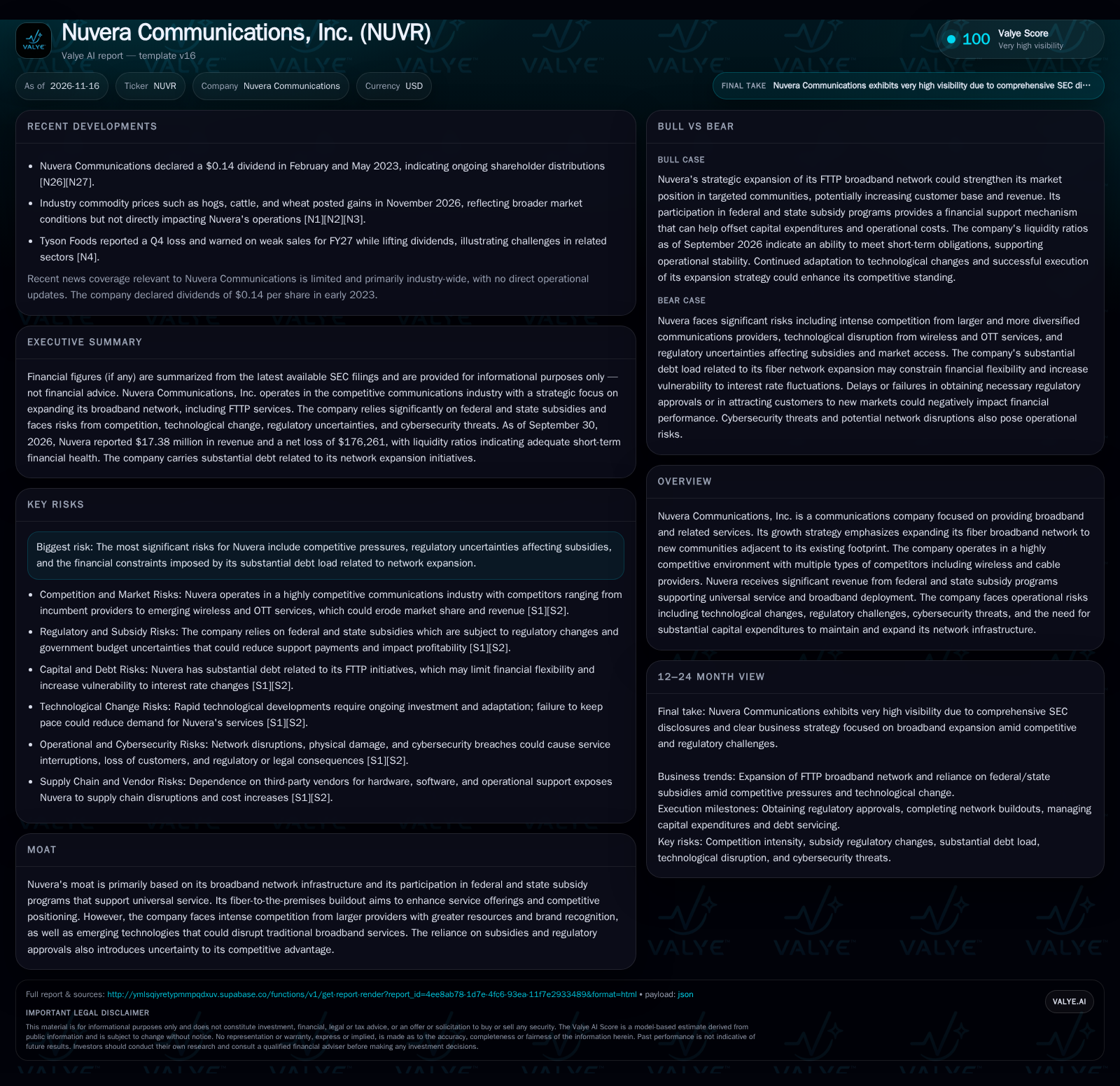
Nuvera Communications is executing a capital-intensive fiber broadband expansion strategy, supported by significant federal and state subsidies. The company faces high competitive pressure, regulatory uncertainty, and a substantial debt burden, making its ability to convert network investments into profitable growth and manage subsidy risk central to its forward thesis. [S1] [S2]
Nuvera Communications finds itself at a crossroads familiar to many regional broadband providers: the promise of fiber-to-the-premises (FTTP) expansion is tempered by a high reliance on government subsidy programs and a mounting debt burden. With $148.7 million in debt and over $11 million in subsidies supporting its 2026 results, Nuvera is navigating a complex landscape where execution risk, regulatory change, and intensifying competition could quickly reshape its outlook. The company’s future performance will likely be determined by its ability to execute on network buildouts, convert new infrastructure into sustainable customer growth, and adapt to shifting subsidy dynamics—all under the watchful eye of creditors and regulators. [S1] [S2]
Nuvera’s Expansion Push: Network Growth, Subsidy Dependence, and Leverage
As of September 2026, Nuvera Communications reported $17.38 million in quarterly revenue and a net loss of $176,261, with basic and diluted EPS of -$0.03. The company’s FTTP buildout is capital-intensive, reflected in its $148.7 million debt load—primarily tied to fiber expansion initiatives. Federal and state subsidies, including Universal Service Fund and Connect America Fund payments, contributed $11.37 million in the first nine months of 2026, underscoring the company’s heavy reliance on external support. [S1] [S2]
How Nuvera’s Revenue Model and Cost Structure Shape Its Economic Engine
Nuvera’s core business economics are defined by the interplay between recurring broadband service revenue, substantial subsidy inflows, and high fixed costs associated with network infrastructure. FTTP and broadband services can offer attractive per-subscriber economics and operating leverage if customer density and adoption rates are achieved. However, capital expenditures for network buildout are front-loaded and require ongoing maintenance, leading to elevated depreciation and interest expense, especially with $148.7 million of debt outstanding. Subsidy programs have historically enabled regional providers like Nuvera to extend service to less dense or economically marginal areas, partially offsetting the risk of low initial uptake or pricing pressure.
Pricing power is limited by intense competition from wireless, cable, satellite, and over-the-top (OTT) providers, which can drive down ARPU and increase churn. While fiber infrastructure can deliver superior bandwidth and reliability, the incremental revenue versus legacy broadband depends on customer willingness to pay and the pace of migration. If Nuvera can successfully densify its network and drive high penetration in new buildout areas, incremental margins may improve over time. Conversely, if subsidy levels fall or competitive intensity rises, the company could face a squeeze between fixed cost obligations and revenue pressure. The capital intensity of FTTP investments also means that Nuvera’s ability to deleverage and reinvest depends on timely revenue conversion from new network areas.
Competitive Realities: Fiber Advantages and the Threat of Substitution
Nuvera’s competitive moat is rooted in its physical broadband network and the regulatory barriers to entry in its regional markets. Fiber-to-the-premises can provide a technical edge over DSL or coaxial cable, especially in terms of speed and reliability. However, this advantage is eroding as wireless carriers deploy fixed wireless access (FWA) using 5G, satellite providers expand coverage, and software-based OTT services further decouple communications from physical infrastructure. Larger incumbents and national ISPs benefit from scale, stronger brands, and the ability to cross-subsidize pricing or invest in next-generation technologies.
For Nuvera, local brand recognition and regulatory relationships are assets, but customer switching costs are relatively modest—especially as new entrants offer promotions or bundled services. The company’s reliance on subsidies helps level the playing field in less dense markets, but any reduction in support could expose its cost structure to greater risk. The question is whether Nuvera can move fast enough to lock in customers and establish critical mass in new buildout areas before competitors deploy alternative offerings or capture market share.
Fiber Network Buildout Drives Profitable Growth—If Adoption and Subsidies Hold
A favorable outcome for Nuvera would see its FTTP investments translating into robust subscriber growth in newly served communities, with high take rates and stable ARPU offsetting capital and interest costs. Continued access to federal and state subsidies would underpin profitability and cash flow, enabling the company to further expand its footprint or begin deleveraging. If competitive threats remain contained—due to regulatory barriers, lack of viable alternatives in rural areas, or superior fiber performance—Nuvera could achieve a virtuous cycle of operating leverage and incremental margin expansion.
Evidence confirming this scenario would include sustained or rising broadband subscriber counts, improving ARPU, successful completion of buildout projects on time and on budget, and stable or growing subsidy receipts. Early signs could also include a reduction in net losses or a shift to positive free cash flow as new areas mature.
Incremental Gains Amid Persistent Headwinds: A Likely Middle Course
The most plausible trajectory for Nuvera is a gradual expansion of its fiber network, with moderate subscriber additions and ongoing dependence on subsidies. Revenue may grow incrementally as new areas are brought online, but pricing pressure and competition from alternative technologies limit ARPU growth and increase churn risk. Debt service obligations remain a significant drag on net income, and the company’s ability to reinvest or pay down debt is constrained by the need to maintain liquidity buffers.
This scenario is confirmed if Nuvera continues to report modest revenue and subscriber growth, persistent net losses or slim profit margins, and stable but not expanding subsidy inflows. Signs of stress would include rising churn, declining ARPU, or delays in regulatory approvals for new buildouts. The company’s future would remain highly sensitive to subsidy policy and competitive dynamics.
When Subsidies Shrink or Competition Intensifies: The Risk of Financial Squeeze
The greatest risk to Nuvera’s business model is a scenario in which subsidy programs are curtailed or eliminated, either due to regulatory change or budgetary pressures. In this environment, the company must absorb more of its fixed network costs from commercial revenue alone—at a time when wireless and satellite competitors may be capturing share with aggressive pricing or new technologies. If new buildouts fail to attract sufficient subscribers, or if pricing erodes faster than costs can be managed, Nuvera could face mounting losses and heightened refinancing risk.
Evidence of this scenario would be a sharp drop in subsidy revenue, rising net losses, negative free cash flow, or an inability to service debt without asset sales or external financing. Early warning signs could include regulatory signals of subsidy reform, competitive launches in Nuvera’s core markets, or customer attrition in newly built areas.
Measuring Nuvera’s Progress: What Will Test the Fiber Thesis Ahead
Quarterly broadband subscriber growth, especially in newly built FTTP areas, would help reveal the success of network expansion.
ARPU trends and churn rates, if disclosed, are critical for understanding pricing power and customer stickiness.
Actual capital expenditures versus guidance or budget for network buildouts will indicate discipline and execution risk.
Updates on federal and state subsidy receipts and any regulatory changes affecting eligibility or payment levels are essential watchpoints.
Debt service coverage and refinancing activity should be tracked for signs of financial stress or improving flexibility.
Progress on obtaining regulatory approvals for new market entry and network expansion would signal execution momentum.
Incidents of network outages or cybersecurity breaches, if reported, could test operational resilience and reputation.
Competitive developments—such as new wireless or satellite deployments in Nuvera’s markets—may signal increasing substitution risk.
Disclaimer: This is research-only, informational analysis and not investment advice. It may include AI-generated interpretation and general industry context. Always verify important details using primary sources.

Comments