
OceanFirst Financial Corp: Navigating Regional Banking Dynamics with Stable Fundamentals
OceanFirst Financial operates as a regional bank focusing on commercial and real estate lending, supported by diverse funding and liquidity sources amid a competitive landscape.
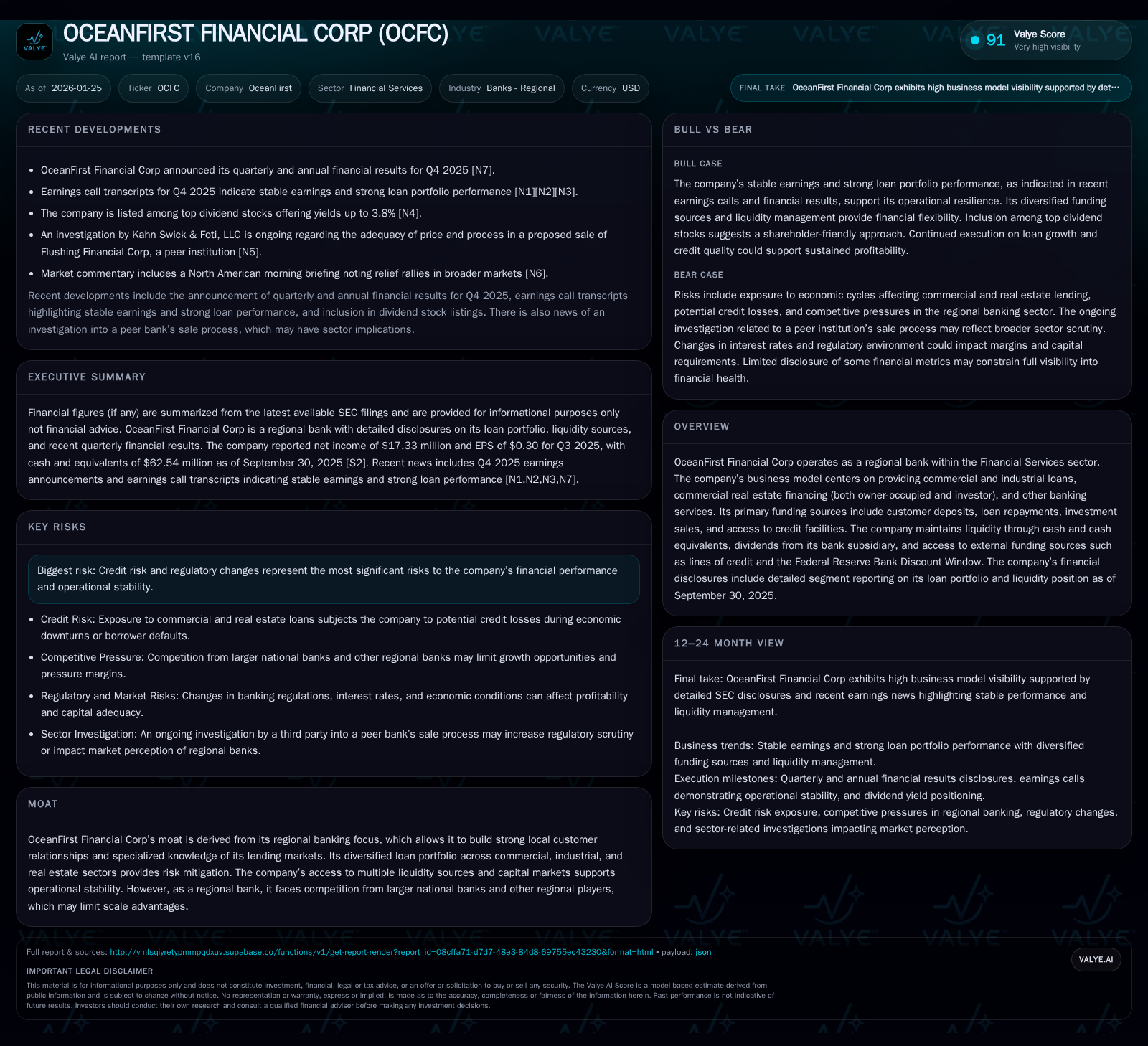
OceanFirst Financial Corp reported steady Q4 2025 earnings driven by strong loan growth and stable credit quality, maintaining a diversified loan portfolio across commercial and real estate sectors. The company’s business model relies on relationship-driven regional banking with funding primarily from customer deposits and loan repayments, supported by access to capital markets and credit facilities. While benefiting from local market knowledge and diversified assets, OceanFirst faces competitive pressures from larger banks and regulatory uncertainties that could impact credit risk and operational stability.
What Changed Recently
OceanFirst Financial Corp (OCFC) released its Q4 2025 earnings, reporting steady loan growth and stable credit quality. The company highlighted strength in commercial lending, particularly within its commercial and industrial loan portfolios, alongside consistent performance in commercial real estate financing for both owner-occupied and investor properties [N1][N4]. Despite the positive operational metrics, the stock experienced a modest dip, potentially reflecting investor caution given broader regional banking sector uncertainties [N3]. The dividend yield, noted among top dividend stocks offering yields up to 3.8%, remains an attractive feature for income investors [N6]. No recent M&A events or regulatory actions specific to OceanFirst were disclosed.
Business Model as a System
OceanFirst operates as a regional bank specializing in diversified commercial lending and banking services. Its core loan portfolio comprises commercial and industrial loans, commercial real estate loans (both owner-occupied and investor types), and other banking products tailored to local market needs [S1][S3]. The company leverages deep local relationships and underwriting expertise to build and manage its loan book.
Funding primarily comes from customer deposits, which provide a relatively stable and low-cost source of capital. These deposits, combined with loan repayments and investment sales, form the backbone of liquidity [S11]. To supplement, OceanFirst maintains access to lines of credit at multiple financial institutions and the Federal Reserve Bank Discount Window, providing ready borrowing capacity if market conditions tighten [S11].
The parent company’s liquidity is further supported by dividends from its bank subsidiary; for the nine months ended September 30, 2025, it received $62 million in dividends, alongside holding $41.4 million in cash and equivalents [S11]. This structure provides flexibility to meet capital needs while supporting shareholder distributions.
Operationally, the bank balances loan portfolio growth with credit risk monitoring, maintaining asset quality through rigorous underwriting and exposure diversification. The loan portfolio's segmentation allows for targeted risk management across commercial, industrial, and real estate sectors, with performance tracking by delinquency buckets and charge-off trends [S1][S3].
Industry Map & Competitive Battlefield
Within the regional banking space, OceanFirst competes against a range of institutions from larger national banks to other regional and community banks. While larger banks benefit from scale, technology investments, and broader geographic footprints, OceanFirst’s moat lies in its specialized local knowledge and customer relationships.
Competition is multifaceted: larger banks leverage extensive digital platforms aiming to capture commercial clients with streamlined services and capital availability. At the same time, regional peers compete on relationship banking, pricing, and niche market expertise. The commercial real estate sector, a significant part of OceanFirst’s portfolio, is particularly competitive due to the high demand for financing in both owner-occupied and investor segments.
Regulatory dynamics also shape the competitive landscape, with compliance costs and capital requirements disproportionately affecting regional banks. This environment encourages consolidation and strategic alliances but also challenges mid-sized banks like OceanFirst to sustain scale efficiencies.
Technological adoption and digital banking capabilities are increasingly important for client retention and acquisition, yet regional banks often face limitations in investing at the scale national players can achieve. OceanFirst’s ongoing competitive positioning will depend on balancing technology upgrades with maintaining personalized service.
Where the Economics Become Real
The economics of OceanFirst revolve primarily around net interest margin (NIM), credit risk management, and operational cost control. Interest income, generated from the loan portfolio, must offset the cost of deposits and borrowings while provisioning adequately for credit losses [S8][S10].
Loan pricing is influenced by local competition and borrower creditworthiness, while deposit costs are shaped by market rates and customer relationship dynamics. The company’s ability to maintain a stable deposit base reduces reliance on wholesale funding, which is typically more expensive and volatile.
Credit risk is a major determinant of profitability. OceanFirst’s diversified loan portfolio, including commercial and industrial loans and commercial real estate, spreads risk but also exposes the bank to sector-specific downturns. Historical delinquency and charge-off data indicate controlled credit losses, but ongoing economic uncertainty could affect asset quality.
Operational leverage is constrained by compliance and technology investments necessary to remain competitive and meet regulatory standards. While revenue from loans scales with asset growth, expenses tied to risk management, compliance, and digital infrastructure can pressure margins if not carefully managed.
Liquidity management is another crucial economic factor. Maintaining sufficient cash and securities balances, alongside access to credit lines and Fed facilities, ensures operational continuity but comes at a cost. The ability to generate dividends from the bank subsidiary supports parent company cash flow but requires balancing capital adequacy requirements.
Diligence Questions / Disconfirming Signals
- How does OceanFirst quantitatively monitor and manage credit risk in its commercial real estate and industrial loan segments, especially given evolving economic conditions?
- What are the bank’s plans and investments regarding technology modernization to compete with larger and more digitally advanced banks?
- How sensitive is the company’s net interest margin to changes in deposit rates and loan yields in its regional markets?
- Are there any emerging regulatory changes that could materially affect capital requirements or operational costs for OceanFirst?
- What is the composition and trend of non-performing assets and loan modification activities in recent quarters?
- How stable is the deposit base, particularly uninsured deposits, and what contingencies exist if deposit attrition accelerates?
- To what extent does the bank rely on wholesale funding versus core deposits, and how does this impact funding cost volatility?
- Are there any pending or potential litigation or compliance issues that could pose risks?
- How does OceanFirst’s dividend policy balance shareholder returns with the need for retained earnings to support growth and regulatory capital?
- What is the competitive trajectory in OceanFirst’s primary lending markets, and how might new entrants or consolidation among peers affect pricing and market share?
This report is based solely on publicly available information and does not constitute investment advice or recommendations. All financial figures are drawn from disclosed sources and industry context. Investors should conduct their own due diligence.
Disclaimer: This is research-only, informational analysis and not investment advice. It may include AI-generated interpretation and general industry context. Always verify important details using primary sources.

Comments