
Odyssey Marine Exploration’s Portfolio and Path Forward Amid Exploration Challenges
OMEX holds a diverse marine mineral exploration portfolio facing liquidity pressures and regulatory hurdles amid long development cycles.
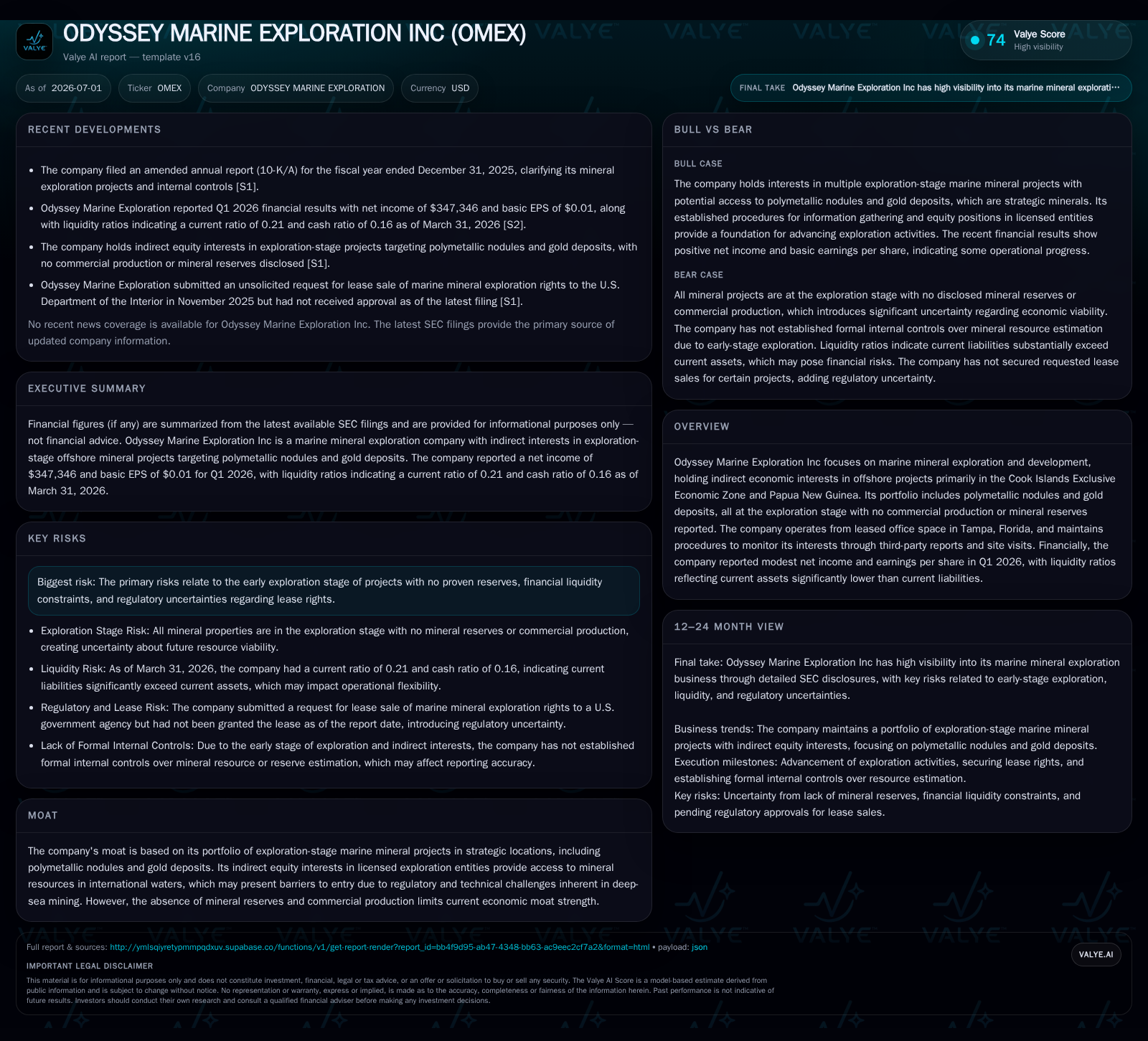
Odyssey Marine Exploration Inc remains firmly positioned as an upstream marine mineral exploration company with interests primarily in polymetallic nodules and gold deposits in the Cook Islands and Papua New Guinea. The latest Q1 2026 filing reveals significant liquidity constraints, with a current ratio of 0.21 reflecting current assets far below current liabilities, a critical factor given the capital-intensive nature of offshore exploration. While no proven reserves or commercial production exist, OMEX’s indirect equity holdings and joint ventures maintain exposure to promising licensed areas, though subject to regulatory risks such as lease revocation. Peer-contextualizing Odyssey alongside companies like DeepGreen Metals highlights typical industry challenges including protracted regulatory approvals and the need for technological advances to advance toward commercial viability. Key near-term milestones include progress on environmental assessments, survey updates, and corporate actions linked to an ongoing merger transaction that may influence strategic options.
Q1 2026 Financial Constraints Highlight Urgency during Upstream Exploration Model Realities
Portfolio Composition: Exploration Licenses Across Strategic EEZs Without Mineral Reserves Yet
Odyssey's asset base comprises indirect equity interests in offshore mineral projects mainly targeting polymetallic nodules and gold deposits located within exclusive economic zones (EEZs) off the Cook Islands and Papua New Guinea [S1]. These licenses are crucial gatekeepers that confer rights to explore but have not yielded reported mineral reserves nor commercial extraction activities so far. The company emphasizes its exploration stage status explicitly: mineral resources noted in disclosures do not equate to reserves with demonstrated economic viability [S1]. This distinction is critical; resource delineation phases must precede reserve classification—a process often spanning years under stringent environmental scrutiny.
The geographic diversification bears strategic merit given rising global interest in Pacific Ocean basin mineral wealth during terrestrial resource depletion trends. However, Odyssey holds these assets through joint ventures or minority stakes rather than direct operatorship, meaning it has limited control but reduces capital burden while maintaining upside exposure if resource economics prove favorable upon further surveying and sampling programs.
Regulatory Compliance and Environmental Assessments: Gatekeepers to Value Capture
Navigating the complex regulatory environment is a fundamental challenge shaping Odyssey’s project valuation trajectory. One salient example involves the Phosagmex Project—jointly held by Odyssey via Oceanica Resources Mexico—which recently experienced mining concession revocation without subsequent restoration as of filing date [S1]. Such regulatory reversals highlight inherent political risk in EEZ jurisdictions where governments retain discretionary authority over exploration licenses.
Comprehensive environmental impact assessments remain necessary preconditions before advancing toward commercial production eligibility under international mining conventions governing deep-sea operations. These requirements extend project timelines substantially due to procedural review periods mandated by national authorities and international bodies tasked with protecting fragile marine ecosystems.
The industry's known long lead times for permits juxtaposed against technology development schedules require sustained capital investment despite uncertain payoff windows. Hence regulatory compliance effectively acts as both a barrier to entry for competitors lacking expertise or resources but also a source of value dilution or loss if delays or denials occur.
Peer Insights: Benchmarking Odyssey Marine’s Exploration Approach Within Marine Mining Industry
Placing OMEX within the competitive landscape clarifies typical journey patterns and structural industry risks faced by marine mineral explorers. Peers such as DeepGreen Metals specialize in polymetallic nodule resource targeting with a large portfolio of active licenses but often at differing stages—some advancing feasibility studies while others remain purely exploratory. Similarly, The Metals Company pursues marine mineral resource development focused on scalable commercial extraction concepts.
In contrast, Nautilus Minerals exemplifies complexities transitioning from exploration into operational deep-sea mining amid technical hurdles and financing difficulties culminating in troubled commercial deployment. This peer caution underscores how protracted development phases coupled with substantial CapEx outlays test even well-capitalized entrants.
Odyssey’s strategy—to rely largely on indirect interests via joint ventures like with CapLat (holding equal shares in Phosagmex)—is consistent with industry norms seeking risk-sharing mechanisms given high upfront costs and uncertain resource yield profiles [S29]. Compared to Ocean Minerals LLC providing marine exploration services without direct ownership stakes, OMEX assumes more upstream risk but also potential reward if successful resource conversion occurs.
Growth Opportunities: Demand Surge for Strategic Minerals and New Licensed Area Openings
Indelible macroeconomic tailwinds support long-run optimism around OMEX’s sector relevance despite immediate operating challenges. Escalation in global demand for critical minerals driven by electric vehicles electrification, renewable energy infrastructure buildouts, and digital technologies ensures strategic minerals sourced from ocean floor deposits will command rising attention across policy makers and investors alike.
Moreover, governments managing exclusive economic zones are incrementally expanding licensed offshore areas made available for exploration as part of sustainable ocean resource utilization initiatives backed by environmental safeguards. Advancements in deep-sea geophysical survey techniques—improving accuracy while reducing marginal cost per square kilometer surveyed—also promise enhanced data quality supporting accelerated resource estimation efforts.
Together these supply-side enablers create a pipeline effect where companies like Odyssey positioned early can capitalize on increasing licensed footprints combined with pipeline projects passing environmental assessment filters. However, actual growth realization depends on navigating detailed regulatory frameworks effectively.
Risks Amplified by Capital Intensity, Regulatory Uncertainty, and Early Stage Exploration Limitations
The highly capital-intensive nature intrinsic to every phase—from initial exploratory sonar mapping through sampling cruises up to drill tests—exposes OMEX to persistent funding challenges compounded presently by its tight liquidity profile outlined earlier [F1]. Absence of proven reserves means market valuations hinge disproportionately on speculative resource potential rather than balance-sheet strength or production cash flows.
Regulatory timing uncertainties pose additional downside threat; failure to renew or loss of licenses due to policy shifts or legal disputes—as exemplified recently by Phosagmex revocation—could materially impair asset value foundations [S1]. Technological uncertainties related to evolving deep-sea mining methods remain albeit partially mitigated by industry-wide R&D investments across peers.
Furthermore geopolitical risk factors manifest particularly when operating within contested EEZs or regions without comprehensive treaties governing seabed exploitation rights add layers of possible interruptions beyond company control.
What’s Next?: Milestones to Track Including Survey Updates, License Status, and Corporate Actions
Looking ahead into late 2026, multiple high-impact developments merit close monitoring. Odyssey recently entered into a merger agreement with American Ocean Minerals Corporation (AOM), structured so that AOM becomes a wholly owned subsidiary post-transaction anticipated late Q3/early Q4 2026 [S24]. This deal includes a sizable PIPE financing tranche ($156M) enhancing financing prospects post-merger but also introduces integration execution risks.
On project fronts, updates on marine geophysical surveys instrumental for refining resource contour models will set directional tone regarding progression from exploratory license classification toward defined resources amenable eventually to reserve status subject to feasibility studies completion [S3]. Concurrently tracking reinstatement progress on revoked concessions like Phosagmex provides insight into regulatory navigation effectiveness.
Adjunct corporate governance dynamics revealed by recent stock incentive plan amendments indicate management alignment initiatives—a positive sign amidst prolonged development uncertainty [S3]. Altogether these milestones collectively shape potential paths reducing risk premiums attached currently due to capital scarcity and regulatory ambiguity.
Financial Profile Discussion
As summarized above based on Q1 2026 data [F1], Odyssey Marine maintains zero debt outstanding historically confirmed through latest filings yet faces pronounced liquidity stress: cash balances of roughly $2.1 million fall dramatically short relative to $13.3 million of current liabilities resulting in an acute working capital deficit at quarter end. This imbalance restricts discretionary spending flexibility essential for proactive engagement with capital-intensive exploration activities requiring mobilization of expensive vessel time and specialist contractors.
Such metrics exemplify typical exploration-stage enterprise financial profiles — minimal leverage offset by brittle cash reserves necessitating continuous capital raises or dilution events unless material operational breakthroughs facilitate credit profile improvement or provoke acquisition interest from strategic partners.
Continuous monitoring of post-merger financing inflows alongside expense burn rates will provide essential data points indicative whether Odyssey can maintain its operational cadence necessary during inherently protracted marine resource evaluation phases before any opportunity arises for monetization.
Disclaimer: This is research-only, informational analysis and not investment advice. It may include AI-generated interpretation and general industry context. Always verify important details using primary sources.

Comments