
OneConstruction Group Faces Structural Challenges with Rising Costs and Operating Losses
The Hong Kong-based structural steelwork contractor reports widening losses amid cost overruns despite steady revenue.
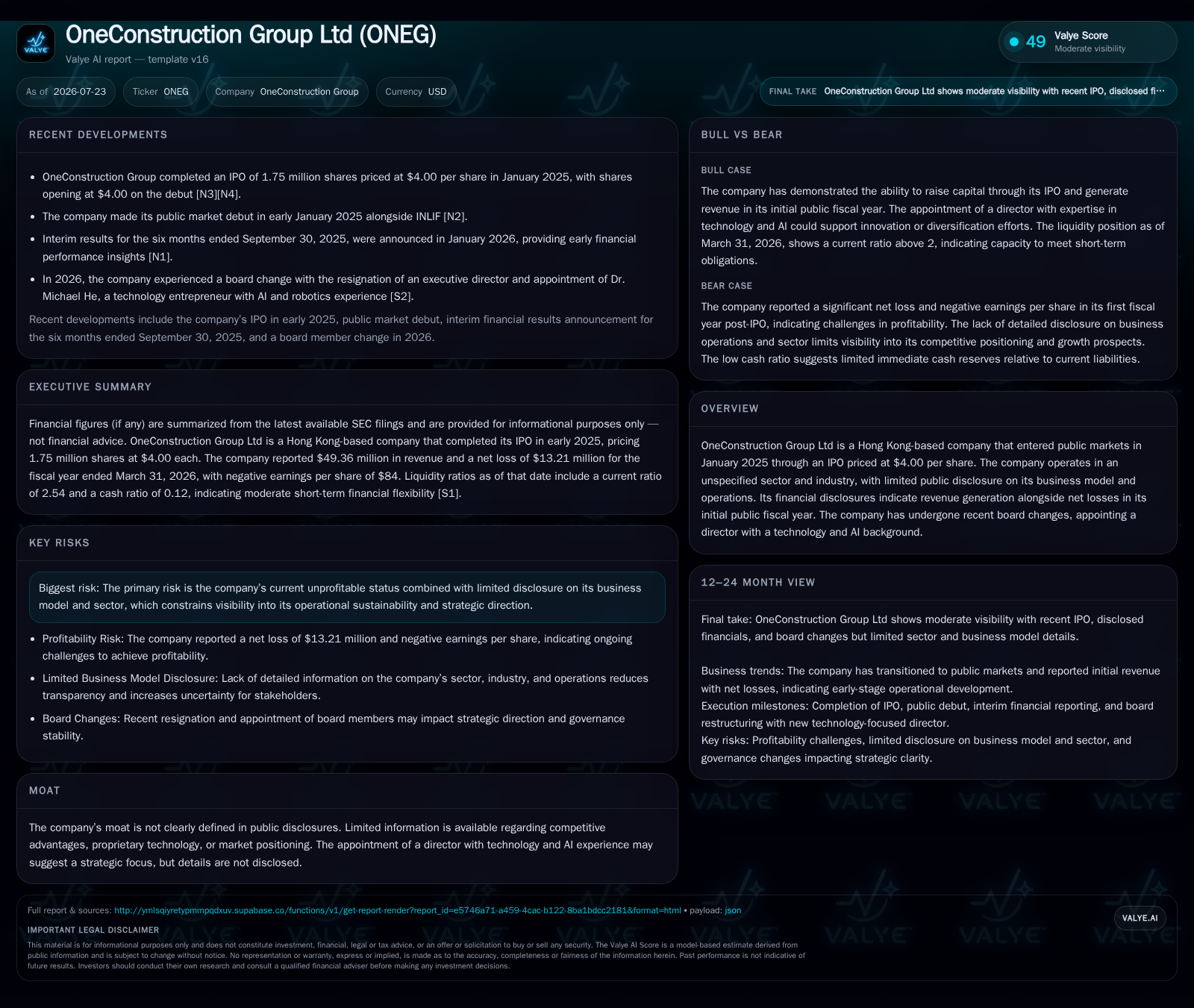
OneConstruction Group Ltd’s latest quarterly update confirms a continued net loss attributed mainly to cost overruns and final account adjustments on legacy projects. Revenue declined modestly, reflecting project mix shifts in public and private sector contracts, while gross margins collapsed into negative territory. The company’s business model as a specialized subcontractor in Hong Kong’s construction sector exposes it to contract risk, raw material price volatility, and client concentration. Recent board turnover and the appointment of a technology-savvy director may signal a strategic recalibration. Financially, OneConstruction maintains moderate leverage with a solid current ratio but faces urgent pressures to restore profitability and control cost structures.
Recent Operating Update
OneConstruction Group Limited’s latest quarterly filing dated July 6, 2026, reveals a continuation of operational challenges marked by widening losses and cost pressures [S2]. The company announced the appointment of Dr. Michael HE, a technology entrepreneur with a background in AI robotics and consumer electronics, to its board following the April 2026 resignation of executive director Mr. Cheung Kam Cheung. While this governance change does not immediately affect operational results, it suggests a potential strategic shift toward leveraging technology-driven solutions or enhanced project management practices within the traditionally labor-intensive structural steelwork subcontracting segment [S2].
Business Model Overview
OneConstruction operates primarily through its Hong Kong subsidiary, OneC Engineering, specializing as a subcontractor in structural steelwork installation for infrastructure, commercial, and residential developments [S1]. The company secures contracts mainly from general contractors engaged by government agencies and private property developers. Revenue is recognized over the contract duration based on percentage-of-completion accounting, a standard practice in construction that ties revenue recognition closely to project delivery milestones and completion rates [S1].
Profitability hinges on precise project cost estimation, efficient on-site execution, and timely resolution of change orders or claims. Cost overruns and final account adjustments on legacy projects have significantly impacted margins, reflecting challenges in project cost control and risk management [S1]. The company’s exposure to raw steel price volatility and labor market tightness further complicates cost forecasting and operational efficiency.
Industry Structure and Competitive Position
Within Hong Kong’s construction ecosystem, OneConstruction competes with other specialized structural steelwork subcontractors and steel fabricators. The sector is characterized by intense competition on contract bids, where price competitiveness and proven execution track records are critical for winning projects. Margins are generally compressed due to high fixed costs related to equipment leasing and skilled labor wages, alongside regulatory compliance costs for safety and quality standards.
Peer contractors in the Asia-Pacific region face similar cyclicality driven by government infrastructure spending and private real estate development trends. These external factors largely dictate demand for structural steelwork services but remain outside the direct control of subcontractors. Consequently, operational discipline in cost control, project delivery timelines, and contract risk management differentiates more resilient players in this space.
Growth Drivers
Demand for structural steelwork services in Hong Kong is supported by ongoing urbanization, government infrastructure modernization initiatives, and sustained commercial and residential construction activity. The increasing architectural preference for steel-intensive frameworks also underpins workload growth for specialized subcontractors.
Technological adoption, such as advanced fabrication methods and digital project management tools, offers potential efficiency gains. Dr. Michael HE’s appointment may signal OneConstruction’s intent to explore such innovations to improve operational performance and mitigate historical execution challenges.
Expansion into adjacent construction services or geographic markets remains a theoretical growth avenue but has not been disclosed in recent filings.
Risks and Watchpoints
Delays in project completion can disrupt contract revenue recognition timing, introducing earnings volatility. The company’s client base is concentrated among government agencies and large property developers, exposing it to client concentration risk and dependency on general contractors’ project pipelines.
Raw steel price fluctuations and supply chain disruptions remain significant cost and schedule risks. Labor market tightness in Hong Kong, particularly for skilled steelwork installers, adds wage inflation pressures that further strain operating margins.
Allowance for credit losses on accounts receivable increased sharply year-over-year, reflecting heightened credit risk exposure and potential collection challenges [S1]. Monitoring change orders and final account settlements will be critical to understanding future margin recovery prospects.
Governance changes and strategic clarity on loss mitigation and operational improvements will be important to watch.
What To Watch Next
Key indicators to monitor in upcoming quarterly disclosures include gross margin trends, cost control effectiveness, and resolution of legacy contract disputes. Operational KPIs such as project backlog size, project completion rates relative to schedule, days sales outstanding (DSO), and change order outcomes will provide insight into contract pipeline health and execution efficiency.
Board-level initiatives following Dr. Michael HE’s appointment may reveal efforts to integrate technology solutions or overhaul project management practices aimed at improving profitability.
Any updates on capital allocation, liquidity management, or leverage reduction will also be pertinent given the sustained operating losses.
Financial Profile Discussion
While the liquidity profile appears stable, sustained operating losses highlight the urgent need for improved cost discipline and operational efficiencies to restore sustainable profitability.
Disclaimer: This analysis is for informational purposes only and does not constitute investment advice. It incorporates company filings and general industry context without speculative forecasts or research views.
Disclaimer: This is research-only, informational analysis and not investment advice. It may include AI-generated interpretation and general industry context. Always verify important details using primary sources.

Comments