
OpenText Corp’s Strategic Pivot Under New Leadership Amid Software Industry Shifts
Ayman Antoun’s CEO appointment signals a sharpened focus through divestitures and operational discipline in OpenText’s evolving enterprise software landscape.
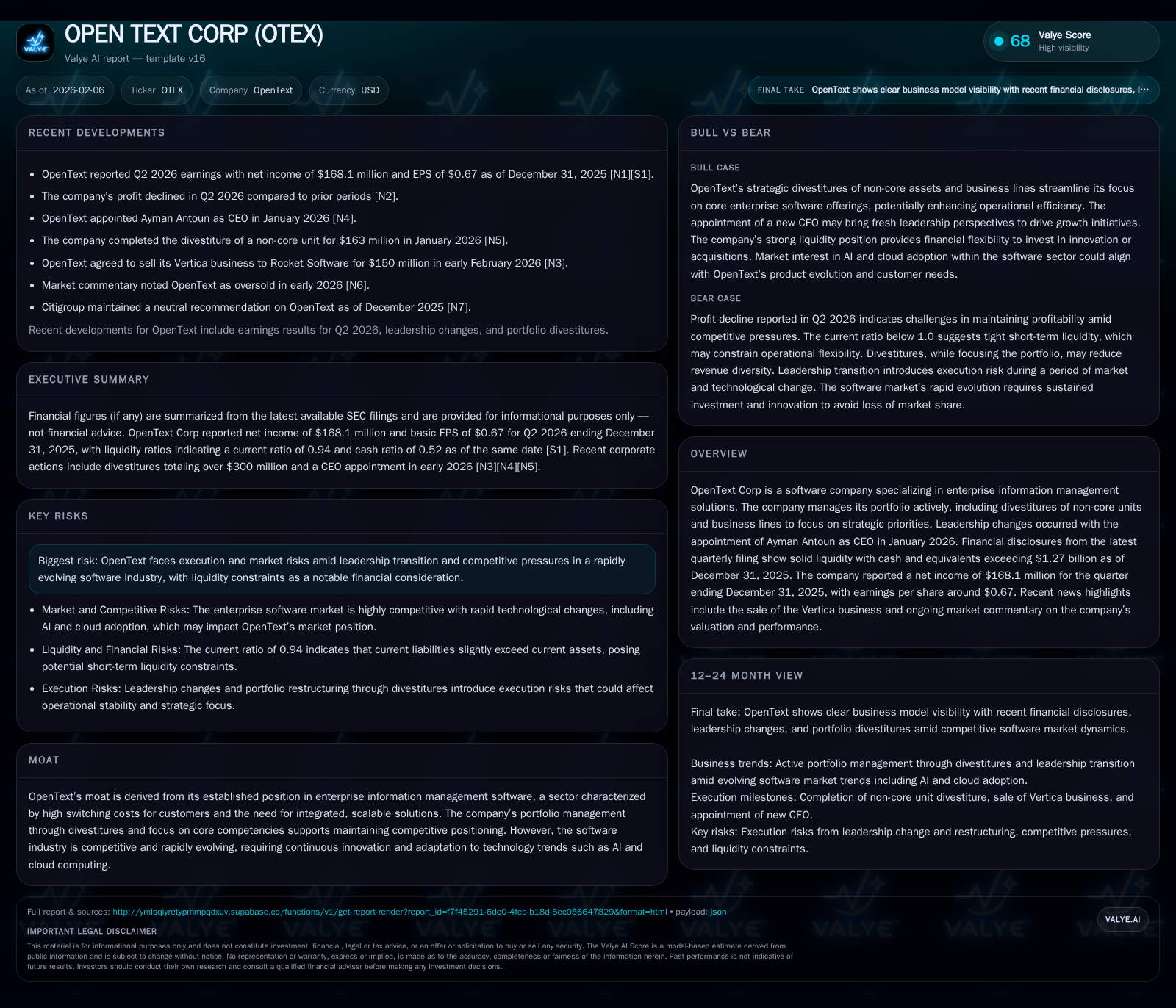
OpenText Corp has entered a pivotal phase with Ayman Antoun stepping in as CEO in early 2026, ushering a portfolio realignment marked notably by the sale of the Vertica business. This strategic tightening aims to reinforce core enterprise information management competencies amid intensifying industry competition and technological evolution. Strong liquidity supports runway, though recent profit softness and near-unity current ratio underscore cautious financial navigation. Market sentiment remains mixed with neutral analyst views offset by oversold technical signals.
Navigating Change: The New CEO's Mandate
The appointment of Ayman Antoun as OpenText's CEO in January 2026 marked a watershed moment for the company. Coming into leadership amid an increasingly complex software landscape, Antoun swiftly signaled his intent to sharpen OpenText’s strategic focus by actively managing its portfolio. This directive differed from prior more incrementally paced approaches; instead, it embraced decisive divestitures such as the recent sale of Vertica, underscoring a shift toward operational discipline paired with innovation prioritization [N2][N1].
During the Q2 2026 earnings call, Antoun emphasized ensuring resources align tightly with market-facing strengths — a nod toward shedding non-core segments dilutive to growth or margins. This focus aligns with broader industry demands where agility and capital efficiency are paramount. The CEO’s mandate clearly balances sustaining existing strengths in enterprise information management (EIM) while invigorating transformation efforts to keep pace with disruptive technologies.
Sharper Focus Through Portfolio Realignment
OpenText’s active portfolio recalibration exemplifies this strategic pivot. Early February witnessed the $150 million divestiture of the Vertica analytics business to Rocket Software, stripping away a non-core asset that diverged from OpenText’s central EIM offerings [N4]. Complementing this was the earlier disposal of another non-core unit for $163 million completed in January [N5]. These transactions do more than inflate cash reserves; they crystallize OpenText’s ambition to concentrate on integrated solutions where it holds differentiation.
These targeted asset sales appear pragmatic beyond mere monetization—they reduce complexity and enable redeployment of capital toward higher-return innovation efforts. In a rapidly evolving software market, such clarity helps combat dilution of management attention and accelerates response times to customer needs that demand seamless data lifecycle management capabilities.
Financial Health: Cash Flows, Liquidity, and Profitability
Financial disclosures for the quarter ending December 31, 2025, paint a nuanced picture. OpenText holds cash and equivalents exceeding $1.27 billion—an impressive liquidity buffer providing flexibility for both operational investments and strategic options [F1]. However, its current ratio hovering around 0.94 (current assets $2.35 billion versus current liabilities $2.50 billion) suggests working capital constraints requiring tight financial controls [F1].
Net income at $168.1 million for this period reflects softness versus historical norms; alongside an EPS of approximately $0.67, earnings show pressure from market competition and possibly transitional costs relating to leadership changes or restructuring [F1][N3]. This juxtaposition between strong liquidity yet compressed profitability underscores the balancing act — defending margins while funding innovation and integration efforts remains critical.
Competitive Moat Amid Rapid Industry Evolution
OpenText’s moat is anchored firmly in its established position serving enterprise clients demanding comprehensive information lifecycle solutions integrated across diverse environments [valye_report_excerpt]. High switching costs embedded in deeply customized deployments serve as both shield and sword against competitors.
Yet the unfolding dawn of AI-driven analytics and cloud-native architectures challenges legacy paradigms. OpenText must evolve not only its technology stack but also delivery models while preserving seamless integration — a hallmark that customers rely upon. The company’s strategy to carve out non-core units thus aligns well with sustaining its moat by focusing R&D bandwidth on emerging technology adoption crucial for differentiation.
Risks in Transition: Execution and Market Pressures
However, risks are aplenty amid this transformative backdrop. The Q2 10-Q references typical uncertainties around executing strategy flawlessly during leadership hand-offs — areas such as talent retention, integration disruption, or misreading market signals remain concerns [S2].
Externally, fierce competition from both traditional software giants scaling AI/cloud initiatives and agile cloud-native startups intensifies margin pressures [valye_report_excerpt]. Liquidity considerations also cannot be ignored; although cash is ample now, continued discipline is essential given current liabilities slightly exceed current assets.
Together these internal-external risk factors compound complexity, demanding stringent execution oversight to avoid eroding investor confidence or ceding ground commercially.
Valuation Signals and Market Sentiment
Market reception captures this tension between challenge and promise aptly. Recent period spelling OpenText as oversold points to technical indicators suggesting pricing softness possibly disconnected from fundamentals [N6]. Analyst sentiment remains neutral per Citigroup assessments — signaling neither strong conviction nor outright skepticism about near-term outlooks [N9].
Options trading volumes hint at heightened investor activity but without clear directional bias reflective of uncertainty about timing or scale of potential rebounds or further corrections [N7]. This ambivalence represents a natural investor response amid leadership transitions coupled with ongoing business reshaping.
Looking Ahead: Innovation and Strategic Outlook
Synthesizing these strands directs attention to OpenText’s capacity to turn strategic refocus into sustainable competitive advantage. Success will hinge on judiciously balancing innovation imperatives — particularly integrating artificial intelligence capabilities seamlessly within enterprise content ecosystems — against pragmatic financial stewardship.
Antoun’s leadership offers promising clarity by reaffirming core strengths while pruning distractions; however, vigilant monitoring of execution is warranted. Capitalizing on rich liquidity yet addressing profitability headwinds through disciplined cost management alongside smart tech investments will dictate resilience.
Ultimately, OpenText must continue evolving its software portfolio expansively enough to meet future EIM demands while narrowly enough to avoid dilution or complexity traps—an exercise demanding adaptive leadership plus operational excellence.
This analysis is provided for informational purposes only without any investment recommendation or advice.
Disclaimer: This is research-only, informational analysis and not investment advice. It may include AI-generated interpretation and general industry context. Always verify important details using primary sources.

Comments