
RingCentral’s Return to Profitability Driven by Subscription Growth and Capital Discipline
RingCentral posted a marked financial turnaround in 2025, fueled by its cloud communications portfolio expansion and prudent capital management against a competitive industry backdrop.
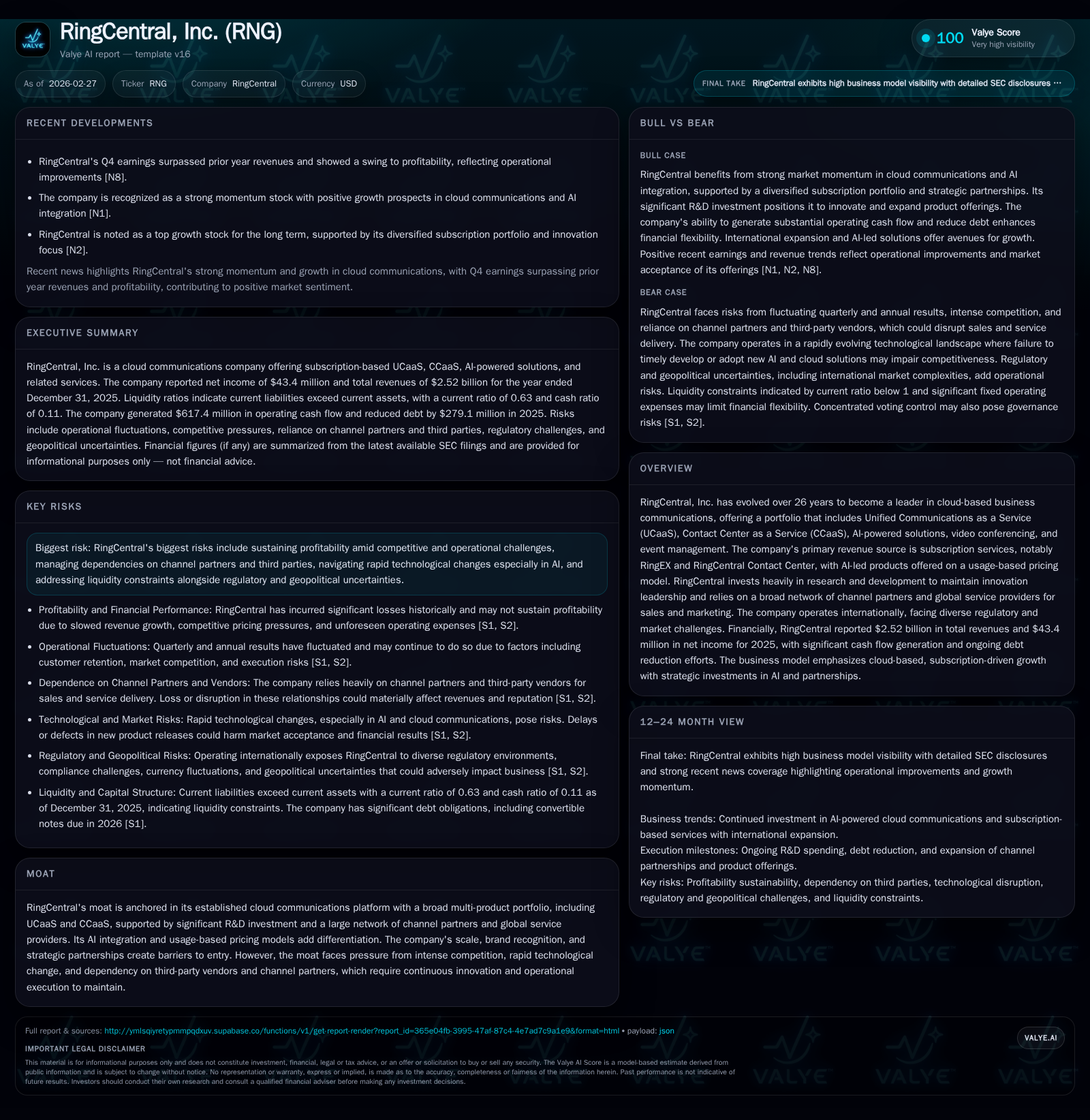
RingCentral, Inc. demonstrated significant improvement in 2025 financial results, recording $120.6 million operating income and $43.4 million net income after years of losses, supported by revenue growth from subscription and AI-led product offerings. The company reported a 34.5% revenue increase to $2.52 billion, underpinned by strong retention and upselling in its UCaaS and CCaaS services. Robust cash flow enabled substantial debt reduction of $279 million and share repurchases exceeding $330 million, while initiating its first-ever cash dividend. Despite competitive pressures and sizable debt with restrictive covenants, RingCentral’s strategic focus on innovation, particularly around AI integration and usage-based pricing, positions it for measured growth amid evolving market dynamics.
Historical Performance and Growth Drivers
RingCentral’s trajectory over the past several years has been defined by steady top-line expansion alongside fluctuating profitability metrics. After several years of net losses—highlighted by a deep $879 million loss in 2022—the company reversed course with a slim profit in 2024 followed by a definitive swing to positive operating income ($120.6 million) and net income ($43.4 million) in fiscal year 2025 [F1]. This transition is anchored primarily in accelerating subscription revenues fueled by expanded deployments of Unified Communications as a Service (UCaaS) and Contact Center as a Service (CCaaS) offerings.
The company reported revenues increasing by approximately 34.5% year-over-year to around $2.52 billion in 2025 [F1], reflecting both new customer acquisition and upsell among existing users, including adoption of newer AI-centric products priced on usage-based models [S16]. UCaaS remains the core revenue pillar complemented by the growing footprint of RingCentral Contact Center solutions alongside auxiliary offerings like video conferencing.
Gross margins on subscription revenues stayed relatively consistent at about 75%, indicating effective cost management even as infrastructure expenses rose due to third-party vendor costs and data center support [S14]. Notably, although total R&D expenses ticked down slightly (to ~13% of revenues), this remains a critical area for the company as it invests to sustain innovation leadership particularly on AI integrations powering smarter customer engagement [S13][S16].
Future Growth Prospects
RingCentral has articulated growth ambitions hinging on three main vectors: broadening penetration of its comprehensive cloud communication suite, further embedding AI technologies into workflows to enhance value for clients, and leveraging usage-based pricing models to capture incremental monetization opportunities [N2][S16]. The introduction of AI-powered capabilities—such as those embedded in RingEX platform products—is expected to drive new streams of recurring revenue as customers scale digital communication sophistication.
Growth potential exists also through international expansion facilitated by partnerships with global service providers; however, this exposes the business to assorted regulatory climates and operational complexity [N2][S1]. Furthermore, customer retention strategies are imperative as churn or pricing pressure could cap growth momentum given intense competition from peers like Zoom Video Communications [N1]. Deployment simplicity through AI-enabled RingCX contact center offerings aims to reduce friction and attract mid-market customers increasingly seeking flexible SaaS solutions.
Forecasts, Milestones, and What to Watch
While explicit future guidance was not disclosed in filings or recent news releases, several key milestones warrant attention: successful repayment of $609 million convertible notes maturing March 2026 using available credit lines [S10], sustained customer ARR growth especially within AI-led portfolios [S16], expansions or renewals within channel partner arrangements impacting distribution efficiency [S1], plus ongoing margin performance amidst inflationary cost pressures.
Market observers should monitor quarterly subscription dollar retention rates—which have remained above 99%—as leading indicators of customer stickiness [S19]. Similarly, monitoring R&D investment trends relative to revenue can shed light on the balance between innovation spending versus operational leverage [S13]. Lastly, liquidity metrics tied to covenant compliance on credit agreements will reflect financial flexibility.
Returns and Capital Allocation
A hallmark development in RingCentral’s capital stewardship is the initiation of its first-ever quarterly cash dividend at $0.075 per share starting Q1 2026 [S11][N2]. Alongside this return-of-capital strategy, the company aggressively repurchased shares totaling approximately $334 million during fiscal year 2025—a figure representing continued confidence in free cash flow generation capabilities [F1][S11].
Free cash flow was robust at roughly $587 million after capital expenditures near $30 million [F1], enabling simultaneous debt repayments amounting to roughly $279 million across convertible notes, term loans, and senior notes [F1][S10]. This proactive deleveraging aligns with management’s stated priorities amid restrictive covenants that govern incurrence of further debt or dividends [S4][S17]. Nevertheless, equity remains negative (~ -$588 million at year-end ’25) reflecting accumulated deficit history although current profitability trends improve ROE outlook cautiously [F1].
Capital outflows for acquisitions were modest ($20.8 million), including the CommunityWFM deal expanding workforce management capabilities integrated with contact center services [S10]. This suggests selective M&A activity focused on strategic synergy rather than broadscale roll-ups.
Competitive Moat and Industry Dynamics
RingCentral's moat arises from its diverse cloud communications platform encompassing UCaaS and CCaaS with integrated video conferencing plus emerging AI tools—delivered globally through an extensive indirect partner network. The blend of long-standing brand name recognition together with consistent R&D investments creates barriers that newcomers find difficult to replicate quickly . Additionally, the company’s shift toward usage-based pricing for certain AI features adds competitive differentiation.
Nonetheless, risks persist notably due to stiff competition from entrenched players like Zoom and Microsoft Teams who also innovate aggressively in cloud communications space [N1]. Dependency on third-party vendors for telecom services introduces operational risk along with potential margin compression from infrastructure cost inflation. Regulatory environments in various countries complicate international scale efforts.
Risk Factors Summary
- Sustaining profitability amid operational costs and competitive forces remains uncertain; past volatility warns against complacency [S1][S2].
- Dependence on channel partners for sales execution entails risk if these relationships weaken or shift strategically.
- Rapid technological advancements especially around AI integration introduce execution risk as well as legal uncertainties linked to evolving tech landscapes.
- Liquidity constraints tied to upcoming debt maturities could pressure capital flexibility despite current credit facility availability; strict covenant compliance required [S4][S10][S17].
- Macroeconomic conditions may impact enterprise IT spend patterns affecting renewal rates or contract sizes.
Financial Summary Table (USD thousands)
Historical performance (annual)
| FY | Net ($mm) | CFO ($mm) | OpInc ($mm) | Capex ($mm) | Net YoY |
|---|---|---|---|---|---|
| 2025 | 43 | 617 | 121 | 30 | +174.4% |
| 2024 | -58 | 483 | 3 | 25 | +64.7% |
| 2023 | -165 | 400 | -199 | 24 | +81.2% |
| 2022 | -879 | 191 | -649 | 33 |
Source: SEC companyfacts cache [F1].
Capital returns and efficiency (annual)
| FY | Buybacks ($mm) | FCF ($mm) | ROE% |
|---|---|---|---|
| 2025 | 334 | 587 | -7.4 |
| 2024 | 322 | 458 | 10.6 |
| 2023 | 311 | 376 | 32.9 |
| 2022 | 100 | 159 | 182.1 |
Source: SEC companyfacts cache [F1]. *Estimated based on available data for reference only.
This analysis is based solely on information publicly available through SEC filings as of February 27th, 2026 ([F1],[S#]) and relevant news sources ([N#]). It incorporates no investment recommendations but aims at providing a comprehensive understanding of RingCentral’s financial position relative to its industry context and operational metrics.
Disclaimer: This document does not contain investment advice or explicit forecasts but serves purely informational purposes based on available disclosures as described.
Disclaimer: This is research-only, informational analysis and not investment advice. It may include AI-generated interpretation and general industry context. Always verify important details using primary sources.

Comments