
Navigating Reservoir Media’s Growth Amidst Liquidity Constraints and Earnings Volatility
Reservoir Media's recent earnings outperformance reveals robust revenue drivers amid modest liquidity and operational opacity.
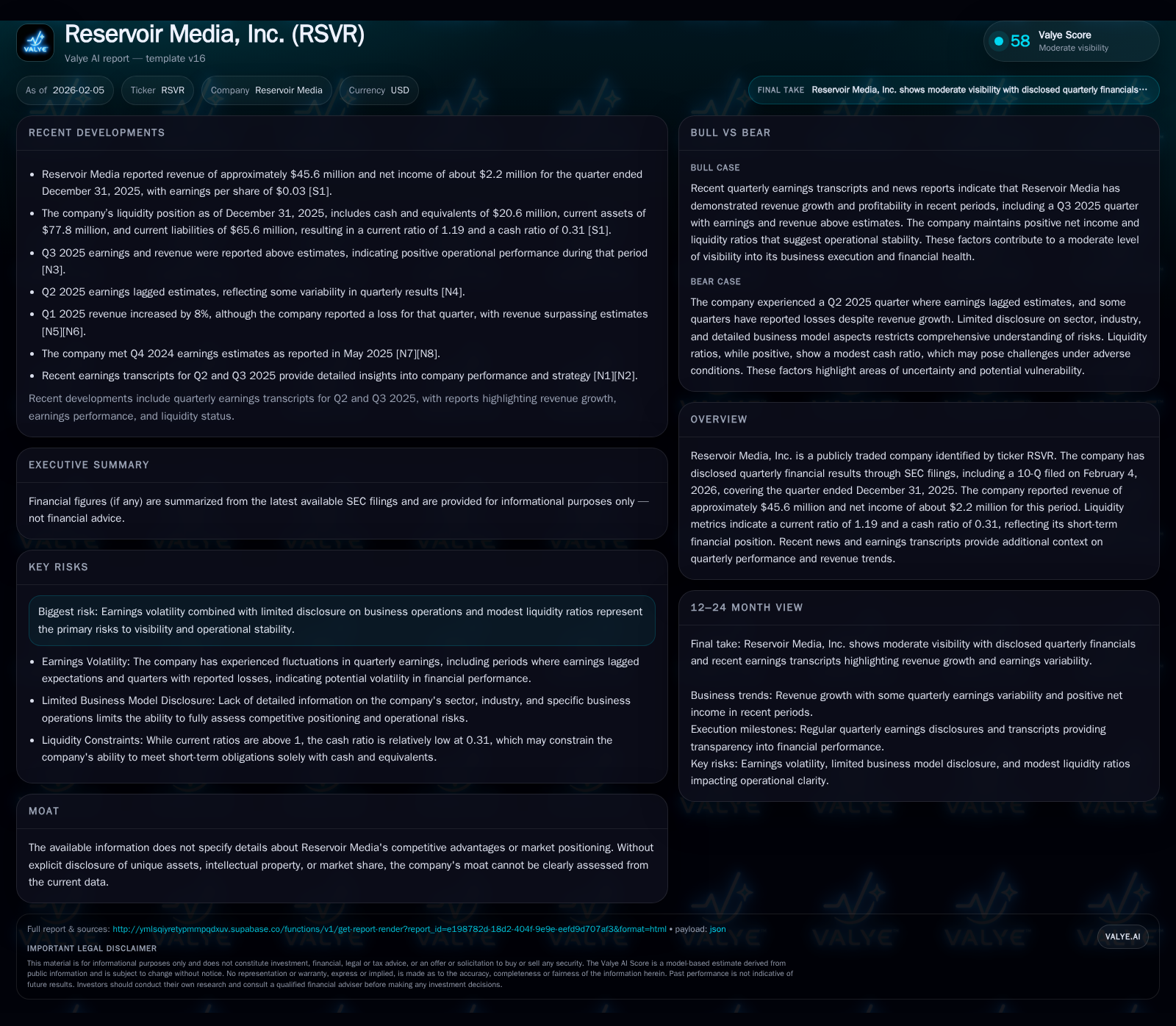
Reservoir Media, Inc. (RSVR) delivered a notable earnings beat in Q3 2025 with revenues reaching approximately $45.6 million and net income around $2.2 million, underscoring operational growth momentum. However, this financial strength contrasts with constrained liquidity ratios—current ratio at 1.19 and a cash ratio near 0.31—highlighting potential short-term risk exposures. Limited transparency in business disclosures and an unclear competitive moat further complicate assessment of the company's long-term stability amid observed earnings volatility.
Outperforming Expectations: Earnings Highlights and Market Reception
What does Reservoir Media's latest earnings beat tell us about its underlying business health? The company posted Q3 2025 revenue of approximately $45.6 million, outpacing consensus estimates by a modest margin, while net income reached about $2.2 million [N3]. This performance injected a cautious optimism into the market narrative, affirming that Reservoir continues capturing demand shifts within the music publishing sector — particularly as digital streaming penetration deepens globally.
The positive surprise comes against a backdrop of an industry grappling with changing consumption patterns and royalty distribution challenges. The fact that Reservoir carved out an earnings beat hints at effective monetization strategies and possibly expanding rights portfolios or licensing efficiency gains. Market reception reflected tempered enthusiasm given prevailing macroeconomic uncertainties affecting discretionary entertainment spending.
Revenue Drivers Behind Q3 2025 Success
What fueled this top-line strength? Insights from the Q2 and Q3 earnings transcripts reveal management attributing revenue uplift primarily to increased payouts from streaming platforms supplemented by legacy catalog license renewals [N1, N2]. They emphasize the diversification of income sources across various rights categories embedding sync placements and digital mechanical royalties.
Financial data aligns with these remarks: streaming-related revenues remain a critical pillar while negotiated licensing deals enhanced recurring income streams [F1]. Management’s dialogue points toward investments in catalog acquisitions and expanding songwriter relationships which potentially underpin sustainable growth.
Nonetheless, explicit breakdowns quantifying segment contributions remain sparse; hence, stakeholders must interpret revenue quality cautiously given the complexity inherent in royalty accounting.
Deconstructing Liquidity: Current and Cash Ratios in Focus
How stable is Reservoir’s financial footing in terms of liquidity? The company reported current assets totaling approximately $77.8 million against current liabilities near $65.6 million, resulting in a current ratio of about 1.19 [F1]. Meanwhile, cash and cash equivalents stood at roughly $20.6 million, translating to a cash ratio close to 0.31.
Such metrics suggest a narrow cushion to cover short-term obligations purely via liquid resources [S2]. For a firm embedded in the music rights ecosystem—where timing of royalty receipts can be uneven—this modest liquidity could expose operational risks during adverse market conditions or unexpected outflows.
The relatively low cash ratio accentuates the importance of effective working capital management to navigate payment cycles for royalties or acquisition opportunities.
Operational Transparency: Assessing the Limits of Public Disclosures
Is Reservoir providing investors enough insight into how it operates? Analysis of quarterly filings alongside earnings call discussions underscores limited transparency regarding specific business lines or strategic growth levers [S2, N1, N2].
Details on catalog composition, contract structures with artists or labels, and pipeline acquisitions are notably scarce. Such opacity complicates confident evaluation of recurring revenue sustainability or margin dynamics inherent to music publishing.
This lack of operational granularity may stem from competitive sensitivities but nonetheless represents an informational gap that impairs thorough due diligence.
Moat Mystery: Competitive Positioning in an Opaque Landscape
Does Reservoir possess a defendable competitive advantage? Available data leaves this question largely unanswered. The company’s disclosures do not highlight distinctive intellectual property holdings beyond typical catalog rights nor significant market share claims [valye_report_excerpt].
Music publishing is often characterized by entrenched incumbents controlling vast catalogs or exclusive distribution channels. Without clear articulation of such barriers or proprietary assets, inferring a robust moat is challenging.
This ambiguity raises questions over long-term resilience should new entrants or platform shifts materially alter royalty flows.
Risks on the Radar: Earnings Volatility and Financial Flexibility
What are the key risk factors emerging from recent results? Earnings have exhibited variability quarter-to-quarter, influenced by fluctuating royalty revenues tied closely to streaming trends and licensing cycles [valye_report_excerpt]. Coupled with Arena's modest liquidity ratios illustrated earlier [F1], this volatility could impact operational stability if unforeseen expenses arise or revenue decelerates.
While no immediate red flags have surfaced, prudent stakeholders will keep watch on cash flow patterns and exposure to rights amortization schedules that might pressure profitability.
In addition, limited public visibility into strategic contingencies restricts reassurances regarding resilience under adverse scenarios.
Forward-Looking Considerations: What Earnings Slips Reveal About Stability
Are there early signals hinting at stability issues ahead? Comparing sequential quarters reveals largely consistent top-line performance but subtle moderation in margin expansion potential according to transcript nuances [N1, N2]. These soft signals warrant attention as they might presage heightened cost pressures—possibly from catalog amortization or royalty advances—or tighter negotiating leverage vis-à-vis streaming platforms.
Absent concrete guidance revisions, the outlook remains cautiously optimistic but tilted toward monitoring incremental changes in operational efficiency metrics alongside liquidity trends [F1].
Synthesizing Transcript Insights: Management’s Narrative on Growth and Risks
How does management frame balancing growth ambitions against existing constraints? Their commentary marries upbeat notes on expanding digital-streaming payouts with frank acknowledgments concerning cash management challenges [N1, N2]. Statements reflect awareness of leveraging catalog acquisitions prudently without overextending financial flexibility.
This strategic posture suggests leadership prioritizes steady scaling over aggressive risk-taking — an approach aligning well with observed metrics yet underscored by implicit caution about macroeconomic headwinds impacting entertainment consumption.
Such calibrated tone positions Reservoir as growth-oriented yet conscious of navigating sector cyclicality carefully.
Financial Metrics Breakdown: Contextualizing Reservoir’s Balance Sheet Health
What does a line-by-line balance sheet review reveal about financial robustness? Current assets include cash bundles around $20.6 million supplemented by receivables likely connected to royalty streams totaling near $57 million [F1]. On the flip side, current liabilities mainly encompass payable obligations to rightsholders aggregating close to $65.6 million [S2].
This tight matching implies ongoing reliance on inflow-outflow timing precision to uphold solvency without tapping external financing heavily. Adequate management of days sales outstanding (DSO) for royalties remains critical here given limited surplus cash buffers.
While long-term debt exposure appears manageable based on filings, short-term liquidity demands represent focal points for maintaining steady operations within the inherently lumpy revenue profile characteristic of music licensing platforms.
Disclaimer: This analysis is provided for informational purposes only based on publicly available data and transcripts as of February 2026. It does not constitute investment advice or recommendations regarding Reservior Media Inc.’s securities.
Disclaimer: This is research-only, informational analysis and not investment advice. It may include AI-generated interpretation and general industry context. Always verify important details using primary sources.

Comments