
Starry Sea Acquisition Corp: Merger Execution, Liquidity Frictions, and the SPAC Value Proposition
Starry Sea Acquisition Corp has entered into a merger agreement with SuperiorMed Holdings, progressing toward its initial business combination after raising $57.5 million in a 2025 IPO.
Starry Sea Acquisition Corp has entered into a merger agreement with SuperiorMed Holdings, progressing toward its initial business combination after raising $57.5 million in a 2025 IPO. The outcome now hinges on timely deal closure, shareholder approval, and the ability to manage redemptions and post-merger integration.
Starry Sea Acquisition Corp’s transition from blank check vehicle to prospective operating company has reached a critical juncture with the announced merger agreement with SuperiorMed Holdings. While the $57.5 million trust account provides a notional capital base for the transaction, the company’s negligible liquidity outside the trust and the postponement of its shareholder meeting underscore the fragility and high-stakes nature of the SPAC process. The next phase will test both management’s dealmaking acumen and the market’s appetite for the proposed combination, with redemption levels and post-merger integration set to determine the ultimate value delivered to shareholders.
Merger Agreement, Liquidity Snapshot, and Meeting Delay: Where Starry Sea Stands Now
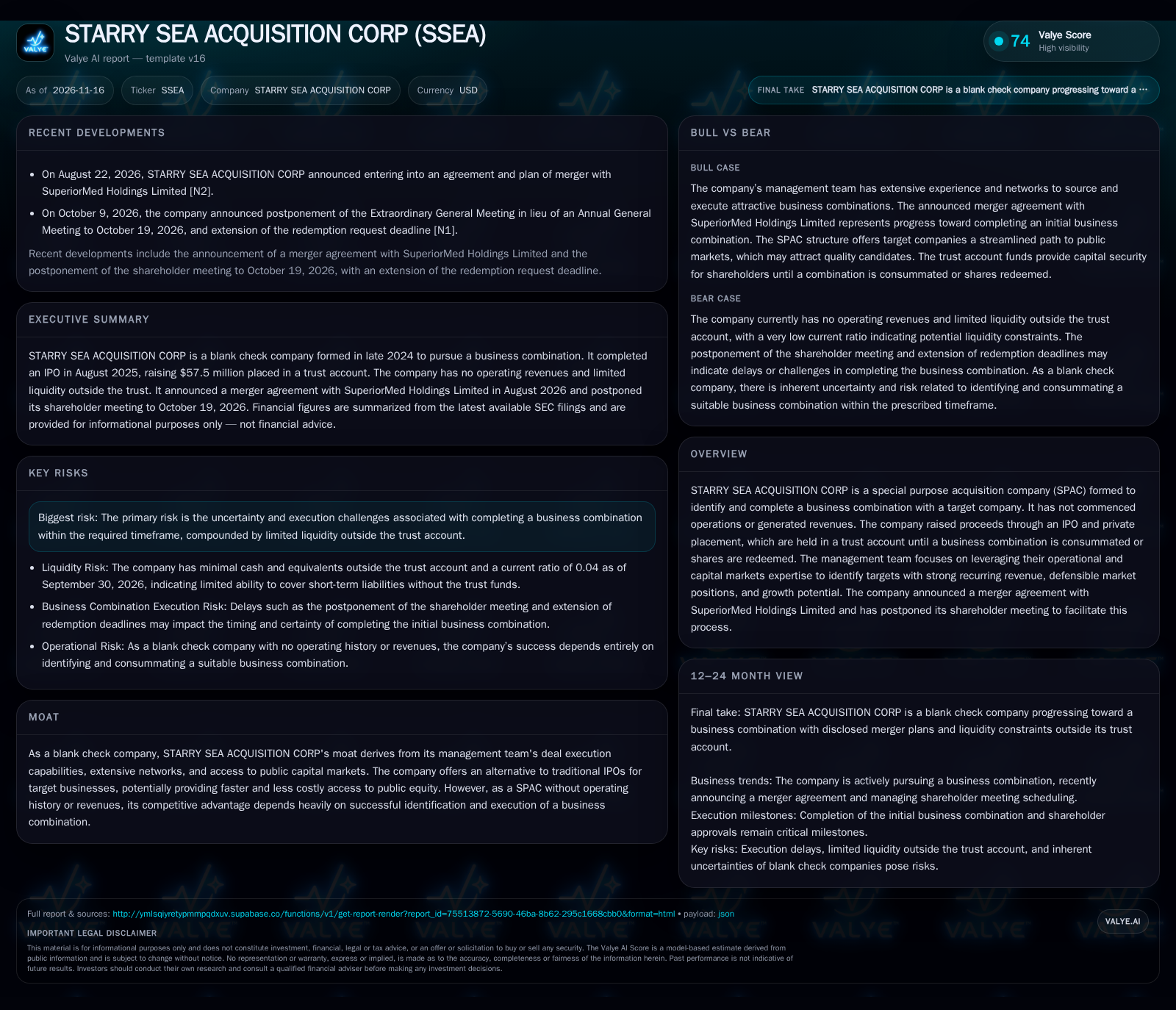
Starry Sea Acquisition Corp has reached a pivotal milestone by announcing an agreement and plan of merger with SuperiorMed Holdings Limited as of August 22, 2026 [N2]. This formally transitions the SPAC from the target search phase to deal execution, a move necessary to fulfill its core purpose. However, the company’s balance sheet outside the trust account is severely constrained: as of September 30, 2026, current assets stood at just $23,768 against $548,344 in current liabilities, yielding a current ratio of 0.04 and a cash ratio of zero [S2]. These figures highlight that, apart from the ring-fenced trust funds, Starry Sea has virtually no operational liquidity. Compounding this, the company postponed its Extraordinary General Meeting to October 19, 2026, and extended the redemption request deadline, signaling potential complexity in securing shareholder approval or managing redemption risk [N1]. These facts collectively set the stage for a high-consequence period in which execution, not capital structure, becomes the gating factor for value realization.
SPAC Economics: Trust Mechanics, Deal Costs, and the Redemptions Variable
Starry Sea’s economic model, like all SPACs, is fundamentally transactional: it raises capital via IPO, parks the proceeds in a trust account, and seeks to deploy those funds through a merger with an operating company. The $57.5 million raised is held in trust and restricted from operational use until the business combination closes or shares are redeemed [S1]. Income to date has been limited to interest on trust assets, not operating activities [S2]. The economics for shareholders now pivot on several variables: the final valuation and capitalization of SuperiorMed at closing, the level of shareholder redemptions (which directly reduce available cash and dilute the capital base), and the costs associated with deal execution, legal, and advisory fees. Should redemptions be high, the actual cash available to the combined entity post-merger could fall far below the headline trust figure, impairing growth plans and public-market credibility. The private placement by the sponsor and any forward-purchase arrangements may partially offset redemptions, but the absence of disclosed additional backstops or PIPEs raises the stakes of deal closure. If successful, the merged entity will face the challenge of transitioning from trust-funded capital to organic cash flow and public-market scrutiny.
SPACs as a Capital-Market Gateway: Differentiation and Structural Headwinds
Within the universe of SPACs, differentiation is driven less by operating assets than by management credibility, sponsor reputation, and the perceived quality of the target. Starry Sea’s team emphasizes deal execution and capital markets expertise, seeking targets with recurring revenue and defensible market positions [S1]. While this focus is standard among SPACs, success is contingent on sourcing a target that not only meets these criteria but also commands investor enthusiasm at deal announcement and closing. The alternative for private companies—a traditional IPO—remains more arduous and costly, so SPACs offer an accelerated path but at the expense of greater deal risk and post-merger volatility. Competitive pressure comes primarily from other SPACs chasing similar targets and from direct listings or strategic buyers. The recent postponement of the shareholder meeting could signal challenges in navigating this competitive landscape, especially if investor sentiment toward de-SPAC transactions is cautious or redemption-prone. Ultimately, Starry Sea’s competitive position will be defined by the perceived attractiveness of SuperiorMed as a public company and the team’s ability to structure a deal resilient to market and redemption risk.
If Redemptions Are Low and SuperiorMed Delivers: The Path to Value Creation
The most favorable outcome for Starry Sea shareholders unfolds if redemptions are modest, leaving the majority of the $57.5 million trust intact to capitalize SuperiorMed at closing. In this scenario, the combined company would benefit from an immediate public listing, fresh capital to fuel growth, and access to the liquidity and branding advantages of public markets. If SuperiorMed possesses the recurring revenue, growth profile, and defensible market position that management seeks, the public listing could unlock multiple expansion and enable further capital raises. Confirmation of this scenario would come from low redemption rates at the shareholder meeting, timely completion of the merger, and strong initial trading liquidity and valuation for the de-SPACed entity. Falsification would occur if redemptions consume most of the trust, if the merger fails to close, or if post-merger trading signals lack of investor confidence.
Merger Closes with Significant Redemptions and Integration Hurdles
The most plausible near-term outcome is that the merger with SuperiorMed proceeds, but with a substantial portion of public shareholders opting to redeem their shares. The merged entity would then need to pivot quickly to generate operating cash flow, secure alternative financing, or manage with a leaner balance sheet. Evidence supporting this scenario would include redemption rates typical of recent SPAC transactions (often exceeding 50%), timely but subdued shareholder approval, and a post-merger entity trading near trust value with reported liquidity position. Falsification would be indicated by either an inability to close the deal due to excessive redemptions or by a surprisingly robust market response that enables additional capital infusions and a higher trading multiple.
Deal Failure or Severe Capital Erosion: Structural Risks Materialize
The most adverse chain occurs if the merger is delayed further or fails to close, whether due to regulatory, shareholder, or target-specific issues. Alternatively, even if the deal closes, severe redemptions could strip SuperiorMed of the cash needed to execute its growth strategy, leaving the public entity undercapitalized and potentially subject to a value-destroying downward spiral. Confirmation of this scenario would come from repeated postponements of shareholder meetings, public disclosures of high redemption intent, or regulatory complications. Post-merger, anemic trading, lack of analyst coverage, or immediate capital-raising needs would further signal that the SPAC structure has failed to deliver durable value. Falsification would require both deal completion and evidence of sufficient retained capital and market acceptance.
Milestones and Metrics That Will Decide the Fate of Starry Sea’s SPAC Thesis
Final redemption rate at the postponed shareholder meeting—this will determine the true amount of capital delivered to SuperiorMed and the viability of post-merger operations.
Timeliness and outcome of the rescheduled shareholder vote—delays or failed approval would signal execution risk or lack of investor support.
Disclosure of any PIPE (private investment in public equity) or additional financing to supplement the trust funds—if disclosed, this would indicate management’s ability to backstop redemptions.
SuperiorMed’s post-merger operating metrics (revenue growth, profitability, cash burn)—these will be crucial for public-market credibility and valuation, once available.
Trading volume and price relative to trust value in the weeks following de-SPACing—persistent discounting would indicate market skepticism.
Management’s communication around integration plans, cost structure, and growth strategy—clear, credible plans would support thesis validation.
Any regulatory or legal complications disclosed prior to closing—such developments could derail or delay the transaction.
A useful metric would be the combined company’s ability to raise additional capital post-merger, as this would test both market confidence and the durability of the business model.
Disclaimer: This is research-only, informational analysis and not investment advice. It may include AI-generated interpretation and general industry context. Always verify important details using primary sources.

Comments