
Stellar V Capital Corp.: SPAC Timelines, Cash Trust Dynamics, and the Execution Imperative
With its IPO proceeds sequestered in a trust and no target yet identified, Stellar V Capital Corp. faces a narrowing window to secure and execute a business combination before mandatory redemption. The thesis now pivots on the interplay between management sourcing acumen, market conditions, and the structural realities of SPAC economics.
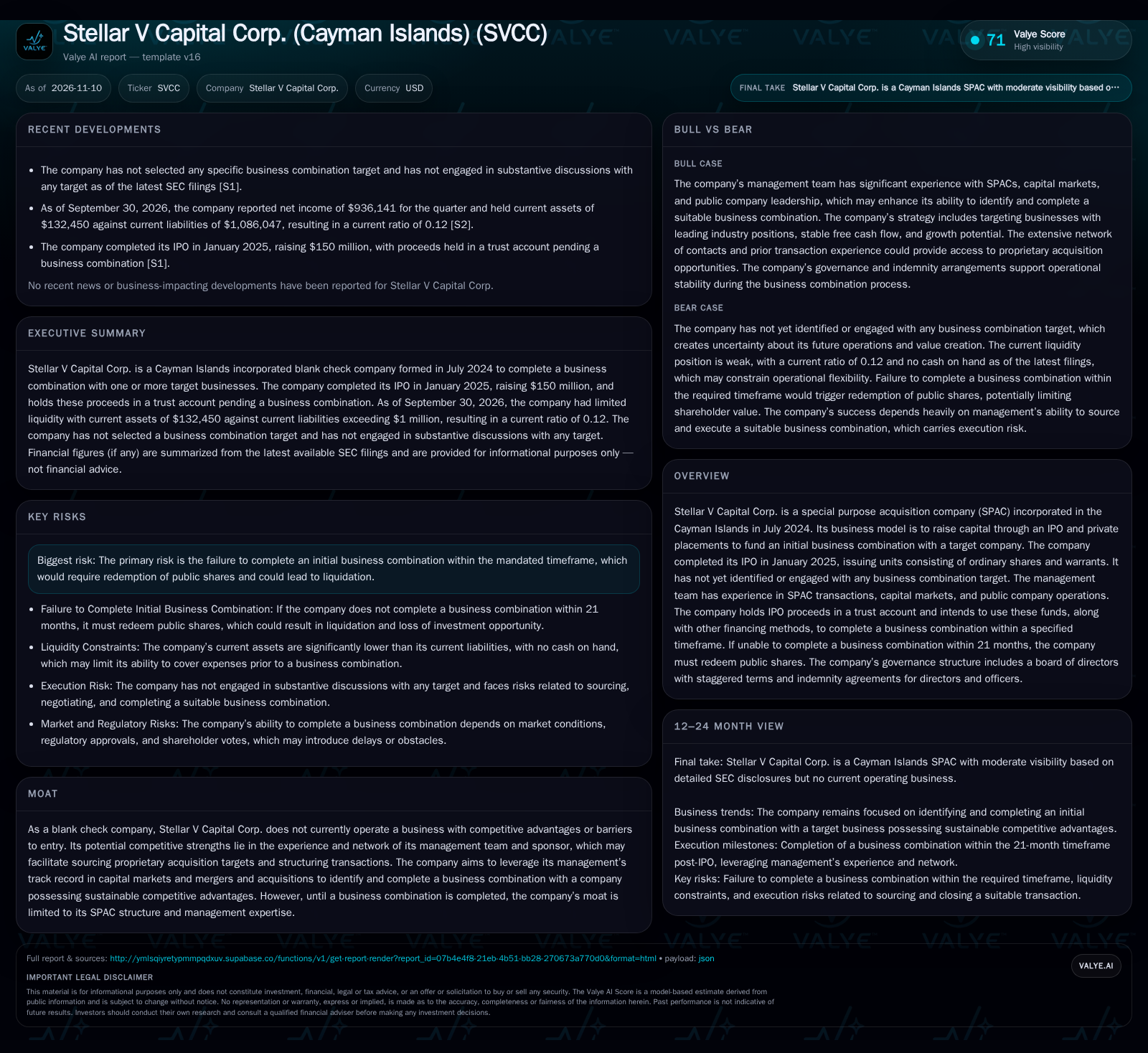
Stellar V Capital Corp. is a Cayman Islands-based SPAC with $150 million in trust from its January 2025 IPO and no operating business or identified acquisition target as of November 2026. The outcome depends on management’s ability to source and close a value-creating deal before trust redemptions erode capital or time expires. [S1] [S2]
Stellar V Capital Corp. exemplifies the modern SPAC dilemma: a substantial pool of investor capital held in trust, a management team with relevant transaction experience, and a strict timeline to deliver a business combination—all while facing mounting execution risk. With just months remaining before its 21-month deadline and no acquisition target identified, Stellar V’s future now hinges entirely on its ability to rapidly source and close a compelling deal. The trust structure protects investor principal but also limits operational flexibility, making this a pure execution and timing test for the management team.
IPO Proceeds in Trust and the Countdown to a Deal
Stellar V Capital Corp. completed its IPO in January 2025, raising $150 million through the sale of 15 million units at $10.00 each. These proceeds, along with a $5.55 million private placement, are held in a U.S.-based trust account, as is standard for SPACs. As of September 30, 2026, the company has not identified or entered substantive discussions with any acquisition target. Its current assets stand at $132,450—far below its $1,086,047 in current liabilities—resulting in a current ratio of just 0.12. The company reported net income of $936,141 for the quarter, entirely from interest on trust assets, but has no operating business or revenue. If a business combination is not completed within 21 months of the IPO (roughly by October 2026), the company must redeem public shares, returning the trust proceeds to investors. [S1] [S2]
The trust account structure, while safeguarding investor principal, inherently limits the SPAC's operational agility. Since the IPO proceeds cannot be accessed for day-to-day expenses or deal-related costs, Stellar V must rely on minimal working capital outside the trust for legal fees, advisory services, and due diligence activities. This constraint creates a delicate balance: management must judiciously allocate scarce resources to maintain deal momentum without prematurely exhausting cash reserves. Additionally, the fixed timeline intensifies pressure to not only identify targets but also to conduct thorough evaluations within compressed windows, increasing execution risk and the potential for suboptimal deal terms.
SPAC Economics: Trust Interest, Sponsor Incentives, and Deal-Driven Value Creation
SPACs like Stellar V generate no operating revenue prior to a business combination. Their economics depend on two phases: pre-deal (where trust funds earn interest, typically benefiting public shareholders) and post-deal (where future value is contingent on the success of the acquired business). The sponsor typically receives a 'promote'—often 20% of post-merger equity—provided a deal closes. Operating costs, such as legal, compliance, and due diligence, must be funded from minimal cash outside the trust, creating an incentive to close a deal before liabilities outpace available resources. Importantly, the trust cannot be used for ordinary expenses, so liquidity is structurally tight. If no deal is completed, the sponsor loses its investment and promote, while public shareholders are made whole via trust redemption. The economics for all parties are thus highly asymmetric: minimal downside for public investors (barring opportunity cost), but significant binary risk for sponsors and warrant holders.
The sponsor's incentive alignment is a critical factor influencing deal quality and timing. Since the sponsor typically earns its promote only upon deal completion, there is a strong motivation to close a transaction before the deadline, even if it means accepting less favorable terms or targets with higher risk profiles. Conversely, public shareholders benefit from downside protection via trust redemptions, creating a tension between sponsor urgency and shareholder value preservation. Furthermore, the inability to use trust funds for operational expenses means sponsors often must invest their own capital upfront, heightening their financial exposure and potentially influencing deal selectivity and negotiation leverage.
Crowded SPAC Field and the Challenge of Sourcing Quality Targets
Stellar V operates in a highly competitive SPAC environment, with dozens of blank-check companies seeking attractive merger targets. The key differentiator for any SPAC is its management team’s deal-sourcing capabilities, industry connections, and reputation for closing transactions. However, with many SPACs chasing a finite pool of suitable targets—especially those with scale, growth potential, and public-market readiness—pricing can be bid up, and less desirable targets may dominate the remaining pipeline. Traditional private equity, direct listings, and strategic acquirers also compete for these assets, often offering more certainty or operational synergies. Stellar V’s management brings SPAC and capital markets experience, which could help, but until a deal is announced, there is no clear competitive advantage beyond the standard SPAC structure.
In a saturated SPAC market, differentiation hinges on proprietary deal flow and sector specialization. Management teams with deep industry expertise and established networks can access off-market opportunities less visible to competitors, potentially securing targets at more attractive valuations. However, as the SPAC lifecycle advances, the pool of high-quality, unexploited targets diminishes, increasing the likelihood of bidding wars and inflated valuations. This dynamic can erode potential returns and complicate shareholder approval. Additionally, the rise of alternative capital-raising avenues, such as direct listings or private placements, reduces the attractiveness of SPAC mergers for certain companies, further constraining the target universe.
Rapid Target Identification and a High-Quality Merger Could Unlock Value
A favorable outcome hinges on Stellar V’s management leveraging its network to quickly identify a compelling private company—ideally one with established revenues, defensible margins, and a clear path to public-market growth. If such a target is found and a deal is structured with attractive terms for both the acquired company and public shareholders, Stellar V could complete its business combination before the redemption deadline. Confirmation would come from a public deal announcement, positive market reaction, and limited redemption of shares at merger close (indicating investor approval and confidence). Additional evidence would include robust post-merger projections, sponsor alignment (e.g., rolling equity), and the target’s ability to secure PIPE (private investment in public equity) or other financing, if needed, to support growth.
Most Likely: Deal Pressure Rises as Deadline Nears, With Mixed Outcomes
The most plausible scenario is that Stellar V, like many SPACs approaching their deadline, accelerates its search in the final months. This could result in the announcement of a business combination with a mid-tier or opportunistic target, possibly at less favorable terms due to compressed timelines. The deal may or may not close, depending on due diligence, regulatory approvals, and shareholder redemptions. Confirmation of this scenario would be a late-cycle deal announcement, a significant portion of shares redeemed at closing (reflecting tepid investor conviction), and a post-merger entity facing typical integration and market challenges. Falsification would require either a high-quality, early-announced deal or a deliberate decision to liquidate and return capital, signaling discipline over deal-for-deal’s-sake.
Failure to Secure a Deal Triggers Redemption and Sponsor Loss
The adverse case is that Stellar V fails to identify or close a suitable business combination within the mandated 21-month window. In this event, the company would redeem public shares, returning trust proceeds to investors and liquidating the SPAC. The sponsor and warrant holders would lose their at-risk capital and promote, and the company would cease to exist. Confirmation would come from a formal liquidation announcement, no deal activity in the final months, and the return of trust funds to public shareholders. Signs of this scenario could include persistent lack of deal news, rising administrative liabilities, or disclosures about the infeasibility of closing a transaction under current market or regulatory conditions.
Milestones That Will Determine Whether Stellar V Delivers Shareholder Value
Announcement of a definitive agreement with a business combination target, including details on sector, scale, and financials.
Level of shareholder redemptions at the time of business combination closing—a low redemption rate would suggest investor confidence.
Execution of any additional PIPE or side financing to backstop redemptions or provide growth capital to the post-merger entity.
Updates on the company’s remaining timeline relative to its 21-month merger deadline.
Sponsor’s willingness to forgo or restructure their promote in the event of high redemptions—if disclosed.
Material changes in administrative expenses or liabilities that could impact the ability to operate until deal close or liquidation.
Regulatory or market developments that affect SPAC dealmaking or target company readiness for public markets.
Disclaimer: This is research-only, informational analysis and not investment advice. It may include AI-generated interpretation and general industry context. Always verify important details using primary sources.

Comments