
BlackRock TCP Capital's 2025 Decline Reflects Debt Portfolio Revaluation and Middle-Market Credit Risks
The company’s 2025 results show challenges in net income amid stable cash flows and ongoing portfolio risks.
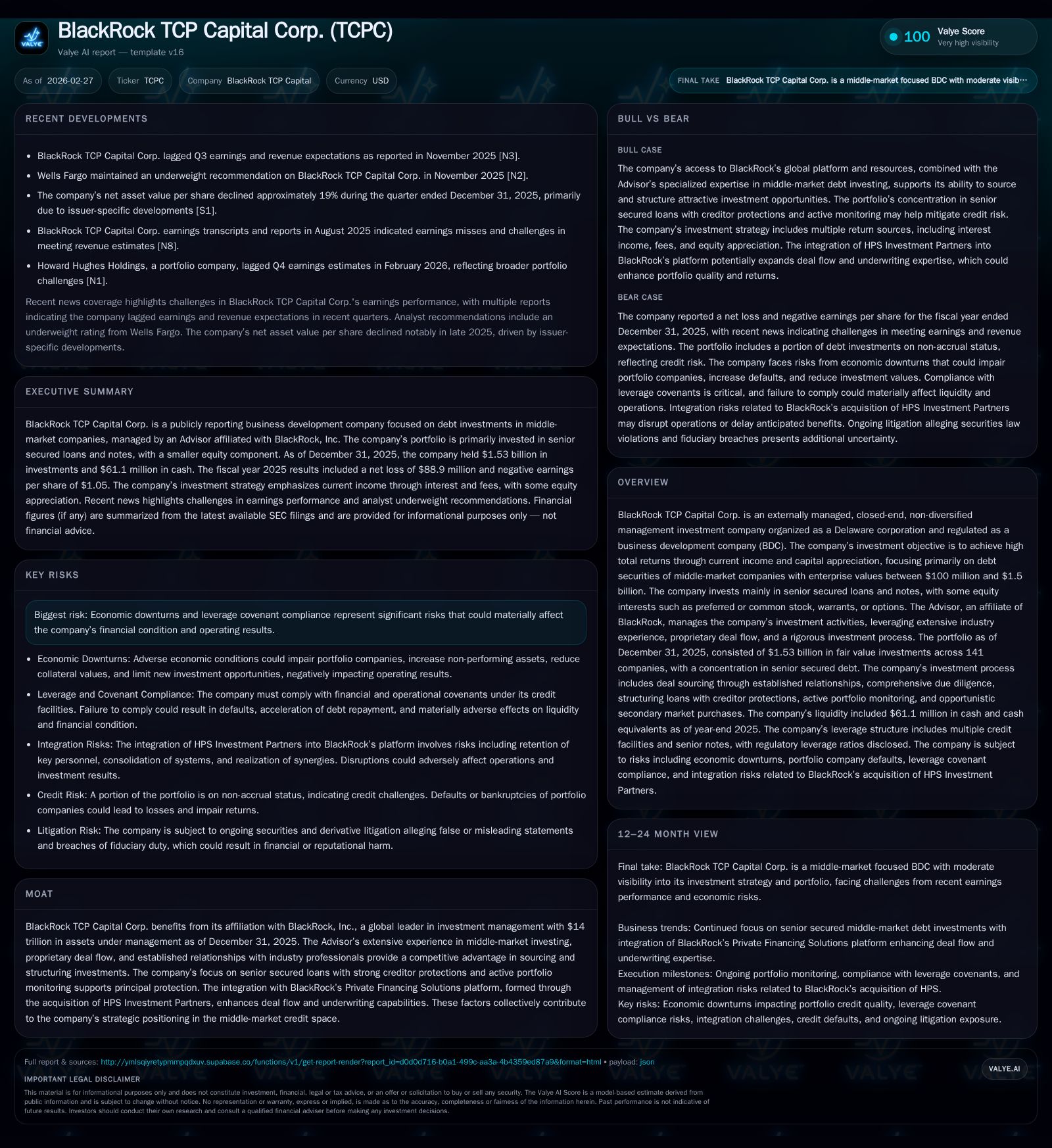
BlackRock TCP Capital Corp. experienced a sharp decline in net income in 2025, driven largely by unrealized losses or credit revaluations in its middle-market debt portfolio despite generating solid operating cash flow. The firm maintains a focus on senior secured loans to middle-market companies, leveraging BlackRock’s resources and deal flow advantages. Key risks include economic downturns impacting borrowers’ covenant compliance and potential legal liabilities from ongoing litigation. Dividend payments remain healthy relative to earnings, underscoring the importance of cash flow management for sustaining distributions.
Company Overview
BlackRock TCP Capital Corp. ("the Company" or "TCPC") is an externally managed, closed-end business development company (BDC) focused on generating high total returns via current income and capital appreciation. Its core investment activity centers on debt securities issued by middle-market U.S. companies—those typically sized between $100 million and $1.5 billion enterprise value. TCPC predominantly invests in senior secured loans and notes, while also taking equity-linked positions such as preferred stock or warrants when opportunistic. The Company's Advisor is a wholly-owned subsidiary of BlackRock, Inc., whose global scale ($14 trillion AUM as of December 31, 2025) amplifies sourcing capabilities and analytical resources.
Historical Performance and Drivers
The company’s financial performance over recent years reveals notable volatility influenced by its credit-cycle-sensitive portfolio.
Historical performance (annual)
| FY | Net ($mm) | CFO ($mm) | Net YoY |
|---|---|---|---|
| 2025 | -89 | 155 | -40.9% |
| 2024 | -63 | 293 | -264.1% |
| 2023 | 38 | 92 | +517.1% |
| 2022 | -9 | 204 |
Source: SEC companyfacts cache [F1].
Capital returns and efficiency (annual)
| FY | Div ($mm) | Buybacks ($mm) | ROE% |
|---|---|---|---|
| 2025 | 95 | 3 | -14.9 |
| 2024 | 123 | 5 | -8.0 |
| 2023 | 101 | 5.6 | |
| 2022 | 70 | -1.2 |
Source: SEC companyfacts cache [F1].
Net income plummeted into negative territory in both FY2024 and FY2025 after a profitable FY2023, evidencing significant valuation adjustments likely tied to increased credit risk or mark-to-market declines within the middle-market loan portfolio [F1]. Notwithstanding this, operating cash flows remained positive and sufficiently strong to cover dividends.
Dividend payments grew steadily until peaking in FY2024 before declining slightly in FY2025 but still representing substantial capital return to shareholders relative to earnings [F1]. Purchase of shares for treasury remains marginal relative to dividends paid.
Investment Portfolio Composition
As of December 31, 2025, the consolidated investment portfolio fair value stood at approximately $1.53 billion distributed among 141 portfolio companies [S14]. Approximately 92.5% of these investments are debt instruments with nearly 89% specifically allocated to senior secured loans — considered less risky due to creditor protections via lien coverage on underlying assets [S14].
This seniority position inherently supports principal protection objectives but does not immunize the Company from defaults or mark-to-market volatility during economic downturns.
Advisor Advantages and Investment Process
Managed by BlackRock’s affiliate Advisor—an experienced middle-market investor with capabilities spanning origination through trading—the Company leverages proprietary deal sourcing channels cultivated via relationships with investment bankers, corporate executives, lenders, restructuring professionals, and private equity sponsors [S21].
Deal structuring focuses heavily on securing strong creditor protections including security interests on borrower assets alongside contractual governance rights such as board observer seats where warranted [S16]. This conservative underwriting stance seeks to balance return enhancement with downside risk mitigation.
Active monitoring of portfolio companies' financial health allows for timely intervention when covenant breaches or adverse developments emerge—a critical feature given the industry exposure embedded in mid-sized enterprises vulnerable to economic cycles [S16].
Capital Structure and Leverage Program
TCPC operates several credit facilities aggregating well over $1 billion:
- Operating Facility: revolving multi-currency credit line up to $300 million (extendable with accordion feature).
- Funding Facility II: senior secured revolving credit facility up to $200 million.
- Merger Sub Facility: assumed revolver originally issued at $265 million capacity.
- Senior unsecured notes: totaling $650 million split into maturities in 2026 ($325 million) and 2029 ($325 million).
- SBA Debentures: up to $111 million committed leverage under small business regulatory programs.
The maturity profile stretches primarily into late-decade timelines offering funding flexibility. However, all facilities impose strict covenants on asset coverage ratios, indebtedness levels relative to equity, dividend distributions, lien incurrence, and minimum equity thresholds that must be complied with lest lenders accelerate repayment obligations or seize collateral .
Recent amendments have updated interest benchmarks replacing LIBOR references with SOFR plus margins hovering between approximately 1.75%-2%, reflecting prevailing market conditions for middle-market credit spread costs post-pandemic era rate normalization .
Risks Highlighted by Management
The Company discloses material risks centered around economic downturns impairing portfolio company ability to service debt leading to elevated non-performing assets affecting valuations adversely [S2]. Covenant compliance failure poses additional liquidity constraints potentially triggering cross-defaults across financing facilities.
Ongoing legal proceedings related to alleged fraud in third-party collateralized loan obligation investments expose the Company to uncertain monetary liabilities potentially exceeding millions — litigation is currently pending without estimated loss provisions [S18]. Additionally, recent shareholder lawsuits allege misleading disclosures although deemed without merit by management thus far [S22].
Market sensitivities tied to trade tariffs affecting certain industries also add macro risk layers that may cascade into borrower operational challenges impacting loan performance [S2].
Dividend Policy & Capital Allocation
Though reporting net losses recently, TCPC has maintained sizable annual dividend distributions near $95-$122 million range over the last two fiscal years supported by solid operating cash flow generation (>$150 million FY25) evidencing a reliance on cash flows rather than earnings for payout sustainability [F1,S20,S23].
Repurchase activity has been minimal suggesting priority allocation toward distributions over buybacks reflecting typical BDC behavior balancing shareholder yield expectations versus capital preservation amid volatile earnings.
Future Growth Prospects & Considerations
Growth drivers hinge substantially on continued access to proprietary middle-market deal flow enabled by BlackRock’s expansive platform integration with HPS Investment Partners—which broadens underwriting capacity and deal origination expertise beyond TCPC's standalone reach [S27].
While current market conditions pose credit stress risks that could throttle earnings ahead if defaults rise materially or refinancing conditions tighten significantly—particularly during prolonged Federal Reserve tightening cycles—TCPC's conservative underwriting standards focused on senior secured positions underpin resilience potentials if macro environment stabilizes or improves moderately.
Close monitoring of leverage covenant compliance remains critical given the relatively high leverage levels permissible under new regulatory asset coverage regulations permitting up to a two-to-one debt-to-equity ratio versus historical one-to-one limits [S11,S12]. Heightened scrutiny is needed around portfolio concentration risks since the top five investments make up roughly a quarter of total assets which can exacerbate volatility impacts if one or more underperforms significantly [S14].
Absent explicit guidance publicly disclosed on milestones or forecasted returns for subsequent periods—investors should watch key indicators such as portfolio non-accrual rates evolution, covenant compliance headroom summaries following quarterly reporting cycles, legal resolution progress updates, and changes in dividend policies reflecting underlying cash generation trends.
Conclusion
BlackRock TCP Capital Corp.'s recent performance illustrates the dichotomy faced by many BDCs specializing in middle-market debt markets: meaningful operating cash flow sustains distributable yields even amid accounting losses linked predominantly to mark-to-market depreciation sensitive to worsening credit conditions.
The company leverages BlackRock’s formidable investment platform for sourcing proprietary deals supported by deep underwriting expertise emphasizing senior secured structures aiming for principal preservation despite unpredictable macroeconomic cycles impacting borrower fundamentals. However, legal uncertainties alongside leverage covenant risks demand vigilant operational oversight through upcoming quarters. Dividend continuity depends heavily on maintaining asset quality and liquidity access more so than bottom-line profitability presently. Future trajectory will be shaped by macroeconomic developments influencing credit defaults as well as successful deployment of sourced opportunities through enhanced underwriting capabilities post-BlackRock/HPS merger integration.
This report is for informational purposes only and does not constitute investment advice or recommendations regarding any securities discussed herein.
Disclaimer: This is research-only, informational analysis and not investment advice. It may include AI-generated interpretation and general industry context. Always verify important details using primary sources.

Comments