
Truist Financial’s Transformation: From Model-Driven Risk to Capital Discipline
Examining how Truist’s AI-enabled risk models and diversified financial platform shape its growth, risk management, and capital returns.
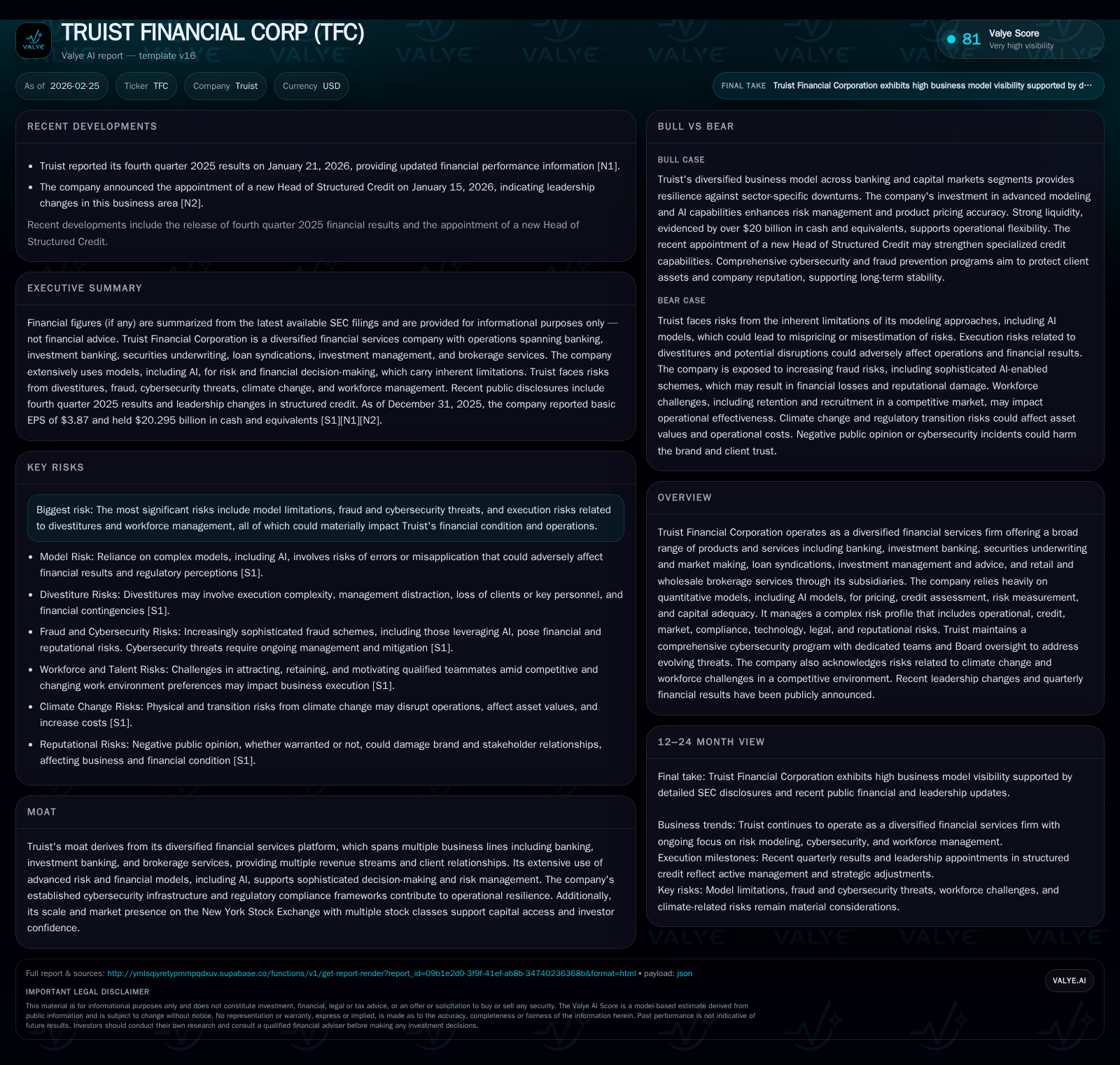
Truist Financial Corp has evolved its business leveraging sophisticated AI-driven quantitative models for underwriting, pricing, and capital adequacy to support a multi-line platform spanning banking, investment banking, and brokerage services. While operating cash flow surged notably in FY25, the bank grapples with subdued ROE largely impacted by goodwill impairments. Its comprehensive cybersecurity and fraud risk framework based on industry-tailored NIST protocols underpins operational resilience amid an intensifying threat landscape. Recent leadership additions targeting structured credit signal strategic growth focus, even as execution risks from ongoing divestitures and the limitations inherent in complex model usage persist.
Historical Earnings Momentum: Model Reliance and Financial Performance Trends
Truist Financial has demonstrated dynamic shifts in its financial performance over recent years, heavily influenced by its sophisticated adoption of AI-powered quantitative models. These models underpin critical functions such as loan underwriting, credit grading, product pricing, market risk measurement, and capital adequacy evaluation [S4][S15].
Operating cash flow (CFO) is a pivotal indicator of Truist's earnings quality and operational leverage. After peaking above $11 billion in FY22, CFO retrenched significantly to $8.63 billion in FY23 before bottoming near $2.16 billion in FY24. However, FY25 saw a remarkable rebound with CFO surging to approximately $5.74 billion—a 165.2% year-over-year increase indicating an operational recovery or working capital recalibration [F1].
Capital expenditures followed a different trajectory: after elevated levels around $564 million in FY22 (up 27.6% YoY), Capex’s absolute impact diminished relative to CFO expansion by FY25 as the firm managed investment priorities amid technological upgrades supporting AI deployment [F1].
Despite these positive cash flows, Truist's reported return on equity (ROE) remains anomalously low at ~0.3% as of FY25 (using trailing annual net income relative to stockholders’ equity of $65.19 billion) [F1]. This unusually weak ROE reflects substantial legacy goodwill impairments ($6.1 billion non-cash charge recorded in 2023) that inflate the equity base without corresponding earnings power [S10]. This impairment distorts capital efficiency metrics but also highlights the challenge of integrating acquisitions profitably.
Additionally, Truist's diversified revenue streams across commercial banking, securities underwriting, asset management advisory services, and brokerage create a complex earnings base that affords cross-selling opportunities but also entails exposure to diverse operational and market risks [S11].
Historical performance (annual)
| FY | CFO ($bn) |
|---|---|
| 2025 | 5.7 |
| 2024 | 2.2 |
| 2023 | 8.6 |
| 2022 | 11.1 |
Note: Omitted columns lack sufficient annual XBRL coverage in the provided tags (need ≥2 annual points): Rev, Net, OpInc, Capex, FCF, ROE%. Source: SEC companyfacts cache [F1].
Capital returns and efficiency (annual)
| FY | Div ($bn) | Buybacks ($bn) |
|---|---|---|
| 2025 | 2.7 | 2.5 |
| 2024 | 2.8 | 1.0 |
| 2023 | 2.8 | 0.0 |
| 2022 | 2.7 | 0.3 |
Source: SEC companyfacts cache [F1].
Note: Net income series data insufficient for inclusion; Capex exact FY24/FY25 figures unavailable from tags.
Evolving Risk Landscape: Cybersecurity, Fraud, and Operational Challenges
Operating in a hyper-connected financial ecosystem exposes Truist to an evolving risk environment characterized by technical sophistication in cyberattacks and fraud schemes [S20][S21][S9]. Truist’s Corporate Information Security Program embraces a risk-based cybersecurity framework anchored on the Cyber Risk Institute Cyber Profile—a tailored application of the National Institute of Standards and Technology (NIST) Cybersecurity Framework that is considered sector best practice.
The firm operates dedicated Cyber Fusion Centers providing continuous threat detection and response capabilities with escalation protocols extending up to the board level via joint oversight committees integrating Enterprise Risk Management (ERM) functions [S20][S26]. This layered governance includes regular risk assessments through simulations designed to validate control effectiveness against emergent threats such as machine learning-assisted fraud attacks.
Fraud risks are compounded by increasingly sophisticated AI-enabled schemes targeting real-time payments rails such as Automated Clearing House (ACH), wire transfers, and peer-to-peer platforms [S9]. Malicious actors exploit AI to create realistic synthetic identities or manipulate authentication processes requiring constant refinement of detection algorithms.
Mandatory internal training programs enhance employee vigilance while third-party service provider cybersecurity practices are stringently monitored through risk-based vendor assessments [S23]. Through these measures Truist reported no material cybersecurity breaches impacting results through fiscal year-end 2025 but underscores that threat severity is expected to rise with technology evolution.
Strategic Growth Catalysts: Diversified Services and Leadership Changes
True to its moat as a diversified financial services provider, Truist spans banking operations alongside robust investment banking advisory and securities underwriting units amplified by retail and wholesale brokerage channels [S11]. This diversification stabilizes revenue streams within shifting market conditions.
Notably, the firm's appointment of a new Head of Structured Credit underscores an intensified focus on expanding credit markets expertise—a core competency promising higher-return lending opportunities beyond traditional frameworks [N2]. This leadership addition signals strategic rebalancing towards areas of complexity where automated credit assessment models can unlock nuanced pricing benefits.
However, diversification introduces tradeoffs: divestiture activities pursued to streamline core competencies pose execution complexities from client retention risks to integration costs potentially perturbing existing client relationships if not meticulously managed [S1][S13].
Capital Allocation Dynamics and Shareholder Returns
Capital allocation practices at Truist reveal tension between maintaining buffer equity levels—amplified by prior goodwill write-downs—and shareholder return initiatives.
Dividends have remained relatively stable around $2.7 billion annually over recent years signalling commitment to yield consistency despite earnings pressures [F1]. Meanwhile, share repurchases accelerated from $250 million in FY22 to $1 billion in FY24 then sharply upscaled to $2.5 billion in FY25 following Board authorization of an unlimited repurchase program replacing older mandates [F1][S7].
This pattern suggests management confidence in free cash flow generation capacity—estimated at nearly $5.17 billion in FY25 after deducting capex —and reflects intent to optimize capital structure amid regulatory constraints [F1][S8]. Nevertheless low ROE (~0.3%) spotlights ongoing challenges translating scale into economic profitability given impaired assets inflating equity without commensurate net income contribution.
Forecasting Milestones and Key Performance Indicators to Monitor
Explicit formal guidance remains absent from public disclosures; however observers should track several leading indicators reflective of Truist’s strategic trajectory:
- Operating Cash Flow trends elucidate underlying business momentum beyond accrual accounting measures;
- Loan portfolio evolution particularly within structured credit reflecting effectiveness of new leadership initiatives;
- Cybersecurity incident reports providing insight into resilience amidst escalating digital threats;
- Model risk assessments capturing recalibrations necessitated by novel data patterns or regulatory reviews;
- Progress on announced divestitures including successful closures without material disruption.
Attention should also be given to potential regulatory developments or litigation outcomes chronicled under legal proceedings disclosures which may influence financial outlooks or necessitate revisions in operational priorities [N1][S4][S3].
Risks Around Divestitures and Technological Disruptions
Executing divestitures introduces operational vulnerabilities ranging from transaction closing uncertainties—regulatory approvals or financing conditions—to client attrition risks during transitional phases [S13]. Such events could distract management focus or fracture business synergies critical for seamless service delivery.
Moreover technological dependencies compound model-related risks: given Truist’s reliance on AI-based models for core decisions—from pricing loans to calculating economic capital—any flaws stemming from erroneous data inputs, obsolete assumptions, or rapid market regime shifts could distort risk profiles or lead to unexpected losses [S5]. The company acknowledges these embedded risks transparently emphasizing ongoing monitoring mechanisms.
Conclusion: Sustainability of Truist’s Competitive Advantages
Truist Financial stands at the intersection of complex model-driven decision frameworks powered by artificial intelligence and traditional capital-intensive banking operations that require discipline amid structural challenges such as impaired goodwill valuations impacting returns.
Its broad-spectrum financial services platform affords diversified revenue stability while advanced cybersecurity governance built upon recognized sector frameworks ensures fortification against rising digital threats.
Strategic investments like the recent structural credit leadership appointment indicate forward-looking growth aspirations although execution risks remain palpable especially concerning divestiture activities and technological model limitations.
For stakeholders analyzing Truist’s prospects, continued vigilance on evolving operating cash flows, cyber incident trends, regulatory developments, and balance sheet health will be crucial markers underlying this transformation journey balancing model sophistication with prudent capital stewardship.
Disclaimer: This analysis is based solely on documented public disclosures including SEC filings and verified news releases as of early 2026 without any speculative judgments or investment recommendations.
Disclaimer: This is research-only, informational analysis and not investment advice. It may include AI-generated interpretation and general industry context. Always verify important details using primary sources.

Comments