
BOA Acquisition Corp. II: Navigating the SPAC Lifecycle Amid Financial Constraints
As a Cayman Islands-based SPAC with no operating business, BOA Acquisition Corp. II’s future hinges on completing a value-accretive acquisition. Its current financial state and structural mechanics frame a narrow but critical runway for shareholder value creation.
BOA Acquisition Corp. II operates as a blank check vehicle with no revenues and liabilities exceeding cash resources as of mid-2026. Its economics depend entirely on securing and closing a promising merger target, leveraging its public listing and capital raised through IPO and over-allotment exercises. The absence of internal operations or assets imposes significant execution risk, while competitive advantage will derive solely from the quality and moat of the acquired business. Investors should focus on the company’s ability to source deals, maintain regulatory compliance, and manage liquidity as key indicators of near-term viability.
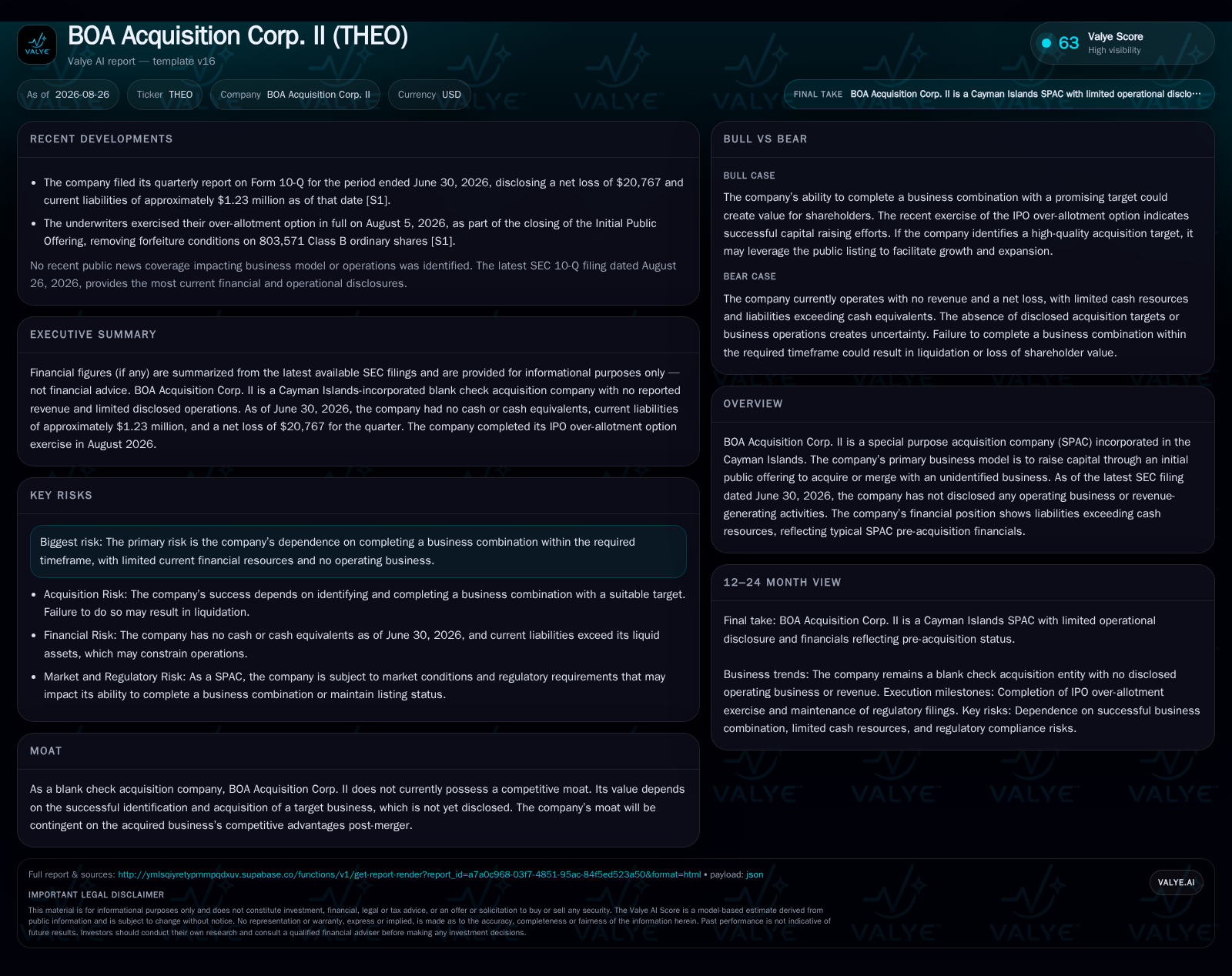
BOA Acquisition Corp. II exemplifies a Cayman Islands-incorporated SPAC that has successfully closed its IPO and over-allotment tranche but remains in a pre-acquisition state with no disclosed operating business. Its balance sheet as of June 30, 2026, shows no cash and liabilities exceeding liquid assets, typical for SPACs before completing a business combination [S1]. The company’s future financial trajectory and investor returns depend critically on its ability to identify and consummate a strategic acquisition that delivers scalable growth and sustainable competitive advantages. Meanwhile, its current financial structure and lack of operating leverage expose it to execution and regulatory risks that require close monitoring.
Latest Operating Snapshot
As of June 30, 2026, BOA Acquisition Corp. II reported zero cash or cash equivalents alongside current liabilities totaling approximately $1.23 million, underscoring its fragile liquidity position typical of pre-merger SPACs [S1]. The company also recorded a net loss of $20,767 for the quarter and $51,370 for the first half of 2026, reflecting ongoing administrative and financing expenses absent operational revenue streams [S1].
A key recent development was the full exercise of the IPO over-allotment option on August 5, 2026, removing forfeiture conditions on 803,571 Class B ordinary shares and signaling successful capital raise execution at the public listing stage [S1]. Nevertheless, no acquisition target has been announced, leaving the company in a holding pattern pending deal origination and regulatory approval.
Business Model and Unit Economics
BOA Acquisition Corp. II’s business model is that of a classic blank check acquisition vehicle: it raises capital through an IPO to seek a target company for merger or acquisition. With no internal operations or revenue-generating assets, its unit economics are fundamentally tied to deal sourcing and transaction execution rather than operating margins or volume growth. The company incurs fixed overhead costs, such as administrative expenses, legal fees, and listing costs, which contribute to net losses prior to acquisition.
Capital intensity is front-loaded into securing capital from public markets and underwriting fees. Operating leverage is absent pre-merger, as expenses do not scale with revenue but are largely fixed. Post-acquisition, leverage depends entirely on the acquired company’s business model. The SPAC’s financial performance will pivot on deal terms, purchase price allocation, and integration efficiency, rather than its own cost structure. The limited cash resources and excess liabilities increase the risk that deal delays could exhaust available capital, forcing costly equity raises or liquidation.
Moat, Competition and Counterforces
Currently, BOA Acquisition Corp. II lacks any intrinsic moat, as it holds no operating business or proprietary assets. Its competitive position depends entirely on the eventual acquired entity’s competitive advantages, such as intellectual property, scale, customer relationships, or regulatory barriers. Until a target is identified, the SPAC competes on sponsor reputation, deal structuring capabilities, and access to capital relative to other blank check vehicles.
Competition arises from numerous other SPACs and traditional private equity firms vying for attractive acquisition targets. The crowded SPAC market can compress acquisition multiples and raise valuation expectations, making it challenging to secure deals that balance shareholder value creation with market realities. Counterforces include regulatory scrutiny of SPAC structures and potential dilution from additional capital raises needed to support acquisitions.
Bull Case
In the bull scenario, BOA Acquisition Corp. II successfully identifies and completes a merger with a high-growth, competitively advantaged company that benefits from public market access and the sponsor’s strategic support. The capital raised through the IPO and over-allotment provides sufficient runway to execute the transaction with minimal dilution, preserving shareholder value. The acquired business’s unit economics and operating leverage unlock scalable growth and margin expansion, driving strong post-merger earnings and cash flow.
Confirming evidence would include timely announcement of a target with strong financial fundamentals, clear strategic rationale, and achievable integration roadmap. Early signs of robust investor demand for the post-combination equity and retention of key management would further validate this positive outlook. Falsification would occur if the company announces deals that require substantial equity raises or present questionable business models lacking defensible moats.
Base Case
The base case envisions that BOA Acquisition Corp. II completes a business combination within the prescribed timeframe, but with a target of moderate growth and competitive positioning. The acquisition provides incremental scale and public market liquidity but faces typical execution challenges such as integration costs and market skepticism. The company’s financials post-merger improve from zero revenue to operating profitability over a multi-year horizon, but shareholder returns are modest, reflecting average market valuations for similar transactions.
In this scenario, the SPAC’s current financial constraints are managed through careful cost control and deal structuring that balances dilution with capital needs. Regulatory compliance and shareholder approval processes proceed without major disruptions. Evidence supporting this scenario includes announcements of targets with proven but not exceptional growth metrics, combined with moderate investor reception. Failure to sustain operating improvements or meet regulatory milestones would undermine this projection.
Bear Case
The downside case centers on failure to complete any business combination within the regulatory deadlines or inability to raise sufficient additional capital to fund a transaction. The company’s lack of cash and liabilities exceeding liquid assets as of mid-2026 pose a material risk of insolvency or forced liquidation. Prolonged market volatility or regulatory tightening could further impede deal origination and shareholder approval, causing the SPAC to wind down and return residual value below initial investor cost.
Confirmation of this bear case would be absence of deal announcements near deadline, announcements of dilutive financings at depressed valuations, or regulatory challenges to listing status. Conversely, falsification would be evidenced by concrete deal progress, timely shareholder votes, and management demonstrating access to bridge financing or alternative capital sources.
What Matters Next
Key performance indicators to monitor include (1) announcement of an acquisition target with detailed financials and strategic rationale, (2) shareholder approval rates for any proposed business combination, (3) changes in cash and liquidity levels reflecting capital raises or expenditures, (4) regulatory filings updating progress on deal timelines and compliance, (5) developments in market conditions affecting SPAC valuations and deal appetite, (6) sponsor communications on deal sourcing and partnership prospects, (7) any announcements of alternative financing arrangements, and (8) post-merger operational metrics if a transaction completes, such as revenue growth, margin expansion, and cash flow generation.
Since the company currently discloses limited operational data, these KPIs function mainly as forward-looking milestones rather than ongoing performance metrics. Investors should pay particular attention to any changes in financial position that suggest constrained liquidity or increased dilution risk, as well as public statements from management on strategic direction.
Disclaimer: This is research-only, informational analysis and not investment advice. It may include AI-generated interpretation and general industry context. Always verify important details using primary sources.

Comments