
Tutor Perini Corp’s Revenue Surge and Project Backlog Expansion Test Execution Efficiency and Earnings Stability
Substantial revenue growth in 2025 and backlog gains underscore Tutor Perini’s expanding scale amid continued execution and risk management challenges.
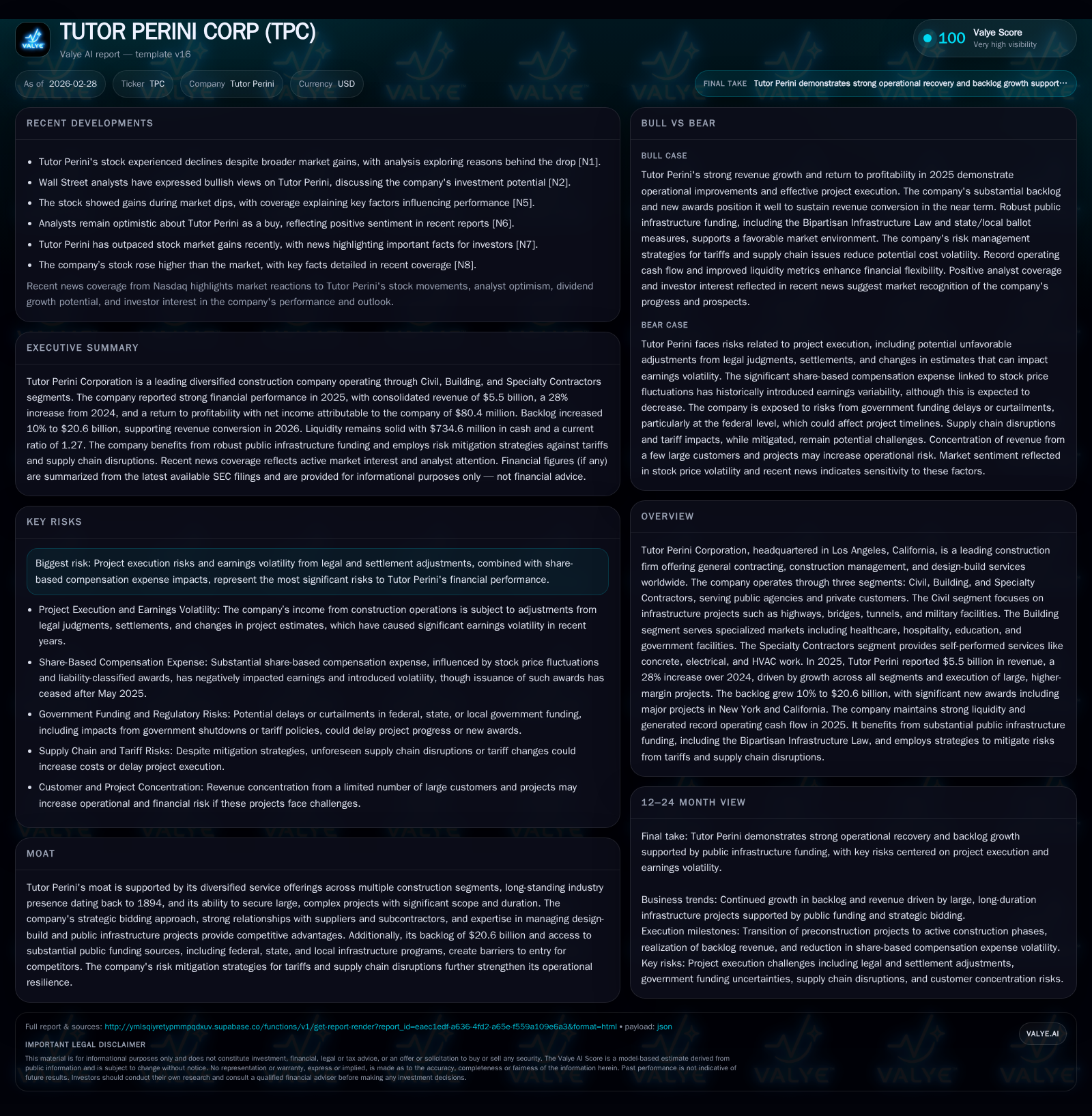
Tutor Perini Corporation reported a striking 28% revenue increase to $5.5 billion in 2025, reversing prior years of operating losses with significant improvement in construction operations income. Growth was broad-based across Civil, Building, and Specialty Contractors segments, fueled by ramp-up on large, complex projects that now constitute a $20.6 billion backlog. However, earnings volatility remains influenced by legal settlements, project adjustments, and elevated share-based compensation expenses linked to stock price volatility. Robust cash flows and deleveraging efforts improved financial flexibility, though capital expenditures surged notably due to new project-related equipment investments. Looking forward, execution on sizable projects and settlement risks will be key factors to monitor as the company realizes backlog over multiple years.
Company Overview and Historical Performance
Tutor Perini Corporation is a diversified contractor headquartered in Los Angeles, known for its general contracting, construction management, and design-build services globally. The firm operates via three main divisions—Civil (public infrastructure), Building (specialized markets including healthcare and government), and Specialty Contractors (self-performed electrical, concrete, HVAC work).
Financially, Tutor Perini demonstrated a pronounced turnaround in 2025 after consecutive years of operating losses. Revenue advanced sharply by 28% to reach $5.5 billion from $4.3 billion in 2024 [F1]. This was primarily fueled by heightened project execution of recently secured large-scale contracts with favorable margins across all segments [S1]. Enhanced operational efficiency and effective risk management helped lift construction operations income from a loss of $103.8 million in 2024 to a positive $232 million in 2025 [F1]. Meanwhile, net income swung from negative $163.7 million in 2024 to a positive $80.4 million last year [F1].
Segmental performance underscored the diverse growth drivers: Civil segment revenue rose robustly on major infrastructure projects including highways, bridges, tunnels, and military facilities; the Building segment boosted revenues mainly via healthcare expansions and correctional facility developments; Specialty Contractors sustained contributions through critical mechanical and electrical services integral to larger projects [S6][S7].
Historical performance (annual)
| FY | Net ($mm) | CFO ($mm) | OpInc ($mm) | Capex ($mm) | Net YoY |
|---|---|---|---|---|---|
| 2025 | 80 | 748 | 232 | 181 | +149.1% |
| 2024 | -164 | 504 | -104 | 37 | +4.3% |
| 2023 | -171 | 308 | -115 | 53 | +18.5% |
| 2022 | -210 | 207 | -205 | 60 |
Source: SEC companyfacts cache [F1].
Capital returns and efficiency (annual)
| FY | FCF ($mm) | ROE% |
|---|---|---|
| 2025 | 567 | 6.6 |
| 2024 | 466 | -14.4 |
| 2023 | 256 | -13.3 |
| 2022 | 147 | -14.5 |
Source: SEC companyfacts cache [F1].
Operating income recovery reflects turnaround from legacy execution challenges; capex jump evidences investment for newer projects.
Drivers Behind Past Growth
The surge in revenues is attributable chiefly to substantial ramp-up of newer large-scale projects across all segments that started gaining momentum during the year [S1][S24]. These projects typically feature higher margins due to complexity and scope enabling better absorption of fixed costs.
The Civil segment had meaningful contributions from mass transit infrastructure — transit systems and tunneling — along with bridges and detention facilities that saw recent contract awards increasing activity levels [S7][S26]. Building revenues benefited significantly from healthcare facility expansion alongside educational institutions and government buildings.
The Specialty Contractors segment's self-perform capabilities provide critical differentiated advantages enabling integrated project delivery with better cost controls — an increasingly valuable aspect amidst supply chain headwinds affecting subcontractors industry-wide [S16]. Strong vendor relationships and strategic bidding have supported project win rates despite tariff risks.
However, earnings volatility persisted due to legal settlements related to legacy disputes totaling substantial net unfavorable impacts ($61.8 million in 2025 vs $45.8 million in 2024), alongside unfavorable adjustments arising from negotiations on lower margin change orders [S1][S18]. Despite this backdrop, improved productivity yields resulted in net favorable impacts amounting to $104 million compared with negative adjustments previously experienced [S1].
Additionally, share-based compensation expense significantly increased (+271%) to $150 million reflecting marked appreciation in Tutor Perini's stock during the year which fair-valued liability-classified awards issued as a short-term incentive mechanism [S1]. This contributed materially to earnings volatility but is projected to decline meaningfully as these awards vest through end-2026.
Backlog Expansion and Future Growth Prospects
Tutor Perini's order backlog expanded by approximately 10% reaching $20.6 billion as of December end-2025 [S24], driven largely by substantial new awards totaling nearly $7.4 billion within the year plus favorable contract modifications.
The backlog mix remains weighted toward Civil projects at around half of total backlog value (49%) with Building accounting for another third (36%) and Specialty Contractors approximately one-sixth (15%) [S24]. This composition reflects continued strong demand for public infrastructure contracts aligned with ongoing federal, state and local government funding programs.
Approximately $6 billion or roughly 29% of the current backlog is anticipated to convert into recognized revenue during calendar year 2026 indicating sustained elevated activity volumes ahead [S24]. Large long-duration contracts generally extend revenue conversion over three-to-five years for Civil work while Building and Specialty Contractors typically realize projects within shorter one-to-three year horizons.
Notably, certain key building projects remain transitioning through preconstruction phases particularly focused on California markets involving healthcare expansions plus hospitality/gaming sectors expected to add momentum beyond near term [N14][S24].
Risk factors continue revolving around successful execution given inherent complexities associated with multi-year megaprojects—along with managing working capital aligned to milestone billing cycles—while ensuring timely resolution of outstanding claims/legal matters that could impose episodic earnings pressures [S23].
Financial Position and Capital Allocation
Liquidity remains robust with cash & equivalents rising substantially from $455 million at prior year-end to about $735 million as of December 31, 2025 [F1], supported by record operating cash flows which surged almost +49% year-over-year to $748 million—the highest level since formation through merger in 2008 [F1][S26]. Strong collections on newer projects combined with improved working capital management were key contributors.
This healthy cash generation enabled the company to fully repay its remaining Term Loan B debt balance ($121.9 million) voluntarily during early-2025 thereby reducing leverage; total debt stands at about $425 million primarily consisting of senior notes due through 2029 [S4][S12]. The debt-to-equity ratio has improved from ~0.46 the prior year down to ~0.32 now evidencing significant deleveraging support pillar for financial flexibility [F1][S12][S26].
Capital expenditures escalated sharply by more than four times prior year levels reaching close to $181 million—mainly driven by equipment acquisitions tied directly to newly commenced owner-funded heavy construction activities on large-scale contracts underway [F1][S17]. The rise reflects operational gearing inherent in scaling up resource-intensive civil infrastructure projects requiring specialized fleet investments.
Dividend payments are modest relative to free cash flow generation with just over $3 million declared during fiscal year ended December 31, 2025 [F1][S14]; no share repurchases occurred within last reported period although a board-approved program ($200M authorization) exists ready for potential deployment contingent on market conditions going forward [S20].
Return on equity stands at roughly 6.6%, signaling moderate profitability consistent with cyclical nature of contractor operations affected by project timing lags between revenue recognition, earnings realization and associated capital outlays [F1].
Outlook / Monitoring Points (Analysis)
Despite strong momentum reflected through backlog growth alongside improving profitability trends documented above, Tutor Perini's near-term outlook hinges critically on disciplined project execution across wide-ranging civil infrastructure endeavors coupled with effective resolution of outstanding claims/legal matters—which historically have introduced earnings swings.
Elevated share-based compensation expenses attributable principally to prior equity award valuations are expected to reduce markedly starting mid-2026 as most liability-class awards vest or expire thereby smoothing future earnings volatility inherent last fiscal year.
Market watchers should track quarterly trends relating specifically to segment-level margins particularly Civil infrastructure where complexity remains high alongside evolving regulatory or funding environments potentially impacting federal or state-supported programs.
Likewise monitoring working capital efficiencies will be important given sizeable project scale requiring phased billing milestones often stretching months between draws; sustained improvement here supports healthier cash conversion cycles reducing dependence on external financing.
In sum, Tutor Perini evolves into a sizeable contractor poised for growth backed by robust backlog secured during buoyant infrastructure spending periods—with prudent capital stewardship evidenced by cash flow strength and deleveraging—but faces ongoing operational execution risks that investment community will keenly observe as these large-scale contracts progress toward completion.
This report is intended solely for informational purposes; it does not constitute investment advice or recommendations.
Disclaimer: This is research-only, informational analysis and not investment advice. It may include AI-generated interpretation and general industry context. Always verify important details using primary sources.

Comments