
WesBanco Inc: Earnings Surge and Capital Discipline Amid Regional Banking Pressures
WesBanco delivers significant net income growth supported by disciplined capital allocation and risk management in a competitive regional banking climate.
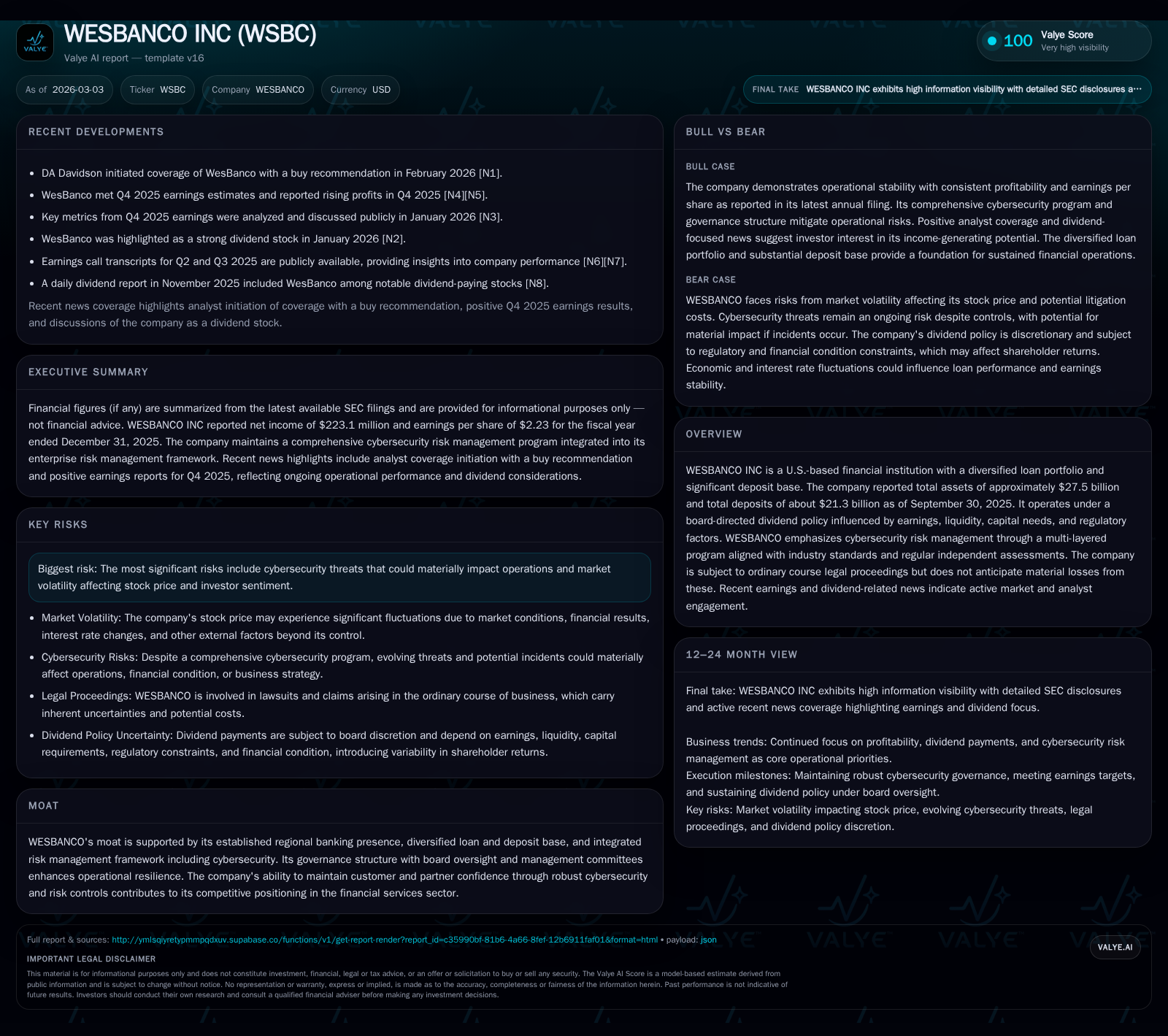
WesBanco Inc posted a robust 47.3% increase in net income for FY2025, underpinned by strong operating cash flows and stable capital expenditures. The bank's diversified loan portfolio and substantial deposit base anchor its competitive moat even as it faces sector-specific risks like credit quality pressures and cybersecurity threats. Its board-directed dividend policy balances shareholder returns with liquidity and regulatory considerations, while recent analyst coverage reflects cautious optimism about future performance amid macroeconomic uncertainties.
Earnings Growth Trajectory: Factors Behind the 47% Net Income Jump
WesBanco posted a striking net income figure of $223.1 million for FY2025, marking a substantial 47.3% increase over the $151.5 million recorded in FY2024 [F1]. This surge reflects effective margin management during a competitive regional banking environment and underscores operational efficiency scaling. Complementing this profit jump, operating cash flow rose by 37.6% to $290.4 million, reinforcing underlying cash generation strength critical for sustaining dividend payments and funding prudent reinvestment [F1]. Meanwhile, capital expenditures remained relatively flat year-over-year at approximately $10.4 million, indicative of controlled reinvestment focused on operational infrastructure and compliance demands [F1]. This combination of accelerated profitability alongside robust CFO growth contrasts favorably against many peers facing margin compression due to rising credit costs or interest rate cyclicality.
Historical performance (annual)
| FY | Net ($mm) | CFO ($mm) | Capex ($mm) | Net YoY |
|---|---|---|---|---|
| 2025 | 223 | 290 | 10 | +47.3% |
| 2024 | 152 | 211 | 10 | -4.7% |
| 2023 | 159 | 169 | 23 | -17.2% |
| 2022 | 192 | 204 | 8 |
Source: SEC companyfacts cache [F1].
Capital returns and efficiency (annual)
| FY | Div ($mm) | FCF ($mm) | ROE% |
|---|---|---|---|
| 2025 | 125 | 280 | 5.5 |
| 2024 | 87 | 201 | 5.4 |
| 2023 | 82 | 147 | 6.3 |
| 2022 | 81 | 196 | 7.9 |
Source: SEC companyfacts cache [F1].
The steady rise in dividends paid mirrors profitability gains and signals management’s commitment to return stability despite external pressures [F1]. The improved top-line profit paired with disciplined cost control serves as evidence of WesBanco’s resilient business model leveraging scale efficiencies within its regional footprint.
Loan Portfolio and Deposit Base: Anchors of Strength and Risk Considerations
As of September 30, 2025, WesBanco commanded total assets of approximately $27.5 billion alongside deposits totaling roughly $21.3 billion – foundational pillars underscoring its competitive moat in regional banking markets [S1][S2]. This robust deposit base features a blend of non-interest-bearing demand deposits ($5.29B) and interest-bearing accounts reflecting high 'deposit stickiness,' crucial for funding the loan portfolio without excessive reliance on wholesale borrowings or volatile market instruments [S16][S19].
The loan book remains diversified across commercial real estate, commercial & industrial loans, consumer credit lines, and specialized mortgage products which collectively mitigate concentration risks commonly impacting regional banks during economic cycles [S2][N3]. While some exposure exists to Commercial Real Estate Land & Construction segments—areas often scrutinized during tightening economic conditions—credit quality metrics such as nonperforming loans and charge-off rates have been maintained within tolerable ranges due to proactive underwriting and active loan modification programs [S2][S4]. Notably, the bank has managed payment deferrals prudently under regulatory guidelines reducing potential visibility risk while preserving asset quality.
Given prevailing interest rate environments adding pressure on borrower servicing costs across sectors, monitoring metrics like criticized loans and exposure to stressed credits remain vital indicators for emerging sector risks.
Embedded Risk Controls: Cybersecurity and Legal Proceedings Impacting Operations
WesBanco integrates cybersecurity risk management directly into its enterprise risk management (ERM) framework through a layered approach targeting threat identification, prevention, mitigation, and response readiness — practices aligned with industry cyber hygiene standards [S1]. Collaboration with third-party security providers furnishes enhanced monitoring analytics and independent testing capabilities ensuring governance oversight remains vigilant against evolving digital threats.
This cross-functional design empowers rapid detection of cyber incidents preventing operational disruptions that could erode customer confidence or trigger compliance breaches—a prime concern given increasing phishing campaigns targeting financial services firms.
On the legal front, WesBanco is involved in litigation customary for banks operating across multiple states; however, it reports no expectation of material loss from these proceedings based on current assessments indicating adequate provision coverage doesn’t impair financial conditions or earnings stability [S1]. Maintaining this posture helps preserve investor confidence by avoiding earnings volatility linked to legal contingencies.
Capital Allocation Focus: Navigating Dividend Policy, Buybacks, and Cash Flow Generation
The board steers dividend policy balancing multiple inputs — including earnings trajectory, liquidity positioning (~$956M cash and equivalents at year-end), regulatory capital requirements, and overall financial condition — resulting in stable dividend progression visible over recent years [F1][S1]. The dividend payout for FY2025 represents around $125 million outflow aligning with growing profitability while preserving capital flexibility under current Basel III-inspired constraints.
Return on equity approximated at near-5.5% remains steady within the bank’s historical range signaling moderate profitability but room for enhancement subject to credit cycle improvements or revenue diversification initiatives [F1]. Operational cash flow of nearly $290 million offset minimal capex obligations (~$10 million), generating free cash flow close to $280 million — offering reliable internal funds supporting dividends without recourse to external financing.
Notably absent from disclosures are aggressive share buyback programs; this may reflect prudence in capital deployment amid uncertain macroeconomic conditions where bank regulators emphasize capital preservation especially for regional lenders navigating sector-specific stresses [S1]. Hence WesBanco appears prioritizing dividend sustainability over buybacks aligning with investor preferences for predictable income streams.
Market Receptions and Analyst Perspectives in Early 2026
In early coverage post-FY2025 disclosures DA Davidson initiated a buy recommendation emphasizing WesBanco’s improving fundamentals bolstered by earnings momentum and consistent dividends attractive amid volatile banking equities sectors [N5]. Nasdaq analyst reports echoed these themes highlighting meeting Q4 earnings estimates as confirmation of execution discipline despite a challenging macro backdrop including rising interest rates and fluctuating credit conditions [N6][N7].
Nonetheless commentators also caution about share price volatility risks stemming from external shocks – common across publicly traded banks where market pricing can diverge sharply from underlying value due to sentiment swings or sector rotation factors detailed in the firm’s risk disclosures [S1]. Investors appear thus balanced between appreciation for operational strengths and vigilance around cyclical pressures.
Outlook Indicators: What the Latest Earnings Calls Suggest About Growth Constraints
Though WesBanco has not provided formal guidance beyond reported results, insights drawn from Q2/Q3 2025 earnings call transcripts identify several soft spots potentially constraining growth trajectory going forward [N3][N4][S1]. These include increasing scrutiny on credit risk particularly within segments like construction lending susceptible to regulatory attention given historical problems elsewhere.
Additionally management references ongoing deposit competition impacting pricing power alongside necessity for calibrated liquidity management strategies potentially limiting aggressive expansion plans.
These remarks provide investors with key watch areas: elevated nonaccrual loans or increased criticized credits over coming quarters could signal emerging stress while deposit flows will indicate managerial effectiveness in retaining core funding amidst segmented regional competition.
Valye’s View: Key Metrics to Monitor for Sustained Performance Momentum
Moving ahead sustained earnings advancement at WesBanco will hinge on maintaining asset quality measured through nonperforming loans ratios trending below sector medians and minimizing gross charge-offs that could erode profitability margins visibly affecting ROE rebound prospects above current mid-single digits.
Dividend stability provides an anchor but must be watched alongside evolving regulatory developments that may influence capital adequacy frameworks imposing stricter buffers on regional banks.
Capital allocation moves such as any future authorization of share repurchases could signal confidence but should be contextualized vis-à-vis prudent liquidity positioning evident under present conditions.
Quarterly earnings surprises relative to consensus forecasts will remain immediate barometers of execution success encapsulating loan growth pacing versus credit cost volatility tradeoffs.
In sum, vigilant scrutiny around these interrelated metrics will be essential for investors tracking WesBanco’s long-term resilience amid an uneven regional banking landscape shaped by macroeconomic shifts and sector-specific disruptions.
Disclaimer: This analysis is provided solely for informational purposes based on publicly available data as of the stated dates without providing investment advice or recommendations.
Disclaimer: This is research-only, informational analysis and not investment advice. It may include AI-generated interpretation and general industry context. Always verify important details using primary sources.

Comments