
Tyson Foods at a Crossroads: Sales Weakness, Supply Chain Moves, and the Stakes of Scale
Tyson Foods enters FY27 facing sales headwinds and a Q4 loss, but is leaning on its scale, supply chain partnerships, and operational oversight to weather volatility in the protein sector. The challenge is translating these advantages into renewed profit growth amid persistent cost and demand pressures.
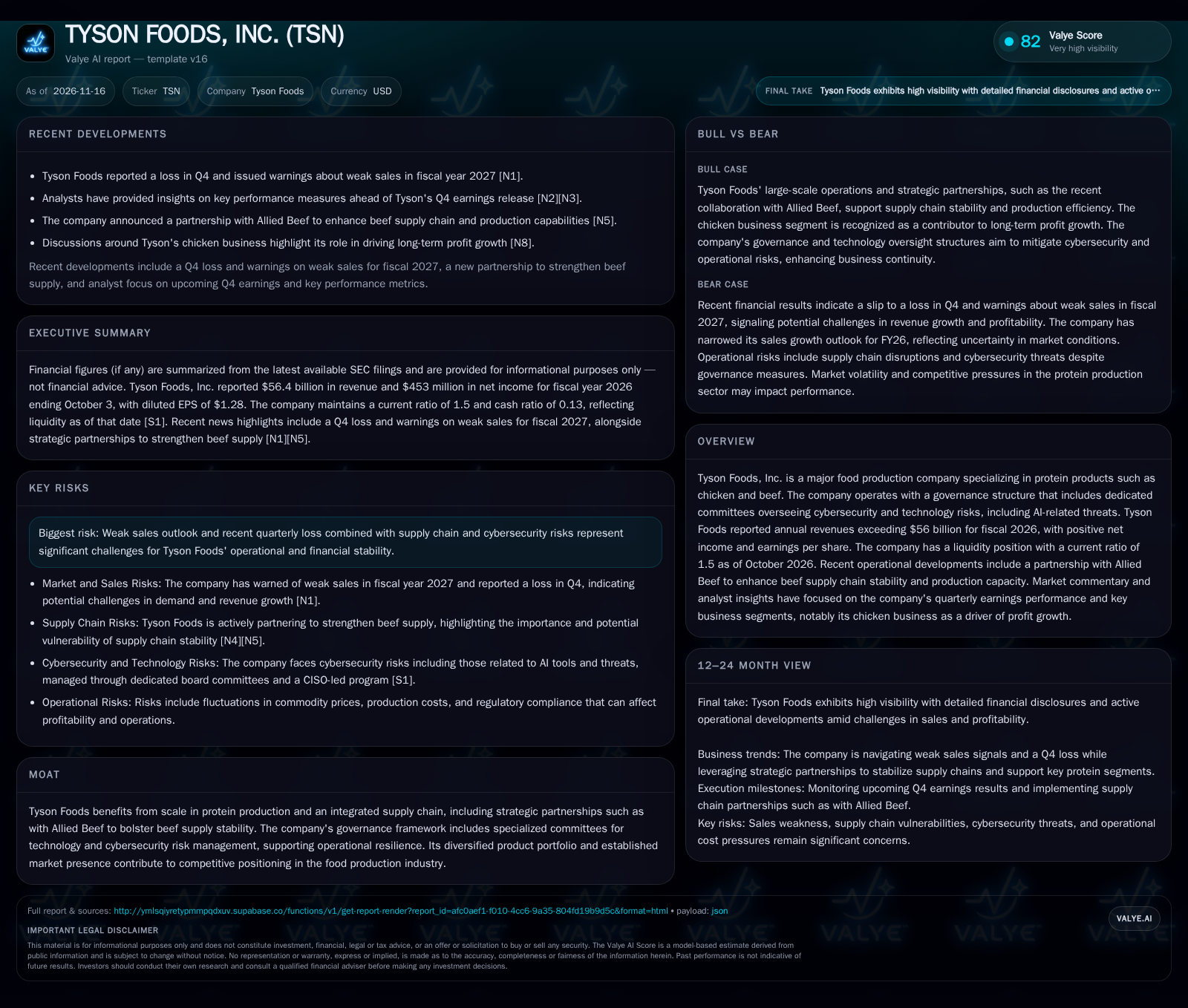
Tyson Foods reported $56.4 billion in revenue and $453 million in net income for FY26 but recorded a Q4 loss and has warned of weak sales for FY27. The company is pursuing supply chain partnerships such as with Allied Beef to stabilize operations and is enhancing cybersecurity and technology oversight. While Tyson’s scale and integrated model offer a potential buffer, ongoing cost and demand challenges put the burden on execution and margin recovery. [S1] [N1] [N5]
Tyson Foods, a dominant player in the protein industry, is confronting a period of operational and market uncertainty as it exits FY26. Despite generating $56.4 billion in annual revenue, the company reported a Q4 loss and has publicly warned of weak sales heading into FY27. Strategic initiatives—including a new partnership with Allied Beef—are intended to shore up Tyson’s supply chain and production efficiency, but questions persist about the company’s ability to restore margins and defend its competitive position as cost and demand pressures intensify. The company’s governance structure, with dedicated oversight of technology and cybersecurity, adds a layer of operational resilience, yet the path to profit recovery remains complex.
Recent Losses, Sales Concerns, and Strategic Supply Chain Partnerships Define Tyson’s Outlook
Tyson Foods reported $56.4 billion in revenue for the fiscal year ended October 3, 2026, and net income of $453 million, but the company slipped to a loss in Q4 2026 and has issued warnings about continuing weak sales in fiscal year 2027. Tyson’s recent partnership with Allied Beef is intended to bolster supply chain stability in its beef segment, which is strategically important to its core protein business. These developments matter because they underscore the tension between Tyson’s large-scale platform and the acute pressures it faces from both market demand and input costs, with execution on partnerships and operational oversight now central to the near-term thesis. [S1] [N1] [N5]
Margin Compression and the Search for Leverage in a High-Volume, Low-Margin Industry
Tyson’s business model is anchored in high-volume protein production—primarily chicken and beef—where scale offers purchasing power and operational efficiencies, but margins remain thin and cyclical. Pricing power is limited by the commoditized nature of meat products and the negotiating leverage of large retail and foodservice buyers. In periods of input cost volatility—such as feed, labor, and logistics—Tyson’s margins can come under acute pressure if cost increases cannot be quickly passed through to customers. The company’s Q4 loss and forecast of weak sales suggest that current market conditions are squeezing both volume and margin.
Fixed costs are significant due to Tyson’s vertically integrated supply chain, encompassing everything from feed mills to processing plants. This structure provides some control over inputs and quality, but also raises the stakes for capacity utilization: when throughput falls, fixed costs are spread over fewer units, magnifying margin compression. Strategic partnerships like the one with Allied Beef may help stabilize input flows and optimize plant utilization, but their impact on economics will depend on execution and the ability to avoid further supply disruptions.
Tyson’s capital needs are ongoing, given the requirements of maintaining, upgrading, and expanding processing capacity, as well as compliance with food safety and traceability regulations. Sustained margin recovery, rather than financial engineering, will be necessary for durable profit growth.
Scale, Integration, and the Challenge of Defending Share in a Fragmented Protein Market
Tyson’s scale and integrated supply chain are traditional sources of advantage in the protein sector, offering cost efficiencies, bargaining power with suppliers, and some mitigation of supply shocks. The company’s product breadth across chicken, beef, and value-added protein products allows for some portfolio balancing when one segment underperforms. However, Tyson operates in a highly competitive and fragmented global market, with rivals ranging from other meat conglomerates to regional producers and plant-based protein entrants.
Substitution risk is growing as consumer preferences evolve—particularly the shift toward alternative proteins and premium branded meats. While Tyson’s scale allows it to compete aggressively on cost, it may be less nimble in adapting to fast-changing consumer trends. Channel partners, especially large grocers and foodservice operators, have significant power to demand price concessions or shift shelf space to alternative suppliers. The company’s recent efforts to strengthen beef supply chain stability through partnerships may help defend share in that segment, but do not insulate it from volume and pricing pressures across the broader protein landscape.
Technology and cybersecurity oversight, while necessary for operational continuity, are now table stakes in food production and do not by themselves create a durable moat—although execution lapses could quickly erode trust and market position.
If Tyson Converts Supply Chain Stability into Margin Rebound
A favorable scenario would see Tyson’s supply chain partnerships—such as with Allied Beef—delivering tangible improvements in input cost management, production efficiency, and throughput, allowing the company to stabilize or even expand gross margins despite weak end-market demand. If Tyson can leverage its scale to negotiate better input terms, optimize plant utilization, and avoid major supply disruptions, it could capitalize on any cyclical rebound in protein demand with outsized operating leverage.
Confirmation of this scenario would come from a return to sequential profit growth, margin expansion in the beef and chicken segments, and evidence that cost savings from supply chain initiatives are flowing through to the bottom line. Additionally, improved volume trends or share gains in core channels—potentially at the expense of less well-capitalized competitors—would further support the bull thesis. Conversely, if margin improvement fails to materialize or input costs remain volatile despite new partnerships, the upside case would be undermined.
Stabilization Efforts Offset but Do Not Fully Overcome End-Market Headwinds
The most plausible path forward is that Tyson’s supply chain and operational initiatives help limit further downside but do not produce a rapid profit rebound. The company may achieve some cost containment and operational efficiencies, particularly in beef, but persistent weak sales and pricing pressure prevent a full recovery in margins. Tyson’s integrated model provides some resilience, but not enough to fully offset a sluggish protein market and ongoing input cost risks.
Evidence consistent with this scenario would be modest sequential improvement in profitability, with gross margins stabilizing but remaining below historical averages. Volume trends may be flat to slightly positive, reflecting stabilization rather than growth, and cash flow generation is sufficient for ongoing operations but does not support major expansion or shareholder returns. If Tyson’s Q4 loss proves to be a nadir and cost initiatives take hold, the company could gradually rebuild earnings power—but this would likely be a slow process, dependent on macro factors and execution discipline.
Prolonged Demand Weakness and Cost Shocks Undermine Tyson’s Integrated Model
In an adverse scenario, Tyson faces continued end-market softness and fails to achieve meaningful cost savings or supply chain improvements. If input costs spike again—due to feed, labor, or logistics disruptions—or if demand for conventional protein erodes further in favor of alternatives, Tyson’s fixed-cost base could drive further losses. Underutilized capacity would magnify margin compression, and the company’s current liquidity, while adequate for normal operations, could come under pressure in a prolonged downturn.
The downside scenario would be confirmed by ongoing operating losses, further margin deterioration, and negative cash flow. Additional warning signs would include asset write-downs, plant closures, or the need to seek external financing. Erosion of major customer relationships or food safety/cybersecurity incidents could accelerate share loss and reputational damage, compounding the financial stress.
Milestones and Metrics That Will Signal Whether Tyson Can Regain Its Footing
Sequential changes in gross margin by protein segment—especially improvements in beef and chicken—would help test whether supply chain initiatives are translating into better economics.
Quarterly revenue and volume trends, particularly in core U.S. retail and foodservice channels, will indicate whether demand is stabilizing or eroding further.
Updates on the Allied Beef partnership: announcements of expanded collaboration, volume commitments, or realized cost savings would provide evidence of execution.
If disclosed, plant utilization rates and capacity adjustments will reveal whether Tyson is optimizing throughput or facing underutilization risks.
Any major changes in customer relationships, such as new large contracts or the loss of significant accounts, would be pivotal for forward visibility.
Cybersecurity incident disclosures or operational disruptions tied to technology failures could quickly undermine Tyson’s stability and reputation.
Commentary on commodity price trends and Tyson’s cost pass-through ability during earnings calls or filings will provide context for future margin direction.
Disclaimer: This is research-only, informational analysis and not investment advice. It may include AI-generated interpretation and general industry context. Always verify important details using primary sources.

Comments