
Texas Roadhouse's Growth Challenges and Capital Allocation Amid Competitive Pressures
Texas Roadhouse faces operational headwinds in expanding profitability while maintaining high capital spending and shareholder returns.
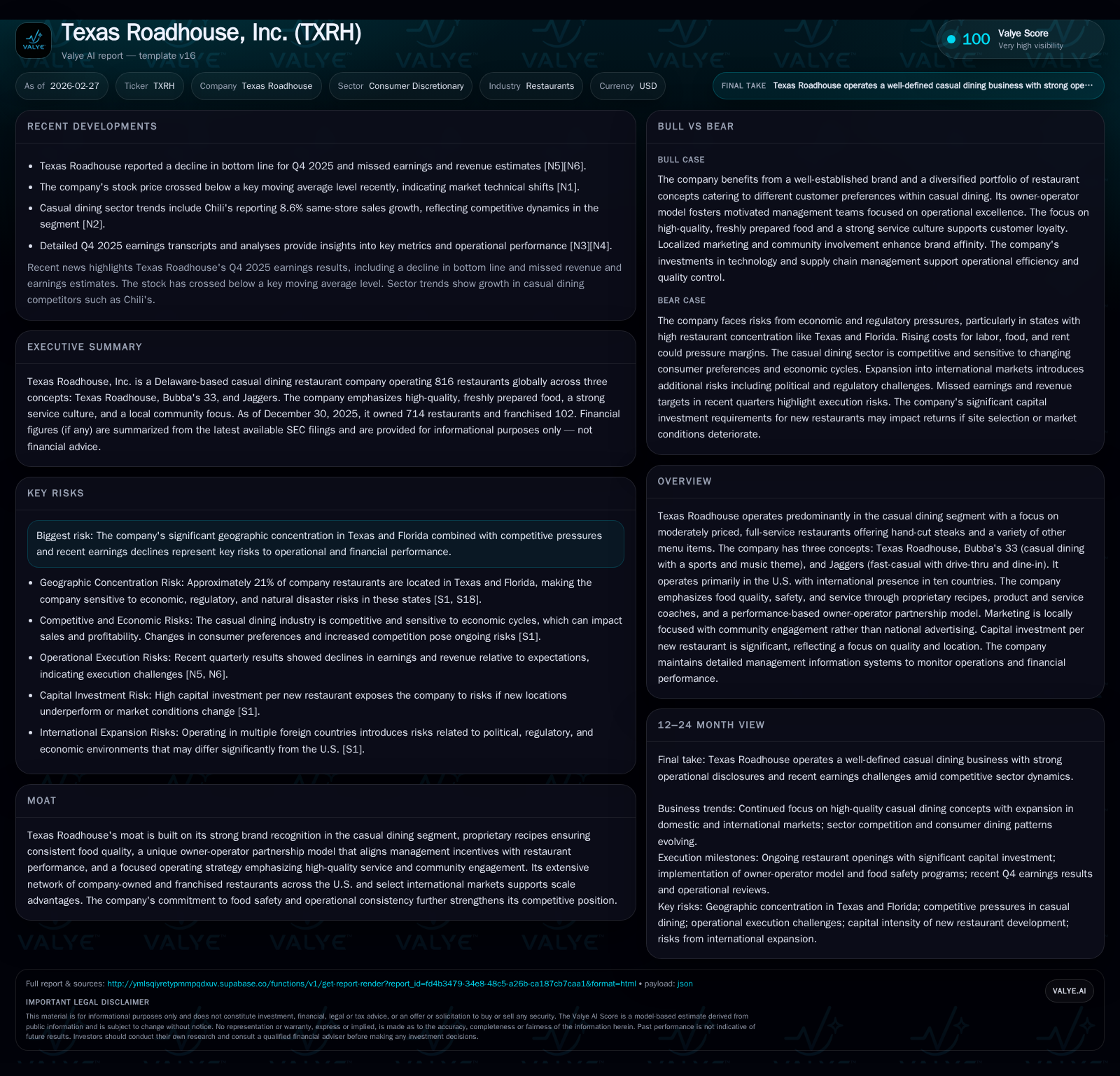
Texas Roadhouse operates largely in casual dining with three restaurant concepts emphasizing quality food and local engagement. Its operating income declined in 2025 after steady growth, pressured by geographic concentration risks and rising costs. The company is focused on disciplined expansion with rigorous site selection and an owner-operator model but must navigate site competition and longer ramp times at new units. Capital allocation remains active with significant capital expenditures, growing dividends, and robust share repurchases sustaining shareholder returns. Key risks include site availability, labor, supply cost inflation, and legal exposures.
Company Overview
Texas Roadhouse, Inc., founded in 1993 and headquartered in Louisville, Kentucky, operates predominantly within the casual dining segment across the United States and ten international countries.[S1] The company runs three restaurant concepts: Texas Roadhouse—the flagship moderately priced full-service steakhouse; Bubba’s 33—a casual dining sports bar; and Jaggers—a fast-casual format featuring burgers and sandwiches with drive-thru options.[S1]
Their mission centers around delivering "Legendary Food, Legendary Service®" supported by core values emphasizing passion and partnership.[S1] The business model focuses on local community engagement over traditional national advertising to build loyal customer bases.
Historical Growth & Performance Drivers
Texas Roadhouse has experienced strong revenue and operating income growth broadly through the 2010s into the early 2020s. The company reported a peak operating income of approximately $516.5 million for FY2024 before declining to $474.7 million in FY2025—a decrease of roughly 8.1% year-over-year.[F1] Net income data is only available through FY2022 where a notable improvement occurred ($269.8 million vs. $245.3 million in FY2021), marking a roughly 10% increase.[F1]
Operating cash flow has grown steadily from $511.7 million in FY2022 to $730.1 million in FY2025, indicating strong cash generation despite the operating income dip.[F1] Concurrently, capital expenditures have risen from $246.1 million in FY2022 to just under $388 million in FY2025, underscoring aggressive capital investment primarily directed toward new restaurants alongside refurbishments.[F1]
This growth trajectory was historically underpinned by:
- The company’s owner-operator partnership model aligning managerial incentives directly with store-level profitability[S25],
- Proprietary recipes and disciplined food safety standards supporting consistent product quality,[S25]
- High-touch customer service with low table-to-server ratios enhancing guest experience,[S25]
- Local-market-driven marketing programs leveraging community connections rather than expensive national campaigns,[S19]
- Rigorous site selection focusing on demographics, traffic generators, accessibility, parking availability, and competitive presence,[S19]
- Balanced pricing strategies customized per market prioritizing value without sacrificing quality[S19].
Financial Summary Table
Historical performance (annual)
| FY | CFO ($mm) | OpInc ($mm) | Capex ($mm) |
|---|---|---|---|
| 2025 | 730 | 475 | 388 |
| 2024 | 754 | 517 | 354 |
| 2023 | 565 | 354 | 347 |
| 2022 | 512 | 320 | 246 |
Source: SEC companyfacts cache [F1].
Capital returns and efficiency (annual)
| FY | Div ($mm) | Buybacks ($mm) | FCF ($mm) |
|---|---|---|---|
| 2025 | 180 | 150 | 342 |
| 2024 | 163 | 80 | 399 |
| 2023 | 147 | 50 | 218 |
| 2022 | 124 | 213 | 266 |
Source: SEC companyfacts cache [F1].
*FY2024 Operating Income jumped significantly from prior year after pandemic-related challenges.
Future Growth Prospects
Texas Roadhouse pursues expansion plans focused on opening new restaurants that meet strict profitability criteria.[S1] Growth is challenged by:
- Difficulty securing prime sites due to intense competition[S1].
- New units requiring several months to overcome start-up inefficiencies before reaching mature operating levels[S1].
- Expansion into less familiar markets where consumer behavior may differ leading to lower sales volume[S1].
- Potential cannibalization effects impacting sales of existing nearby restaurants[S1].
The owner/operator employment contracts include refundable deposits tied to managerial performance bonuses,[S25] incentivizing operational success critical for expansion execution.
Capital allocation remains significant as capex rose about 9.5% year-over-year into FY2025,[F1] although inflationary pressures on construction costs require careful management.
Forecasts / Milestones / Expectations
No explicit forward guidance was disclosed.[N1][N3][S3] Key metrics to watch include:
- Same-store sales trends relative to peer rebounds amid casual dining traffic shifts[N10][N12].
- Operating margin recovery following recent earnings misses[N3].
- Pace of real estate acquisitions amid industry-wide scarcity[S1].
- Management commentary on pricing actions balancing guest value against input cost inflation[S19].
These will indicate Texas Roadhouse's ability to navigate current market challenges.
Returns & Capital Allocation
Texas Roadhouse has a history of returning capital via dividends and buybacks.[F1][S5][S10] Dividends increased to $180 million in FY2025 from about $163 million the prior year,[F1] reflecting steady payout growth aligned with earnings. Share repurchases accelerated to over $150 million annually,[F1] underscoring emphasis on share buybacks. Approximate return on equity is near 18.5%, derived from latest available net income (FY2022) over equity at end-FY2025.[F1] Free cash flow remains strong with operating cash flow exceeding capex by approximately $342 million in FY2025.[F1] Liquidity is supported by a revolving credit facility providing up to $450 million capacity maturing April 2030; interest rates vary based on leverage ratios.[S4][S6][S9] The company complied with all financial covenants as of Q3 FY2025 without borrowings outstanding under this facility,[S6][S9][S18] indicating conservative leverage.
Industry Position & Operational Risks
Texas Roadhouse benefits from:
- Strong brand recognition as a leading steakhouse-focused casual diner across many U.S. markets[S23].
- Proprietary recipes ensuring consistent food quality creating reliable guest satisfaction[S23][S25].
- Owner-operator model aligning management incentives with restaurant profitability via performance bonuses tied to pre-tax income[S25].
- Community-based localized marketing replacing costly national campaigns[S19][S25].
- Extensive company-operated and franchised unit network covering diverse geographies reducing single-market dependence.
Risks include:
- Geographic concentration notably within Texas and Florida leading to intense competition for sites affecting pricing power[S8][S20].
- Litigation exposure including dram shop statutes related to alcohol service liability requiring vigilant risk management[S8][S20].
- Regulatory compliance complexity including tax law changes adding operational uncertainty.
- Challenges hiring qualified management partners impacting new store consistency[S1][S25].
- Volatile input costs particularly beef supply amidst limited vendors[S17].
- Possible delays or increased costs due to construction or parking issues impacting restaurant openings[S1].
The company’s focus on dinner service during weekdays may limit volume upside compared with competitors using full lunch/dinner shifts daily,[S19] requiring ongoing adaptation if consumer preferences shift.
Conclusion & Outlook
Texas Roadhouse remains a well-established casual dining operator leveraging an owner/operator framework that historically supported growth while investing heavily in new unit development. Recent operating income declines after years of expansion reflect sector-wide competitive dynamics coupled with geographic concentration risks. Strong cash flow supports shareholder returns through dividends plus accelerated buybacks despite headwinds. Key milestones will include same-store sales momentum restoration, successful profitable new unit ramp-up, and effective cost control amid inflationary pressures. Close attention is warranted regarding site availability and regulatory environments given their material impact potential going forward.
This analysis uses publicly available information as of February 27th, 2026 including SEC filings ([F1],[S#]) and recent news reports ([N#]). It does not constitute investment advice or recommendations.
Disclaimer: This is research-only, informational analysis and not investment advice. It may include AI-generated interpretation and general industry context. Always verify important details using primary sources.

Comments