
Upstart Holdings: AI Lending Leader Faces Crossroads Amid Earnings Volatility and Macro Risks
Upstart’s proprietary AI models have redefined credit underwriting, but recent financial results expose challenges in sustaining growth amid economic headwinds.
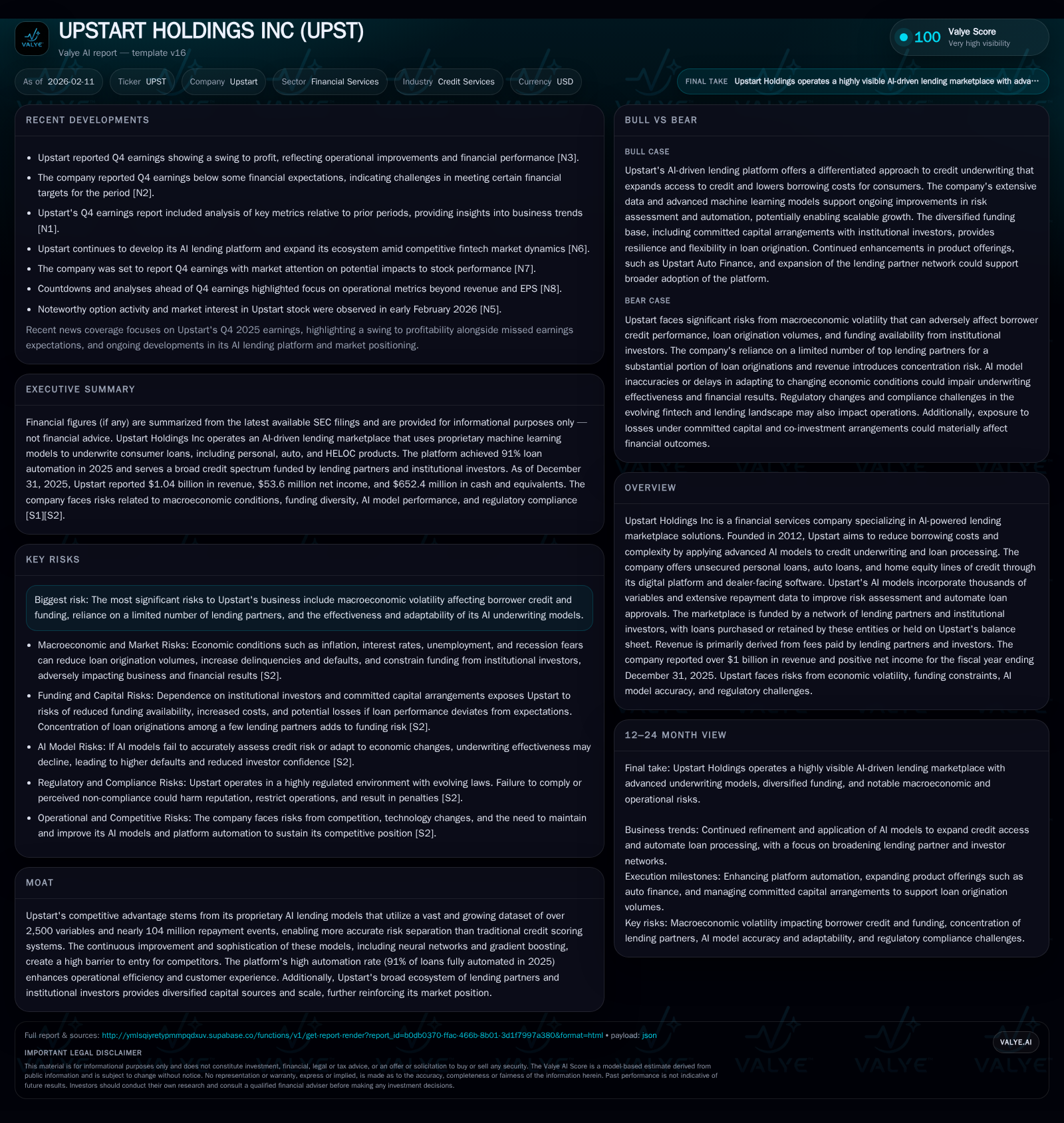
Upstart Holdings Inc has pioneered the use of advanced AI to transform the lending marketplace with a data-driven underwriting approach that automates over 90% of loan approvals. Despite reporting over $1 billion in revenue and a return to profitability in fiscal 2025, the company’s latest earnings missed expectations amid tightening credit conditions and investor concerns about model adaptability. Upstart's competitive moat centers on an expansive dataset and sophisticated AI, yet economic volatility and concentrated funding relationships highlight ongoing risks. The company is actively pursuing product diversification and expanded lending partnerships to navigate these challenges and reinforce its position within the evolving credit services landscape.
AI-Powered Lending: Upstart’s Revolutionary Edge
Since its founding in 2012, Upstart Holdings Inc has positioned itself at the vanguard of using artificial intelligence to revolutionize credit services. At its core lies a proprietary underwriting engine that digests more than 2,500 unique variables coupled with an extensive database encompassing approximately 104 million repayment events—a scale far beyond typical credit scoring mechanisms like FICO. This enormous and continuously growing data flywheel fuels nuanced risk separation, allowing Upstart to underwrite loans more accurately and inclusively than legacy models.
This capability translates into higher loan approval rates alongside lower borrower interest costs and more predictable returns for Upstart’s lending partners and institutional investors. The process is highly automated; in 2025, Upstart reported a fully automated loan approval rate of 91%, eliminating much friction traditionally encountered in lending. Supporting these models are continuous upgrades employing neural networks and gradient boosting techniques fine-tuned over ten years—offering both scalability and precision.
Beyond underwriting, Upstart extends its AI advantage into identity verification, fraud detection, income validation, and detecting loan stacking behaviors—a holistic digital ecosystem engineered for consumer convenience through platforms like Upstart.com and dealer-facing auto finance software.
Deep Dive into Upstart’s Latest Financial Results
Fiscal year 2025 marked significant milestones with revenues surpassing $1.04 billion ([F1]). Despite this topline progress, fourth-quarter results revealed headwinds: while net income rebounded to $53.6 million ([F1], [N9]), earnings notably missed analyst expectations ([N2], [N3]). This gap underscored pressures from softening borrower demand and cautious institutional capital deployment amid a challenging macroeconomic backdrop.
Operationally, revenue was driven largely by fees from lending partners purchasing loans on the platform or investing via securitization programs. Although profitability resumed after prior losses—reflecting some cost discipline—the mismatch versus estimates signals sensitivities inherent in Upstart's marketplace dynamics during economic tightening phases ([N4]).
Data-Driven Moat or Market Mirage? The Strength of Upstart’s AI Models
The fulcrum of Upstart’s competitive differentiation resides in its proprietary AI underwriting prowess that claims an ability to outperform traditional credit metrics systematically. However, management prudently acknowledges risks tied to these models' performance under shifting economic realities ([S1], [S2]). The rapid escalation in borrower credit risk due to macro headwinds tests whether the AI can timely recalibrate predictions without degradation.
Crucially, failure or delay in adapting models could erode investor confidence or lead to increased defaults—pressures compounded by potential emergent competitors aiming to replicate or innovate beyond Upstart's methodologies ([S1]). Yet the expansive proprietary dataset remains a formidable barrier to entry; competitors must assemble similarly vast repayment histories and variable sets—a nontrivial endeavor—lending credence to Upstart's data moat.
Capital Sources and the Diverse Funding Ecosystem
Upstart's marketplace operates atop a triad of capital channels: institutional investors acquiring approximately 64% of loan originations, lending partners accounting for another 26%, with roughly 10% retained on Upstart's own balance sheet ([S1], [F1]). Institutional investors typically absorb higher-risk loans unsuited for conventional banks or credit unions.
This funding structure diversifies capital sources yet introduces dependencies on external entities’ appetite for risk-bearing assets. Concentration among top lending partners further amplifies this vulnerability should key participants reduce exposure or exit entirely—a material business continuity risk emphasized in filings ([S1]). Moreover, periodic macroeconomic shocks can constrain liquidity supply from these investors.
Macro and Microeconomic Risks Impacting Credit Underwriting
Operating within consumer credit markets inherently exposes Upstart to volatilities tied to broader economic cycles. Prevailing uncertainties—such as inflationary pressures, employment shifts, interest rate fluctuations—directly influence borrower repayment behavior and creditworthiness ([S1], [S2]).
Deterioration in borrower profiles raises default frequency risks; simultaneously, funding partners may tighten capital availability or demand higher returns. Such dual-sided pressures challenge revenue stability and cast doubt on upward scalability absent adaptive countermeasures.
Hence, sustaining growth requires superior risk modeling granularity capturing real-time economic signals alongside flexible marketplace mechanisms adjusting pricing or eligibility swiftly.
The Road Ahead: Strategies to Maintain Growth and Profitability
Facing evolving headwinds, Upstart management is vocal about a strategic evolution beyond its original focus on unsecured personal loans ([S1], [S2], [N5]). This includes banking on emerging product lines such as auto loans and home equity lines of credit (HELOCs), sectors offering potentially robust demand heterogeneity and cross-selling opportunities.
Concurrently, efforts are underway to broaden the lender base by attracting new institutional partners while deepening existing relationships—critical levers for sustaining capital flow diversity. Technological investments continue targeting enhancements in model sophistication alongside customer experience improvements aiming at higher retention and acquisition efficiencies.
Ultimately, these initiatives reflect a deliberate attempt to transform from a single-product fintech disruptor into a multi-faceted consumer credit ecosystem resilient against cyclical cycles.
Competitive Landscape: Navigating Industry Disruption and Rivals
Upstart does not operate in isolation; it contends with peers aggressively embedding AI into credit underwriting workflows. For instance, Pagaya is rapidly scaling its data-driven platform emphasizing asset-backed securities relative analysis ([N8]), while SoFi is leveraging broad fintech capabilities integrating direct-to-consumer offerings powered by machine learning ([N7]).
Additionally, emerging players like Innodata pursue so-called agentic AI applications potentially heralding next-generation automation beyond current statistical modeling paradigms ([N1]). These competitors illustrate intensifying innovation battles where data scale alone may not suffice absent continuous algorithmic breakthroughs.
Nonetheless, Upstart’s established relationships combined with entrenched datasets fortify its standing—at least until rivals demonstrate parity or superior market traction.
Risk Management in a High-Volatility Lending Environment
Robust internal controls underpin Upstart’s operational stability amid inherent sector risks. Its proprietary AI extends into fraud prevention layers detecting anomalies including synthetic identity attempts or coordinated loan stacking schemes—a frequent stress point for online lenders ([S1], [S2]).
Cybersecurity remains paramount as breaches could inflict reputational damage or regulatory sanctions. Management highlights ongoing investments in technology infrastructure resilience coupled with compliance adherence reflecting global evolving frameworks governing consumer data privacy.
Liquidity risk also commands vigilance given reliance on third-party capital; market disruptions necessitate readiness plans including contingency financing or temporary loan portfolio retentions.
Investor Sentiment and Market Reaction Following Q4 Earnings
Notwithstanding profitability achievements reported for Q4 calendar quarter 2025 ([N9]), initial investor reactions skewed cautious. The stock exhibited above-average options market volume with pronounced put activity signaling hedging behavior amidst visibility concerns over near-term earning trajectories ([N11], [N12]).
Technically deemed oversold per momentum indicators ([N13]), the share price nonetheless declined more sharply than broader indices post-results ([N14]). This dichotomy suggests prevailing wariness about macro implications on loan origination volumes alongside skepticism regarding the timing of sustained margin recovery.
Looking ahead, investor confidence will likely hinge on transparency into AI model updates effectiveness and tangible scaling across diversified product verticals promised by management.
This analysis synthesizes publicly available information including SEC filings up to February 10, 2026 ([S1], [S2]) and recent earnings reports alongside market commentary ([N2]-[N14]) without providing investment recommendations. Readers should consider individual circumstances before drawing conclusions regarding any valuation or investment decisions related to Upstart Holdings Inc.
Disclaimer: This is research-only, informational analysis and not investment advice. It may include AI-generated interpretation and general industry context. Always verify important details using primary sources.

Comments