
Vishay Precision Group's Path from Innovation Roots to Market Dynamics in 2025
VPG’s long-standing innovation in precision measurement confronts evolving market pressures and strategic shifts after a robust revenue expansion.
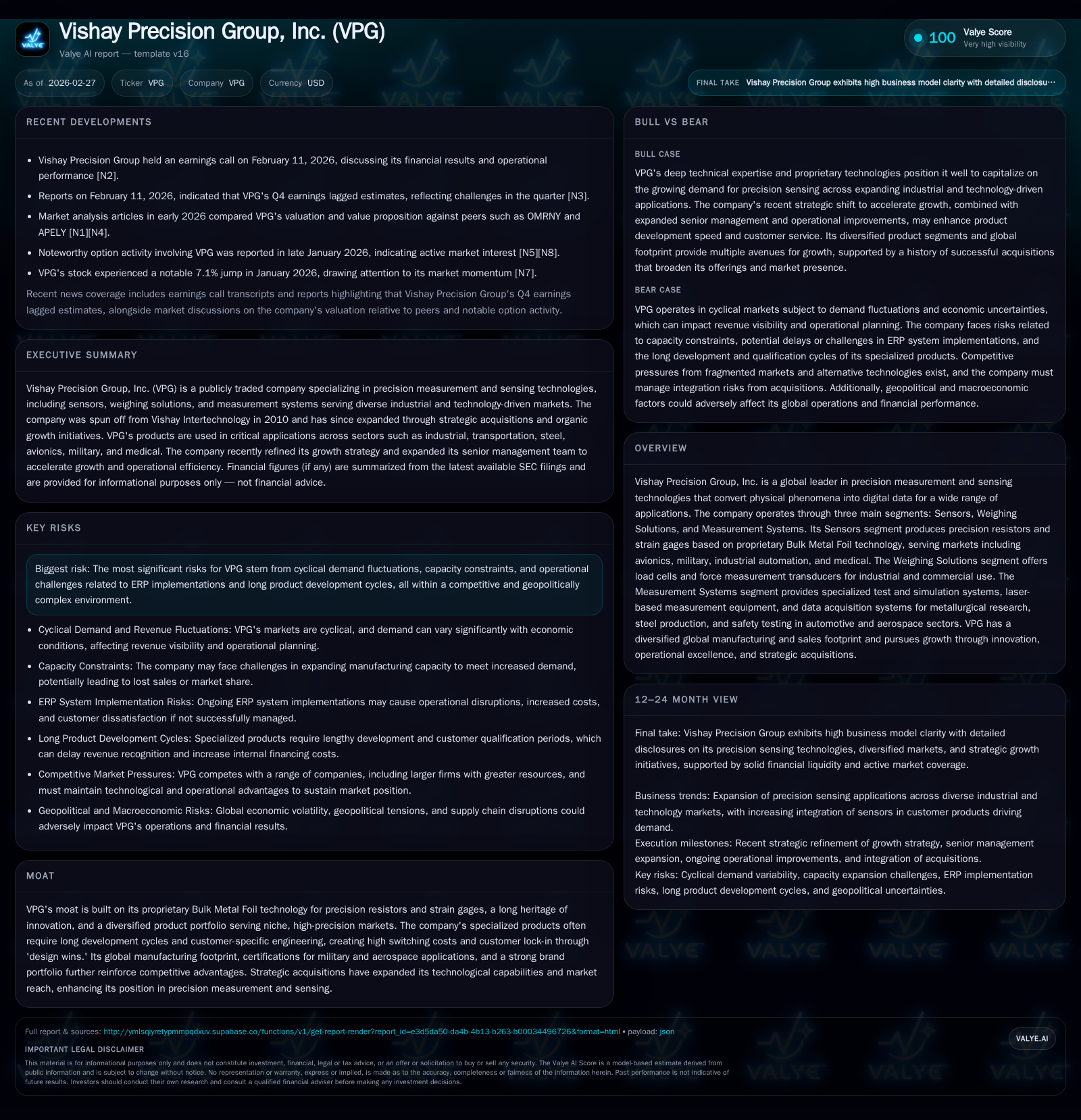
Vishay Precision Group (VPG) has experienced remarkable revenue growth fueled by its proprietary Bulk Metal Foil technology and diversified product segments. However, despite top-line momentum, 2025 saw declining operating income and net profits linked to cyclical demand, ERP challenges, and rising costs. The company is addressing these issues through leadership additions and operational realignment aimed at standardization and efficiency. Its moat remains anchored in technology-driven design wins and high switching costs, though competitive fragmentation and geopolitical risks persist. Investors should monitor backlog stability, restructuring outcomes, and new product adoption as key indicators for near-term performance.
From Bulk Metal Foil Roots to Modern Precision Solutions: VPG’s Growth Trajectory
Founded on the legacy innovations of Vishay Intertechnology dating back to the early development of Bulk Metal® foil resistors and foil strain gages, Vishay Precision Group (VPG) has cultivated a robust foundation in precision measurement technologies. This proprietary bulk metal foil technology remains at the core of VPG’s competitive advantage, offering exceptional accuracy, reliability, and stability used extensively across aeronautics, military systems, industrial automation, medical devices, and semiconductor testing.
Since its spin-off in 2010, VPG has grown substantially through organic development and strategic acquisitions that expanded its reach from precision resistors into load cell-based weighing solutions and specialized measurement systems for metal processing and safety testing [S4]. As of fiscal year-end 2025, VPG reported total revenue of $307.2 million—a striking near 300% uplift compared to $77 million in 2018—highlighting a compounded annual growth driven by deepening penetration into niche applications requiring high precision sensing products [F1].
This trajectory leverages extensive ‘design wins,’ a sector term describing customer-specific engineering integrations that notoriously lengthen adoption cycles but solidify customer lock-in due to high switching costs embedded within equipment design frameworks. These long-term engagements stabilize demand for the Sensors segment’s foil resistor products despite cyclical end-market behaviors [S12],[S22]. Meanwhile, manufacturing transitions toward more automated production setups particularly in Israel have improved quality control and operational scalability within the sensor business unit [S7].
2025 Financial Results: Revenue Surge Amid Eroding Margins
While VPG’s top line surged impressively to $307 million in 2025 (up roughly 299% relative to prior year), the operating income contracted by approximately 17.9% to $13.8 million amid persistent margin pressures likely tied to structural cost increases and ERP system integration burdens discussed during earnings calls [F1],[N1],[N2]. Net income declined even more sharply by nearly half (-46.6%) to $5.3 million further evidencing margin squeeze effects.
Operating cash flow also fell by around 27% vis-à-vis FY24 levels to just over $14 million—a signal that working capital dynamics or one-time operational expenses may be weighing on liquidity generation despite higher sales volume [F1]. Earnings call commentary attributes some of this drag specifically to growing pains associated with enterprise resource planning enhancements which can disrupt supply chain efficiency or order fulfillment temporarily during rollout phases [N1].
Such dynamics underscore that the recent surge is not simply pure operational leverage but complexly intertwined with system transformation costs while navigating volatile demand patterns characteristic of industrial sectors served by precision sensors and weighing solutions.
Historical performance (annual)
| FY | Net ($mm) | CFO ($mm) | OpInc ($mm) | Net YoY |
|---|---|---|---|---|
| 2025 | 5 | 14 | 14 | -46.6% |
| 2024 | 10 | 20 | 17 | -61.4% |
| 2023 | 26 | 46 | 42 | -28.7% |
| 2022 | 36 | 33 | 44 |
Source: SEC companyfacts cache [F1].
Capital returns and efficiency (annual)
| FY | Buybacks ($mm) | ROE% |
|---|---|---|
| 2025 | 0 | 1.6 |
| 2024 | 8 | 3.1 |
| 2023 | 6 | 7.8 |
| 2022 | 3 | 11.8 |
Source: SEC companyfacts cache [F1].
Note: Fiscal years reflect calendar-year period ends per SEC filings consolidated from multiple sources.
Market Segments and Competitive Pressures within VPG’s Portfolio
VPG organizes its operations into three principal segments: Sensors (precision resistors & strain gages), Weighing Solutions (load cells & force transducers), and Measurement Systems (specialized test/simulation equipment).
The Sensors segment enjoys technological insulation due to proprietary Bulk Metal Foil products enabling superior precision beyond commoditized alternatives made primarily by Chinese competitors—a recurring concern noted given their ability to compete on pricing but not consistently on quality or innovation [S1]. Nonetheless, semiconductor-based strain gages represent a technological threat as their performance improves over time even if currently less stable than foil sensors.
Conversely, the Weighing Solutions arena features highly fractured competition dominated by numerous smaller firms specializing by application or geography with limited pricing power common among load cell manufacturers; typically winning orders involves nuanced customer relationships combined with product reliability factors rather than purely technological differentiation [S1],[S25]. This segment includes products sold under brand names such as BLH Nobel and Vulcan alongside newer onboard weighing systems integrating micro-electromechanical systems (MEMS) technology expanding into heavy equipment markets [S17].
The Measurement Systems unit commands a niche position through brands like KELK and DTS focused on steel industry process control along with automotive/aviation safety testing respectively—markets characterized by stringent certification standards but limited scale requiring sustained R&D efforts [S15][S20]. This complexity demands ongoing innovation but heightens susceptibility to delays or costly design flaw corrections impacting profitability.
Collectively these segments exhibit differing competitive forces balancing proprietary technological moat benefits against commodity-like pricing pressure especially notable in load cells.
Transformation through Leadership Expansion and Operational Realignment
Recognizing these challenges amidst accelerating growth aspirations led VPG in late 2025 to broaden its executive team with two freshly created roles: Chief Business & Product Officer plus Chief Operating Officer reporting directly to the CEO aimed at aligning sales strategy with enhanced operational execution capabilities across all divisions [S4]. These moves signal an intent to leverage standardized processes enabling better scaling capacity while reducing time-to-market friction for new offerings.
Operationally there are continued manufacturing footprint rationalizations supporting cost efficiencies—increased automation in higher-cost Israeli facilities coupled with outsourcings or expansions in India and China seek optimized unit economics amid global labor market tightening [S7].[S24] These initiatives dovetail with broader corporate culture emphasis on accountability expected to drive margin improvement post-transition.
Capital Deployment, Returns, and Cash Flow Evolution
On capital stewardship metrics, VPG demonstrated disciplined investment behavior evidenced by restrained capital expenditure that enabled positive free cash flow estimated near $7 million after capex outlays despite earnings softness [F1]. The decision to halt share repurchases starting FY25 marks a conservative stance reflecting mid-cycle profit pressure uncertainty versus prior moderate buyback activity totaling several million annually between FY22-24.
Return on equity metrics remain modest lately (~1.6%), mirroring compressed net profitability against sustained equity base enlargement as growth investments accumulate without immediate matching bottom-line impact [F1]. This pattern highlights a transitional phase where financial returns await realization from strategic realignment efforts underway.
Technology Edge in Design Wins: Sustaining the Moat
Underpinning VPG’s competitive differentiation is its deeply ingrained expertise around Bulk Metal Foil technology which indeed creates substantial intangible barriers through lengthy non-recurring engineering (NRE) engagements for customized sensor integrations—termed design wins—often exceeding yearlong timelines before volume production begins [S12],[S22]. This lock-in effect reduces incremental competitive threats post-adoption while allowing premium pricing reflective of mission-critical reliability requirements particularized within aerospace or military-qualified product lines certified under AS9100 standards.[S10]
R&D teams across multiple global sites collaborate closely with field applications engineers who maintain critical customer-facing technical support ensuring tight feedback loops for continuous product refinement fostering sustained innovation pipeline vitality.[S8]
Risks and Cyclical Pitfalls Facing VPG’s Precision Markets
Notwithstanding its strong technology base, VPG navigates inherent cyclicality risks exacerbated by customer-driven backlog variability where order cancellations occur without penalty undermining revenue visibility notably within the Sensors segment reliant on forecasted production needs.[S24] Labor shortages affect both own operations plus critical suppliers aggravating capacity constraints potentially limiting agility during demand spikes.[S1]
ERP system rollouts compound implementation risks introducing temporary inefficiencies reflected already in recent earnings communication delaying shipment cycles or inflating operating expenses.[N1][S15] Furthermore geopolitical instability surrounding manufacturing hubs—particularly India, China and Israel—adds external risk layers as do shifting trade policies including tariffs or export restrictions which could distort supply chain economics abruptly.[S23]
Additionally competition from semiconductor strain gage technologies continues evolving posing incremental threat if they eventually improve reliability materially beyond current levels.[S1]
Outlook and What Investors Should Watch Next
VPG has not delineated formal forward guidance post-2025 releases publicly; as such attention should focus on several leading indicators including backlog maturation rates revealing strength/duration of demand recovery following recent volatility.[N1] Progress reports on ERP stabilization coupled with operational KPIs pre-empting margin recovery will be vital considering drag observed recently.[N2]
Also pivotal will be confirmation that expanded leadership functions tangibly accelerate cross-divisional synergies driving faster time-to-market gains for innovative products validated by new design wins particularly within upgraded MEMS-enabled weighing systems that could unlock volume expansion avenues.[S4]
Finally monitoring geopolitical developments affecting raw material sourcing alongside labor availability will help anticipate possible disruptions highlighted under risk disclosures[S23][S5]. These factors collectively will shape medium-term trajectories beyond the legacy innovation foundation underpinning VPG today.
This analysis reflects information assembled exclusively from publicly filed documents including Vishay Precision Group's latest annual report (10-K), quarterly reports (10-Q), related SEC disclosures up to February 27, 2026, as well as contemporaneous earnings call transcripts dated February 11, 2026 alongside corroborating market commentary sources cited herein. No forward-looking statements or investment recommendations are expressed or implied herein.
Disclaimer: This is research-only, informational analysis and not investment advice. It may include AI-generated interpretation and general industry context. Always verify important details using primary sources.

Comments