
Virtus Investment Partners' Multi-Manager Model Faces Margin Pressure Despite Robust Revenue Growth
The firm's diversified asset management approach sustains top-line expansion amid operational headwinds and market uncertainties.
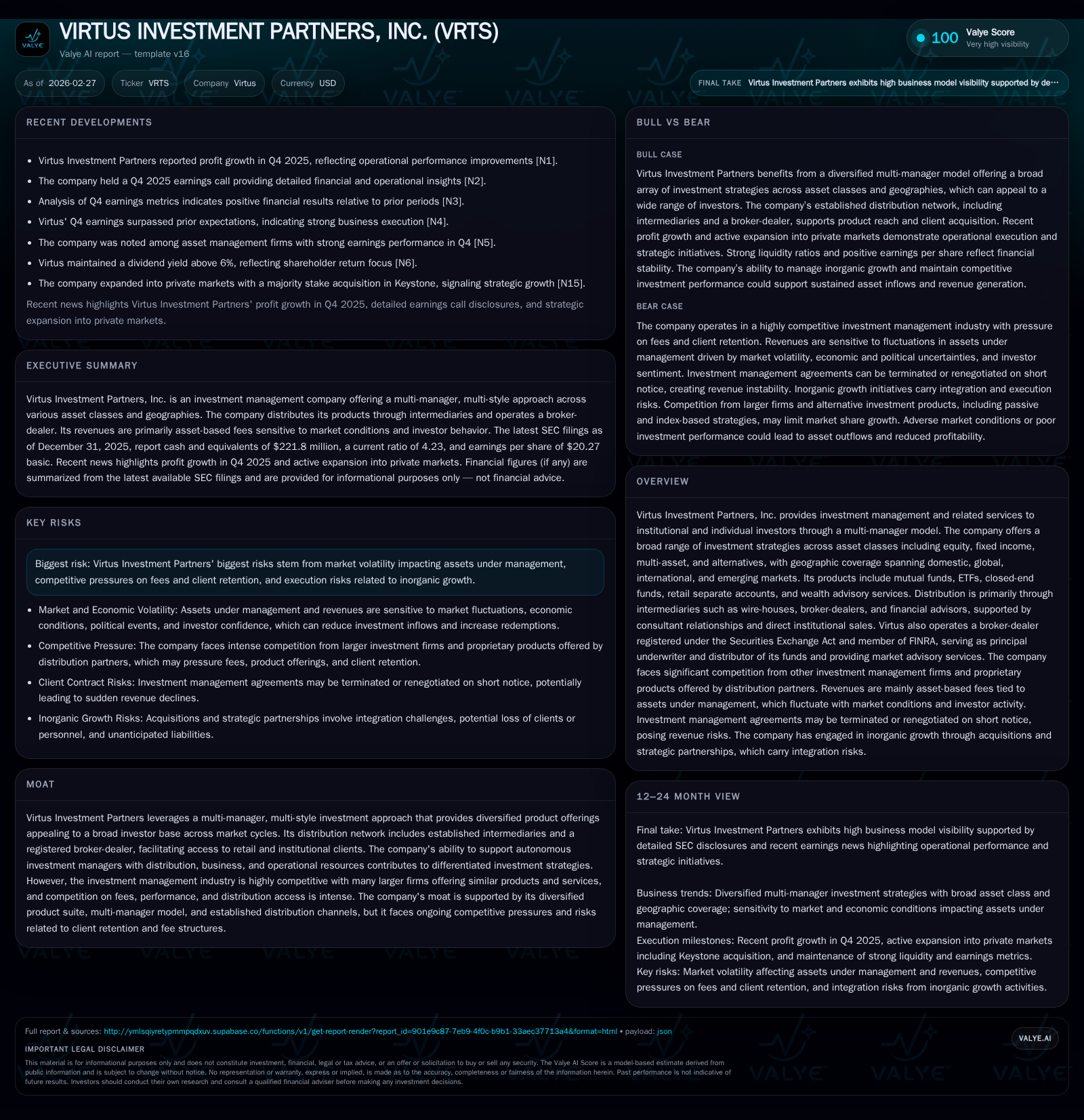
Virtus Investment Partners, Inc. reported strong revenue growth driven by its multi-manager model spanning equities, fixed income, and alternatives. Revenues grew approximately 17.5% year-over-year through 2020, while operating income showed fluctuations with a decline of about 7.6% in 2025. The firm maintains disciplined capital allocation with consistent share repurchases totaling nearly $60 million in 2025 and steady dividend payouts supported by a healthy balance sheet featuring $399 million in term loan debt under a seven-year credit facility. Key risks include fee pressures, market-sensitive assets under management, and evolving regulatory requirements.
Overview
Virtus Investment Partners, Inc. operates a diversified investment management business primarily through a multi-manager model encompassing equity, fixed income, multi-asset strategies, and alternatives. Its product lineup includes mutual funds, ETFs, closed-end funds, retail separate accounts, and wealth advisory services. Distribution is largely conducted via intermediaries such as wirehouses, broker-dealers, and registered financial advisors leveraging longstanding consultant relationships alongside direct institutional sales efforts [S27][N1]. The firm also owns an affiliated broker-dealer to facilitate marketing and distribution.
Historical Performance
Virtus has exhibited steady revenue growth over recent years driven by asset growth within its multi-manager framework. The latest available full-year revenue data is from FY2020 at $171.6 million—a roughly 17.5% increase from FY2019 levels of $146.1 million [F1]. Operating income has shown variability recently; it declined by approximately 7.6% to $168.7 million in FY2025 from $182.5 million in FY2024 [F1]. Net income figures for recent years are partially unavailable but prior data indicates significant volatility.
Operating cash flow turned negative to -$67.2 million in FY2025 compared to positive inflows in prior years—reflecting working capital timing differences and increased accrued compensation expenses tied to equity-based awards used for talent retention [F1]. Capital expenditures remain moderate at around $6.9 million annually supporting technology upgrades and compliance initiatives.
Historical performance (annual)
| FY | CFO ($mm) | OpInc ($mm) | Capex ($mm) |
|---|---|---|---|
| 2025 | -67 | 169 | 7 |
| 2024 | 2 | 182 | 6 |
| 2023 | 237 | 151 | 9 |
| 2022 | 133 | 197 | 7 |
Source: SEC companyfacts cache [F1].
Capital returns and efficiency (annual)
| FY | Buybacks ($mm) | FCF ($mm) |
|---|---|---|
| 2025 | 60 | -74 |
| 2024 | 45 | -4 |
| 2023 | 45 | 228 |
| 2022 | 90 | 126 |
Source: SEC companyfacts cache [F1].
Note: Latest revenue data is through FY2020; operating income tracked through FY2025; net income data is limited beyond FY2021 [F1]. CFO stands for cash flow from operations; capex denotes capital expenditures.
Recent Developments & Q4 Earnings Commentary
In the Q4 earnings call held February 6, 2026, Virtus highlighted stronger-than-expected profitability metrics despite challenging market conditions across global equity and fixed income asset classes [N1][N3]. The company emphasized inflows into diversified strategies underpinned by its multi-manager approach as a key driver of fee revenue resilience amid market volatility impacting assets under management [N7].
Capital returned to shareholders remained consistent with prior years through roughly $60 million of share repurchases authorized and executed alongside maintained quarterly dividends near $2.40 per share [N8][N9][S11][S17].
Business Model & Competitive Positioning
Virtus' multi-manager platform differentiates it within the asset management industry by supporting autonomous boutique managers across multiple investment styles and geographies—spanning domestic U.S.-focused funds through emerging markets allocations [S27][S28]. This approach provides clients with broad diversification while leveraging distribution relationships primarily through intermediaries such as wirehouses and registered investment advisors.
Ownership or joint ventures with boutique firms enable Virtus to offer differentiated strategies beyond scale-oriented competitors focused mainly on flagship active or passive products [S28]. The affiliated broker-dealer enhances distribution capabilities via underwriting and fund marketing activities.
However, the firm faces intense competition from both established asset managers with overlapping offerings and low-cost passive providers exerting fee pressure industry-wide [S14]. Client retention depends on consistent performance relative to benchmarks while navigating rising regulatory compliance costs amid evolving global fund governance standards [S18].
Future Growth Prospects
Growth drivers include expanding assets under management within existing strategies benefiting from sustained market participation coupled with product innovation notably in alternatives and ESG-focused funds gaining traction industry-wide.
Geographic diversification into international markets offers potential incremental inflows if global capital markets stabilize following geopolitical tensions affecting investor confidence [S26]. Internal investments totaling approximately $305 million in new manager incubations reflect a long-term strategy to develop differentiated offerings that may generate future fees despite near-term earnings volatility due to mark-to-market adjustments on certain securities positions [S16].
Risks persist from potential fee compression triggered by larger competitors’ scale advantages; macroeconomic challenges leading to redemptions or weaker net inflows; client churn; and execution risk on acquisitions or manager integrations affecting operational synergies [S14][S29]. Regulatory complexity also contributes to rising operational expenses [S18].
Financial Condition & Capital Allocation
At fiscal year-end December 31, 2025:
- Virtus had approximately $399 million of term loan debt outstanding under a seven-year credit agreement secured in September 2025 plus an undrawn revolving credit facility of $250 million bearing interest linked primarily to SOFR plus margin adjustments typical for asset management lenders [S4][S6][S12].
- Debt covenants restrict certain cash flow uses including mandatory principal repayments starting fiscal year-end December 31, 2026 with amortization charged quarterly at about one percent per annum plus potential excess cash flow sweeps depending on leverage ratios measured periodically [S6][S13].
- Cash balances excluding consolidated investment products were around $370 million; the firm holds additional capital deployed in collateralized loan obligations (CLOs) representing alternative investment exposure but with limited risk beyond its invested equity amount (~$116 million) [S9][S10].
- Operating cash flow swung negative last reported year (-$67 million), partly due to working capital timing differences and increased accrued compensation expense including incentive pay linked to longer vesting restricted stock units and performance shares granted under management retention plans [F1][S22][S24].
- Capital expenditures were modest at roughly $7 million annually aligned with technology upgrades supporting compliance needs and digital distribution efforts [F1].
- Shareholder returns continue through regular quarterly dividends elevated modestly to around $2.40 per share alongside opportunistic share buybacks totaling close to $60 million authorized or executed during fiscal year ended December 31, 2025—demonstrating commitment to returning excess capital while balancing investments for growth areas like alternative strategy incubations commenced recently [S11][S17][N8].
Risks Summary
Key risks revolve around market-driven fluctuations affecting assets under management directly tied to fee revenue generation—given the firm’s reliance on asset-based fees—and ongoing pricing competition pressuring margins amid inflationary wage pressures required for regulatory compliance [S14][S26].
Additionally, incubating new investment offerings requires capital deployment without immediate returns exposing earnings volatility risk if market dislocations occur or anticipated inflows are delayed [S16]. Legal proceedings or regulatory sanctions are assessed at low probability but could adversely impact reputation and stakeholder confidence if they occur unexpectedly [S14].[N1]
Outlook & Monitoring Points (Analysis)
Explicit forward guidance remains limited publicly; however, key indicators to watch include:
- Quarterly updates on assets under management across major product lines clarifying organic growth momentum or loss trends;
- Fee rate adjustments reflecting competitive dynamics;
- Efforts toward operating margin stabilization amidst inflationary cost pressures;
- Deployment pace and performance of incubated alternative portfolios;
- Regulatory developments impacting fund registration costs or disclosure requirements;
- Capital allocation balancing buybacks against strategic acquisitions or new product launches.
Monitoring these factors will indicate whether Virtus can sustain its revenue growth trajectory while restoring operating profitability currently challenged by elevated expenses amid macroeconomic headwinds.
This analysis compiles publicly available filings up to February 27, 2026 along with relevant earnings call transcripts without offering investment advice or price forecasts.
Disclaimer: This is research-only, informational analysis and not investment advice. It may include AI-generated interpretation and general industry context. Always verify important details using primary sources.

Comments