
VYNE Therapeutics Shifts Focus Amid Clinical Setbacks and Merger with Yarrow Biosciences
VYNE Therapeutics transitions from clinical-stage BET inhibitor development to a new strategic direction following mixed trial outcomes and a merger agreement.
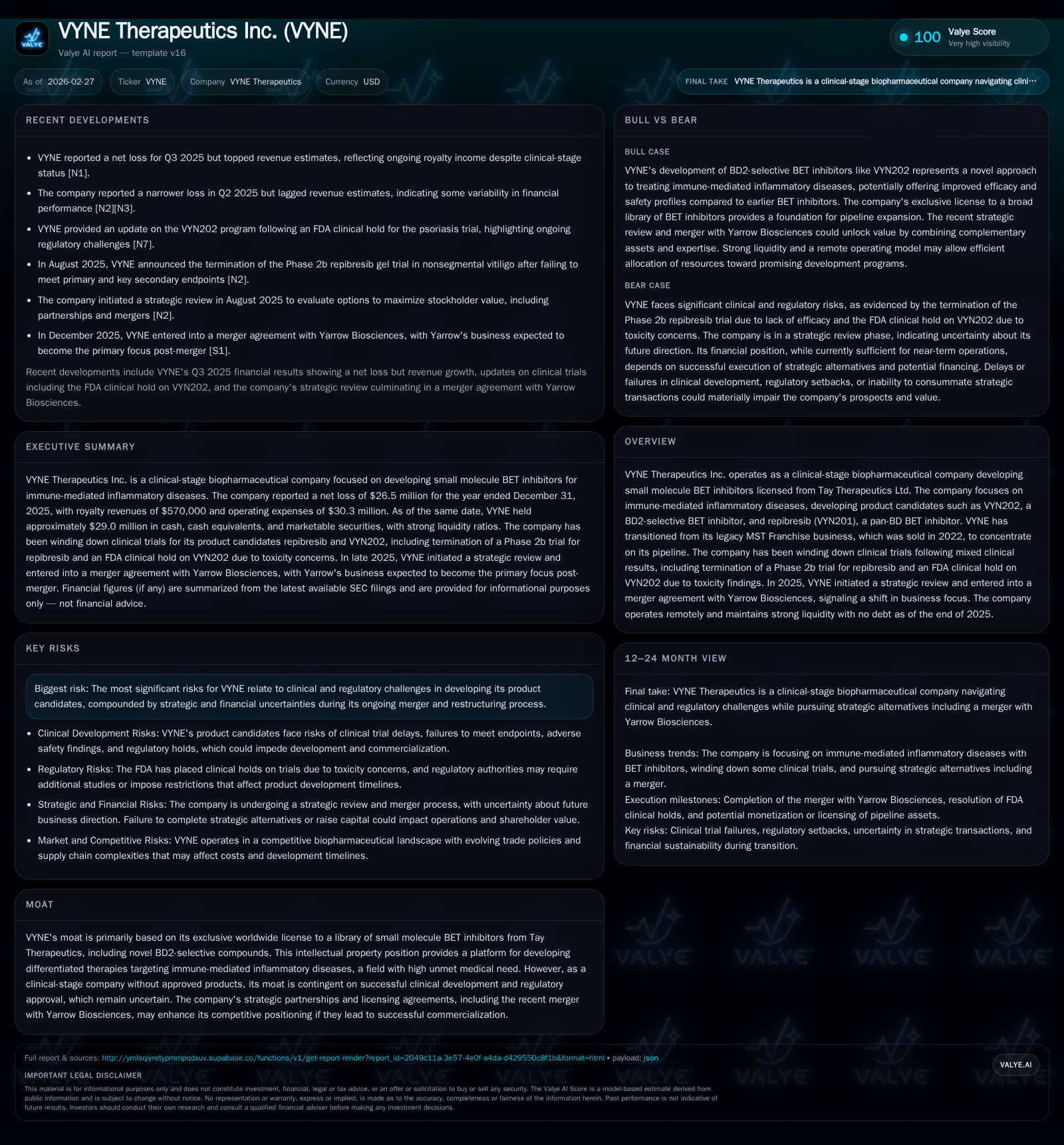
VYNE Therapeutics, focused on small molecule BET inhibitors for immune-mediated inflammatory diseases, faced clinical challenges leading to halted trials and an FDA clinical hold. The company sold its legacy MST Franchise in 2022 and initiated a strategic review in 2025, culminating in a planned merger with Yarrow Biosciences that will redefine its business focus. Despite operating remotely and maintaining strong liquidity with no debt, VYNE’s near-term prospects hinge on the success of this merger and potential monetization of existing assets.
Company Background and Business Model
VYNE Therapeutics Inc., a Delaware-based clinical-stage biopharmaceutical company, focuses on developing novel small molecule bromodomain and extra-terminal domain (BET) inhibitors targeting immune-mediated inflammatory diseases [S1], [S28]. The Company holds exclusive worldwide rights licensed from Tay Therapeutics Ltd., including access to a compound library of pan-BD BET inhibitors such as repibresib (VYN201) and BD2-selective inhibitors like VYN202 [S28]. This strategy aims to address inflammatory disorders while mitigating adverse effects associated with earlier pan-BD BET inhibitors.
Previously, VYNE operated the MST Franchise commercial business which was sold to Journey Medical Corporation in January 2022 for upfront payments totaling $25 million plus potential milestone payments up to $450 million contingent on sales performance [S8]. This divestiture enabled the Company to concentrate resources on its BET inhibitor pipeline.
Historical Performance and Clinical Development Challenges
Recent annual results show substantial operating losses but with improvement in 2025 compared to prior years. Operating loss decreased to $29.7 million in 2025 from $43.6 million in 2024 reflecting reduced research and development expenses as the Company wound down clinical trials following disappointing efficacy data [F1], [S16]. Net loss similarly improved by approximately one-third year-over-year to $26.5 million [F1]. Cash used in operating activities remained steady at approximately $33.1 million for 2025 [F1].
Clinical setbacks include termination of repibresib's Phase 2b trial after failing its primary endpoint related to facial vitiligo improvements reported mid-2025 [S5]. Additionally, development of VYN202 faced an FDA-imposed clinical hold on its Phase 1b psoriasis trial due to testicular toxicity observed in canine toxicology studies [S20]. The hold was lifted for female subjects at limited doses, but further non-clinical toxicology data expected by late 2026 will determine future progress [S20]. The Company ceased enrollment in psoriasis trials but continues exploring other indications.
Strategic Review and Merger Transformation
In response to these developments, VYNE's board initiated a strategic review in August 2025 considering various options including partnerships, licensing arrangements, asset sales, or corporate restructuring [S2], [S5]. This culminated in a merger agreement signed December 17, 2025 (amended January 30, 2026) with privately held Yarrow Biosciences [S3], [S16]. Yarrow develops YB-101 (GS-098), a humanized monoclonal antibody targeting thyroid-stimulating hormone receptor for autoimmune thyroid diseases such as Graves’ disease.
The merger is expected to close in Q2 2026 pending customary closing conditions and stockholder approvals [S16]. Concurrent financing includes Series A preferred stock issuance and pre-closing financings aggregating approximately $200 million led by institutional investors including RTW Investments [S16]. Prior to closing, VYNE plans a special cash dividend estimated between $14.5 million and $16.5 million payable pro rata to common stockholders as part of value distribution steps [S7].
The Company transitioned to a fully remote work model effective November 1, 2025, ceasing office leases previously held in Bridgewater, New Jersey—a move consistent with cost reduction efforts during operational restructuring [S1].
Financial Summary Table
Historical performance (annual)
| FY | Net ($mm) | CFO ($mm) | OpInc ($mm) | Net YoY |
|---|---|---|---|---|
| 2025 | -26 | -33 | -30 | +33.5% |
| 2024 | -40 | -34 | -44 | -40.0% |
| 2023 | -28 | -25 | -29 | -22.6% |
| 2022 | -23 | -29 | -34 |
Source: SEC companyfacts cache [F1].
Capital returns and efficiency (annual)
| FY | ROE% |
|---|---|
| 2025 | -95.4 |
| 2024 | -76.5 |
| 2023 | -32.1 |
| 2022 | -74.4 |
Source: SEC companyfacts cache [F1].
Cash equivalents include marketable securities; low current liabilities yield a strong current ratio above 12x indicating solid short-term liquidity.
Capital Structure and Allocation
As of December 31, 2025, VYNE reported no outstanding debt and shareholders' equity of approximately $27.8 million reflecting accumulated deficits nearing $758 million due primarily to ongoing net losses incurred over multiple years [F1]. Capital allocation has prioritized funding research activities until recent program wind-downs aligned with strategic shifts [S19]. No dividends or share repurchases have been declared given constrained free cash flow; operating free cash flow remains negative around $33 million annually [F1], [S19]. The planned special dividend ahead of the merger represents an atypical capital return linked to corporate restructuring rather than ongoing profitability [S7].
Future Outlook
Post-merger with Yarrow Biosciences expected mid-2026, the combined entity will pivot toward biologics focused on autoimmune thyroid diseases rather than small molecule BET inhibitors—marking a significant shift in therapeutic focus with distinct risk/reward profiles [S16]. Near-term value creation depends largely on successful transaction closing alongside regulatory approvals for the merger and resolution of outstanding toxicology concerns affecting VYN202 development [S16], [S20].
Investors should monitor:
- Progress toward merger completion including financing milestones
- Outcomes of ongoing toxicology studies influencing resumption or cessation of oral BD2-selective BET inhibitor trials
- Potential monetization or licensing transactions involving existing product candidates before or after closing
- Clinical advancement milestones delivered by Yarrow’s biologics pipeline
- Regulatory developments impacting immunomodulatory therapies targeting novel mechanisms.
Conclusion
VYNE Therapeutics’ transition reflects typical high-risk clinical-stage biotech dynamics where mixed trial results necessitate strategic realignment through mergers or asset reallocation. The upcoming combination with Yarrow Biosciences provides fresh capital infusion (~$200M committed) and pivots toward biologic therapeutics addressing autoimmune thyroid diseases while winding down legacy small molecule programs beset by safety challenges.
This analysis is based solely on publicly filed SEC documents as of February 27, 2026 and does not constitute investment advice.
Disclaimer: This is research-only, informational analysis and not investment advice. It may include AI-generated interpretation and general industry context. Always verify important details using primary sources.

Comments