
XPLR Infrastructure LP’s Strategic Capital Shifts and Portfolio Performance Amid Renewable Energy Expansion
XPLR’s evolution from rapid growth to a phase of strategic capital intensity and operational calibration shapes its financial profile and market positioning.
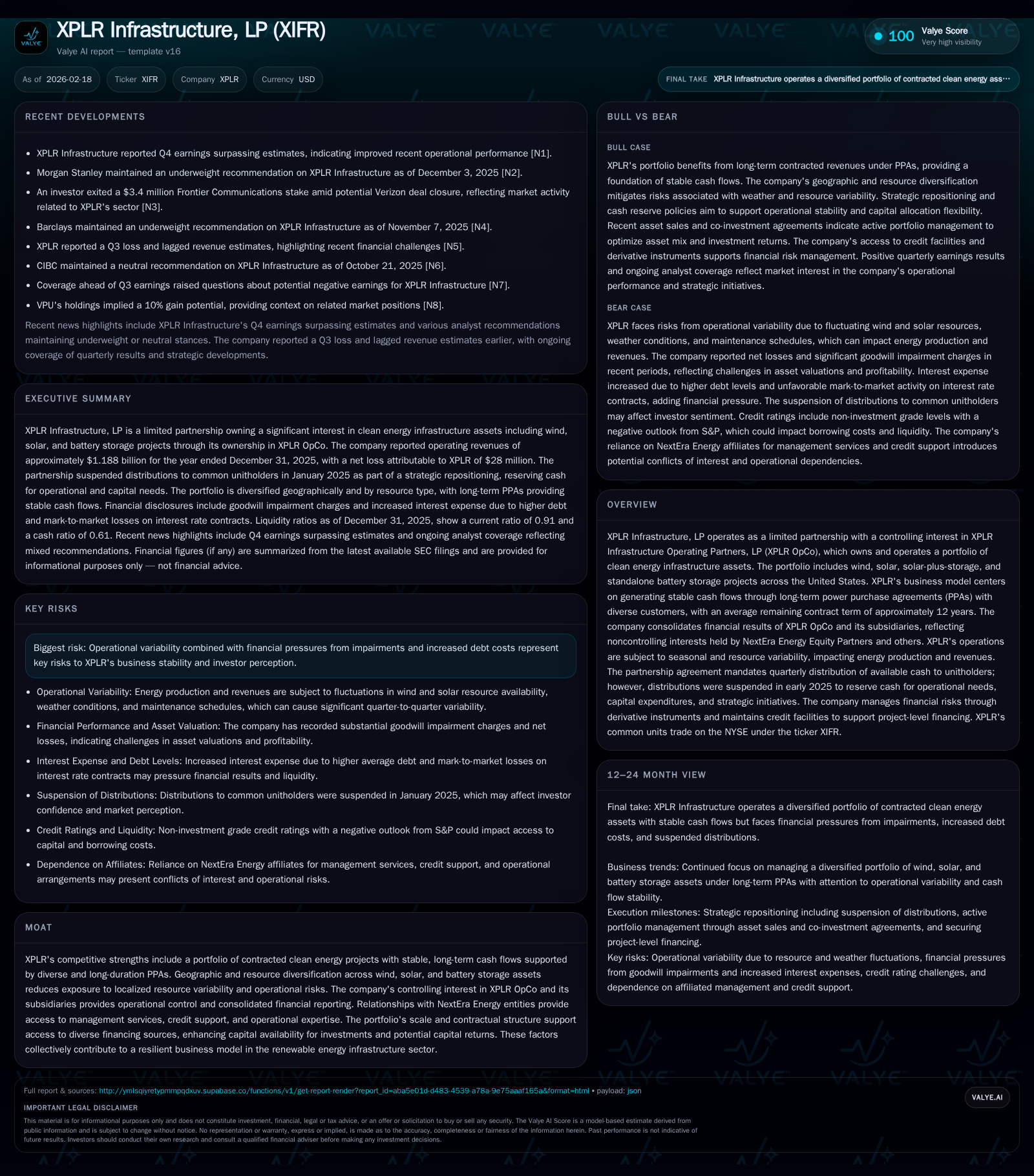
XPLR Infrastructure, LP continues to mature its clean energy portfolio with an emphasis on wind, solar, and battery storage assets across 28 states. After years of top-line growth driven by capacity additions, FY2025 reflects a transition toward operational stabilization amidst elevated capital expenditures, primarily allocated to repowering initiatives. While revenue declined modestly by 3.4% and operating losses narrowed year-over-year, free cash flow turned negative due to a nearly threefold surge in capex. The partnership’s capital structure shows active management through debt refinancing and facility resizing tailored to support its repowering efforts and maintain liquidity. Looking forward, XPLR’s contracted PPA backlog with an average 12-year contract life underpins stable cash flow expectations, though seasonal resource variability and capital deployment dynamics will influence near-term distribution policies and returns.
Historic Growth Profile and Underlying Drivers Through 2025
XPLR Infrastructure, LP has demonstrated a trajectory characterized initially by aggressive capacity buildout followed by a tactical shift toward maximizing operational stability during enhanced capital reinvestment demands. From FY2022 through FY2024, revenue exhibited volatility reflecting project acquisitions and divestitures but generally trended upward from approximately $1.21 billion in 2022 to $1.23 billion in 2024 [F1]. However, FY2025 marked a moderation with revenues decreasing 3.4% year-over-year to approximately $1.19 billion [F1]. This dip is attributable mainly to natural seasonal fluctuations, resource variability inherent in wind and solar generation, as well as maintenance outages typical of maturing renewable assets.
Operating income mirrored this pattern but shifted sharply negative; while positive $197 million was reported in FY2022, the partnership recorded operating losses expanding to -$459 million in FY2024 before improving significantly in FY2025 to -$186 million [F1]. The improvement reflects better cost management alongside non-cash impairment charges that had pressured prior periods but saw no material impairments recognized recently [S1]. Net income followed suit, moving from a positive $477 million in FY2022 to losses near -$28 million in FY2025 [F1]. Notably, operating cash flows remained fairly resilient throughout this volatility — ticking down modestly from $800 million in FY2024 to $739 million in FY2025 (a decline of 7.6%) — indicating underlying operational cash generation capability notwithstanding net losses [F1], [N1].
Key drivers behind these results included project additions that expanded XPLR's portfolio footprint significantly over multiple years; however, revenue gains have meanwhile been moderated by the natural seasonality of wind speeds across geographic regions served and solar irradiance variability as well as planned outages for turbine repowering work [S1]. Hence the shift from accelerating growth toward consolidating steady-state operations while investing heavily in asset enhancement strategies.
Historical performance (annual)
| FY | Rev ($mm) | Net ($mm) | CFO ($mm) | OpInc ($mm) | Rev YoY | Net YoY |
|---|---|---|---|---|---|---|
| 2025 | 1188 | -28 | 739 | -186 | -3.4% | -21.7% |
| 2024 | 1230 | -23 | 800 | -459 | +14.1% | -111.5% |
| 2023 | 1078 | 200 | 731 | -28 | -11.0% | -58.1% |
| 2022 | 1211 | 477 | 776 | 197 |
Note: Omitted columns lack sufficient annual XBRL coverage in the provided tags (need ≥2 annual points): Capex, Div, Buybacks. Source: SEC companyfacts cache [F1].
Capital returns and efficiency (annual)
| FY | FCF ($mm) | ROE% |
|---|---|---|
| 2025 | -219 | -0.3 |
| 2024 | 559 | -0.2 |
| 2023 | -538 | 1.4 |
| 2022 | -575 | 3.3 |
Source: SEC companyfacts cache [F1].
Note: Dividends paid and share buybacks data are not available from provided tags.
Operational Portfolio Mix: Geographic and Technological Diversification as Risk Mitigants
XPLR controls approximately 10 GW of net generating capacity concentrated primarily in wind (8 GW), complemented by solar (1.7 GW), solar-plus-storage configurations, and standalone battery storage (~274 MW) dispersed across some 28 states [S1]. This vast geographic footprint is designed expressly to mitigate risks from localized weather patterns or regulatory influences.
In sector-native terms, XPLR's portfolio benefits from a blend of long-duration PPAs averaging about twelve years remaining contract tenure which ensures predictable revenue streams insulated from spot market volatility [S1]. Wind assets include substantial recent investments into repowering projects aimed at upgrading turbines for improved efficiency — with variable speed turbines replacing aging equipment consistent with sector best practices for lifecycle extension.
The integration of co-located battery storage systems alongside solar farms enhances dispatchability offering grid services beyond simple energy generation such as frequency regulation or peak shaving, thus diversifying ancillary revenue potential [S1]. This technological diversity reduces exposure to single-resource dependency.
Moreover, the company holds controlling interests that facilitate consolidated financial reporting allowing streamlined governance over O&M strategies critical during repowering cycles which involve planned outages affecting output intermittently.
Key Financial Outcomes from FY2025: Revenue, Profitability, and Cash Flow Trends
In FY2025, XPLR recorded revenues of approximately $1.19 billion — a decline of roughly 3.4% compared with the previous year largely due to weather-related generation variability compounded by scheduled maintenance associated with ongoing repowering activities [F1], [N1]. Operating losses narrowed materially from -$459 million in FY2024 to -$186 million — a positive swing reflecting fewer impairment charges plus improved cost efficiencies despite lower revenue [F1], [N1].
Net income remained negative at around -$28 million (-21.7% YoY decline), reflecting ongoing amortization expenses tied to intangible PPAs amortized over contract lives and interest costs tied to leveraged growth initiatives including new financing arrangements concluded in late 2025 [F1], [N1].
Importantly, operating cash flow held steady at $739 million but showed a slight decline (-7.6%) relative to prior periods exemplifying strong underlying earnings quality despite headline losses stemming mostly from non-operational or accounting measures [F1], [N1]. This operative resilience underscores reliable project-level performance aided by diverse counterparty base.
Capital Allocation in Focus: Capex Surge and Implications for Free Cash Flow
FY2025 saw a notable spike in capital expenditures reaching $958 million — nearly triple the previous year’s spend (+297.5%) — chiefly attributed to wind turbine repowering efforts alongside investments into battery storage deployments enhancing flexibility [F1], [S22], [N1].
This capex intensity reflects broader industry trends where mature renewable assets undergo mid-life enhancements boosting output per MW installed while extending useful lives up to three decades or more through component modernization — key for maintaining competitive levelized cost of energy (LCOE).
Consequently, free cash flow turned negative at approximately -$219 million when comparing CFO less capex within the fiscal period [F1]. The partnership is transitioning through a reinvestment phase sacrificing short-term distributable cash flows for longer-term value accretion embedded in upgraded asset performance.
As highlighted by management commentary during earnings release periods, this step-up in reinvestment is expected but requires careful liquidity planning given potential pressures on quarterly distributions absent offsetting financing activity or operational ramps post-repowering completion [N1], [S22].
Balance Sheet Evolution: Debt Refinancing, Facility Amendments, and Liquidity Position
XPLR has actively refined its capital structure over recent periods, focusing on extending maturities whilst balancing leverage metrics appropriate for infrastructure-grade exposures.
A significant development was the reduction of the XPLR OpCo revolving credit facility size from $2.45 billion down to $1.25 billion effective February 2026 with provisions for incremental commitments increasing total available credit lines back up toward $2 billion conditional on future needs stabilizing liquidity availability while aligning undrawn revolver levels closer with forecasted short-term obligations [S3], [S4], [S8].
Additionally, XPLR issued senior unsecured notes with coupon rates ranging between ~7.75%–8.62%, extending maturities through early-to-mid-2030s which locked balance sheet funding costs amid rising rate environments albeit at increased absolute interest expense levels reflective of credit market conditions during issuance windows [S5], [S11], [S23]. Furthermore, term loan facilities totaling approximately $1.6 billion serve dedicated financing sources earmarked for wind repowering projects enhancing asset-specific leverage profiles subject to limited recourse structures mitigating parent entity exposure directly [S8], [S11].
At December-end metrics show liquidity bolstered by near-$960 million of cash & equivalents offsetting current liabilities higher than short-term assets producing a current ratio just below unity at approximately 0.91 – indicative of tight working capital management consistent with infrastructure partnerships balancing holding wide liquidity buffers against drawdowns arising from capital investment cycles or covenant compliance demands [F1], [S4].
Compliance with debt covenants remained intact through FY2025 including leverage caps and interest coverage tests essential for maintaining distribution flexibility under credit agreements restricting discretionary payments amid fluctuating operating cash flows [S15]–[S17].
Future Prospects: PPA Longevity, Market Demand Drivers, and Constraints
Looking ahead, XPLR benefits from sizable contractual backlog embodied chiefly within long-dated PPAs averaging roughly twelve years remaining duration providing robust visibility into fundamental revenue streams insulating the partnership from wholesale power price volatility common in merchant renewables exposure scenarios [S1], [N1].
Growth vectors focus heavily on continued asset life-extension via turbine repowering which leverages existing site permits thereby limiting new regulatory risk while potentially boosting annualized output per MW installed leveraging state-of-the-art turbine technology advances.
Battery storage deployment stands as an increasingly vital complementary revenue source via grid ancillary service markets including frequency regulation and capacity products as the U.S power system integrates greater intermittent renewable penetration demanding flexible dispatch capabilities enforced by increasingly stringent renewable portfolio standard (RPS) mandates nationwide.
Constraints remain chiefly operational through resource availability uncertainty inherent to wind/solar meteorology contributing seasonally variable generation profiles impacting quarterly distributions unpredictably notwithstanding geographic diversification which softens localized production downturn impacts (sector norm) [S17]. These fluctuations pressure distributable cash flow particularly during heavy maintenance or outage intervals linked directly to asset repowering works.[N1]
Strategic Milestones to Monitor in 2026 and Beyond
Stakeholders should closely watch progress on scheduled completion dates for wind turbine repowering projects funded partially via newly drawn term loan tranches expected to incrementally increase debt levels temporarily but ultimately improve EBITDA contribution post-completion.[S2],[N1]
Further developments around PPA renewals or extensions could significantly bolster contracted backlog lengthening revenue visibility beyond the current ~12-year average horizon.[N1]
Additionally,XPLR's management may pursue acquisitions or bolt-on investments adjacent geographically or technologically within the U.S power sector that align with core competencies including battery system expansions offering cross-selling opportunities or enhance grid services footprint.[N1]
Any shifts in distribution policy particularly related to cash reserve buildup for potential buyout rights exercises involving noncontrolling Class B investors warrant attention given their impact on available free cash flow distributed externally.[S22],[S24],[S25]
Distribution Policy and Returns Considerations Amid Cash Flow Variability
By partnership design governed under limited partnership agreements,XPLR Infrastructure mandates quarterly distribution of all "available cash" defined broadly as residual operating liquidity after establishing business reserves encompassing O&M expenses,debt servicing,future capex funds,and specific buyout-related reserves where applicable.[S22]
Notably,the operator (XPLR OpCo GP) retains discretional authority over reserves enabling withholding distributions even when operational profits exist aiming at prudent capital stewardship given inherent volatility associated with renewable production seasonality coupled with timing adjustments related to repayment schedules under complex multi-layered financing structures.[S17]
Returns metrics show subdued trends consistent with reinvestment cycle impacts:ROE approximates slightly negative territory near -0.3%, influenced primarily by modest net loss outcomes overshadowing equity bases nearing $11 billion inclusive of significant noncontrolling interests.[F1]
For investors accustomed to infrastructure assets' typical yield profiles,this tradeoff between aggressive growth-capital deployment depressing immediate distributable free cash flow versus medium-terms gains grounded in enhanced asset productivity frames a key dynamic necessitating ongoing monitoring especially as capex normalizes following peak repowering completion phases.
This report synthesizes publicly available documents including SEC filings (notably Form-10K/XBRL data), recent earnings releases,and authoritative news reports without extrapolating beyond disclosed information or providing investment recommendations.
Disclaimer: This is research-only, informational analysis and not investment advice. It may include AI-generated interpretation and general industry context. Always verify important details using primary sources.

Comments