
Youxin Technology's AI-Powered PaaS Platform Navigates China's Mid-Tier Retail Digitalization
Youxin Technology Ltd is pioneering AI-enhanced PaaS solutions targeting complex digital needs of mid-tier retail in Mainland China amidst operational and financial headwinds.
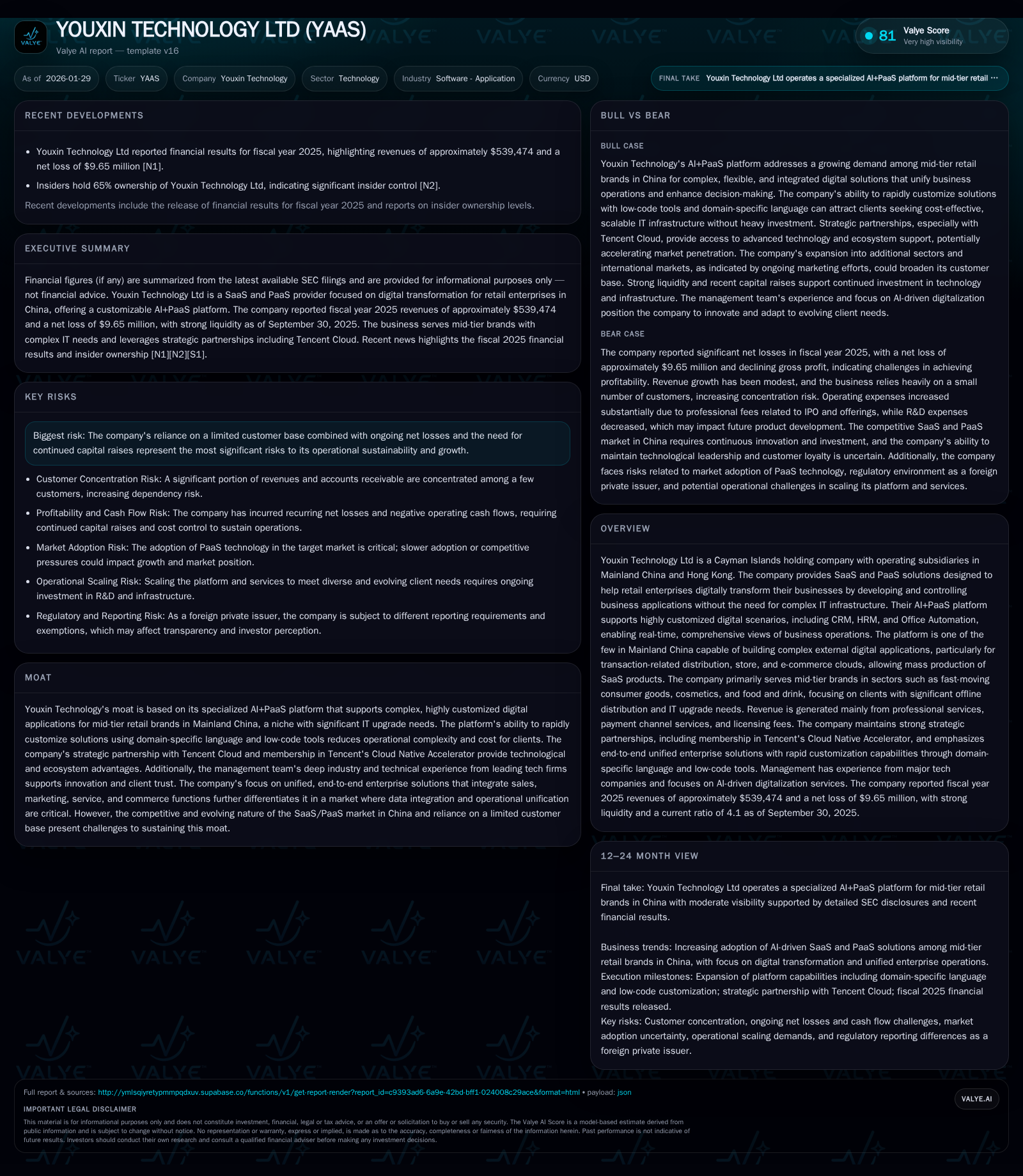
Youxin Technology Ltd offers a unique AI-driven PaaS platform enabling mid-tier retail brands in Mainland China to digitally transform through rapid, customizable applications tailored for offline distribution and e-commerce integration. Strategic alliances with Tencent Cloud and recent acquisition moves augment its technological ecosystem, positioning the company within a niche sector facing robust demand for agile enterprise software. Despite modest revenue growth and evolving product offerings from bespoke CRM contracts to scalable SaaS products, the firm grapples with sustained net losses, concentrated customer risk, and capital requirements. Its lean workforce and distributor-led model aim to balance cost control with scaling potential as it seeks fuller monetization of its next-generation platform.
Charting the Digital Transformation of Mid-Tier Retail in China
Mainland China's mid-tier retail enterprises stand at a crossroads where traditional offline distribution channels are increasingly integrated with e-commerce ecosystems. This transformation requires nimble digital tools capable of handling not only complex transaction recording but also the real-time visibility spanning distributors, stores, and online platforms. Youxin Technology Ltd addresses this acute market need with its SaaS and PaaS offerings that enable retailers, especially mid-tier brands in fast-moving consumer goods, cosmetics, and food sectors, to digitally unify their commerce functions without the burden of complex IT infrastructure (company overview)[S1].
Unlike large-scale retailers that may deploy costly legacy ERP systems, these mid-tier clients often suffer from IT upgrade gaps amid growing volume demands. Youxin’s solutions provide fast deployment omnichannel systems that manage distributed inventory and integrate sales data seamlessly across physical and digital stores. The ability for retailers to make critical business decisions anytime—powered by real-time operational dashboards—is central to extracting value from digital transformation efforts.
Unpacking Youxin Technology’s AI-Enhanced PaaS Platform: Architecture and Advantages
The core of Youxin’s competitive moat lies in its third-generation PaaS platform "Youxin Cloud," architected specifically for flexibility and efficiency in distributed retail operations. Leveraging multi-cloud private deployments maximizes code efficiency while reducing latency across extensive retail networks. Importantly, the platform integrates AI-driven natural language processing which automates the generation of complex customized application code, dramatically accelerating client-specific app delivery timelines—from months typical of bespoke software down to weeks or even days.
This technological leap reduces costly hands-on programming efforts common in traditional CRM developments, allowing less technical users to configure powerful applications using domain-specific low-code tools. Retail chain participants such as distributors and stores gain access to unified screens showing comprehensive transactional data in real-time, streamlining decision-making across sales, marketing, service, and inventory management facets.
The suite includes foundational engines (interface, settlement, integration) that underpin seamless commerce clouds encompassing both offline stores and e-commerce channels. Through continuous R&D investment post-IPO, including embedding AI models into its platform architecture, Youxin enhances product delivery capacity while attracting diverse clients outside pure retail (e.g., cruise lines), emphasizing flexibility across industries[S1].
Strategic Positioning: Partnership Synergies and Market Penetration
Youxin’s strategic alliance with Tencent Cloud serves as a crucial enabler both technologically and commercially. Membership in Tencent’s Cloud Native Accelerator embeds Youxin within an ecosystem fostering synergy through shared technology innovation pathways and customer reach expansion[S1]. This relationship likely provides robust cloud infrastructure support as well as access to sales channels complementing Youxin’s distributor network.
Further expanding service capabilities, Youxin acquired a majority stake in Celnet Technology Co., Ltd., a significant Salesforce partner in China. Integrating Salesforce CRM expertise promises enhanced interoperability options for clients seeking globally recognized CRM frameworks along with localized Chinese market adaptations. These partnerships confer credibility benefits vital when competing against legacy enterprise software vendors resistant to such ecosystem collaboration[S1].
From Customized CRM to SaaS Products: Evolution of Client Solutions
Historically reliant on professional services contracts delivering fully customized CRM systems requiring intensive developer input—and typically executed on annual renewal terms—Youxin has pivoted towards launching standardized SaaS products like "Yunzhuidan" since early 2023[N1][S1].
This shift marks a strategic evolution enabling broader client adoption by offering ready-to-use SaaS delivered via licenses that reduce entry barriers compared to bespoke projects. While customers still benefit from customization options powered by the AI+PaaS platform backbone, standardization facilitates scalability—libraries of templates replace ground-up coding—accelerating product rollout cycles across multiple brands simultaneously.
Feedback collected during trial deployments of the third-generation PaaS informs ongoing optimization efforts ensuring product-market fit continually improves. The emerging SaaS offerings remain tightly aligned to sector-specific workflows such as offline distribution management combined with social commerce features critical for China’s retail environment[S1][N1].
Financial Pulse Check: Growth, Losses, and Capital Dynamics
Fiscal year 2025 revenue reached approximately $539K—a modest 3% increase from prior year levels—illustrating early-stage commercial traction but also signaling slow monetization vis-à-vis platform investments[F1][N1]. Net losses persisted at nearly $9.6 million underscoring significant operating expenditures largely tied to R&D advancements and go-to-market scaling while headcount was strategically reduced from 32 to 22 over the year.
Despite losses, liquidity remains solid with cash balances close to $9.9 million supported by a current ratio exceeding 4x; this cushion allows continued development runway pending acceleration of subscription-based revenues derived primarily from license fees tied to user account counts[S1][F1]. The firm conveys confidence that existing headcount suffices for near-term demand given automation gains embedded within its third-gen PaaS system.
Investor communications emphasize incremental revenue growth driven by ongoing onboarding of distributors licensing the platform who assume customer acquisition cost burdens[N1],[S1]. This distribution-led licensing model tempers direct sales expenses while facilitating incremental scale absent proportional increases in personnel or operational overheads.
Workforce Leaning and Distribution-Led Scaling Model
Reflecting embedded efficiencies within its AI-enabled platform, Youxin pursued deliberate workforce trimming during lockdown-related operational shifts starting November 2022—cutting employee count by roughly one-third within fiscal 2025[S1]. This lean staffing approach aligns with the transition from labor-intensive customized CRM deployment projects toward automated SaaS delivery requiring fewer human resources.
Distributors licensed under agreements shoulder responsibilities for sales execution and customer support implementation processes which decentralizes operational complexity away from Youxin itself. As distributors acquire end clients for the third-generation PaaS system, Youxin functions primarily as the technology provider focusing on continuous product enhancement rather than direct sales force expansion.
This model illustrates a cost-efficient scaling mechanism potentially beneficial if distributor incentives align effectively; however, it presupposes distributor effectiveness in customer penetration which remains a variable factor impacting sustainable revenue growth trajectories[S1].
Risks Lurking Behind Innovation: Single Customer Dependency and Cash Burn
Among prominent risks disclosed is Youxin's concentration on a limited number of customers which heightens revenue volatility should major accounts reduce engagement or delay renewals (risk overview)[S1]. Such dependency is compounded by persistent net losses driving reliance on external capital raises threatening financial sustainability absent accelerated monetization pathways.
Moreover, substantial insider ownership totaling approximately 65% concentrates control among founder executives[N2], creating governance considerations that could affect minority shareholder influence or raise concerns about risk exposure alignment.
Cash burn stemming from investment-heavy R&D efforts paired with slow initial revenue ramp means capital adequacy must be carefully managed moving forward—including prudent timing around new funding rounds—to avoid liquidity constraints hampering innovation progress or market competitiveness.Such risks accentuate the need for disciplined execution balancing growth ambitions against financial stewardship[P&L data][N1][S1].
Competitive Landscape and Differentiators in the Mainland China SaaS Space
Within China's crowded SaaS environment targeting retail verticals—which ranges from large-scale ERP incumbents to emerging cloud-native startups—Youxin carves out differentiation by addressing highly specific pain points endemic in mid-tier offline-to-online retail flows (analysis).
Its domain-specific low-code tooling enables clients to bypass typical bottlenecks associated with inflexible legacy platforms lacking real-time data integration or cross-channel operational views that modern omnichannel strategies mandate. This technical agility coupled with seamless process unification—from sales through distributed inventory management—presents a value proposition difficult to replicate without considerable engineering depth.
The AI-infused natural language programming capability further distinguishes Youxin's platform by democratizing application customization beyond traditional developer dependence—a noteworthy competitive advantage especially among Chinese retailers expanding digital footprints rapidly but constrained by IT talent shortages[S1], [valye_report_excerpt].
Prospective Trajectory: Balancing Innovation Momentum Against Market Headwinds
Looking ahead, Youxin positions itself at an inflection point where growing acceptance of PaaS architectures tailored for mid-tier brands could drive substantial long-term growth given sufficient adoption momentum among distributors and end clients[N1],[F1]. Early-stage SaaS product launches lay foundations for recurring revenue streams potentially improving gross margins versus prior professional services models.[S1]
Nevertheless, challenges loom relating to delayed full monetization cycles inherent in platform trials still underway alongside dependency on distributor channels whose performance can vary widely. Prolonged net losses underscore fragile near-term profitability prospects entailing careful cash flow management amid evolving macroeconomic conditions impacting discretionary IT spending within China's retail sector.[N1],[valye_report_excerpt]
Success will hinge on translating technological advantages into broader market penetration while maintaining tight control over operational costs—including optimizing distributor partnerships—and navigating regulatory or competitive shifts prevalent in China’s dynamic software landscape.
This analysis summarizes available data sources up to January 2026 without making investment recommendations or price forecasts. It reflects publicly filed disclosures combined with contextual industry insights intended solely for informational purposes.
Disclaimer: This is research-only, informational analysis and not investment advice. It may include AI-generated interpretation and general industry context. Always verify important details using primary sources.

Comments